The Lifestyle - Watches

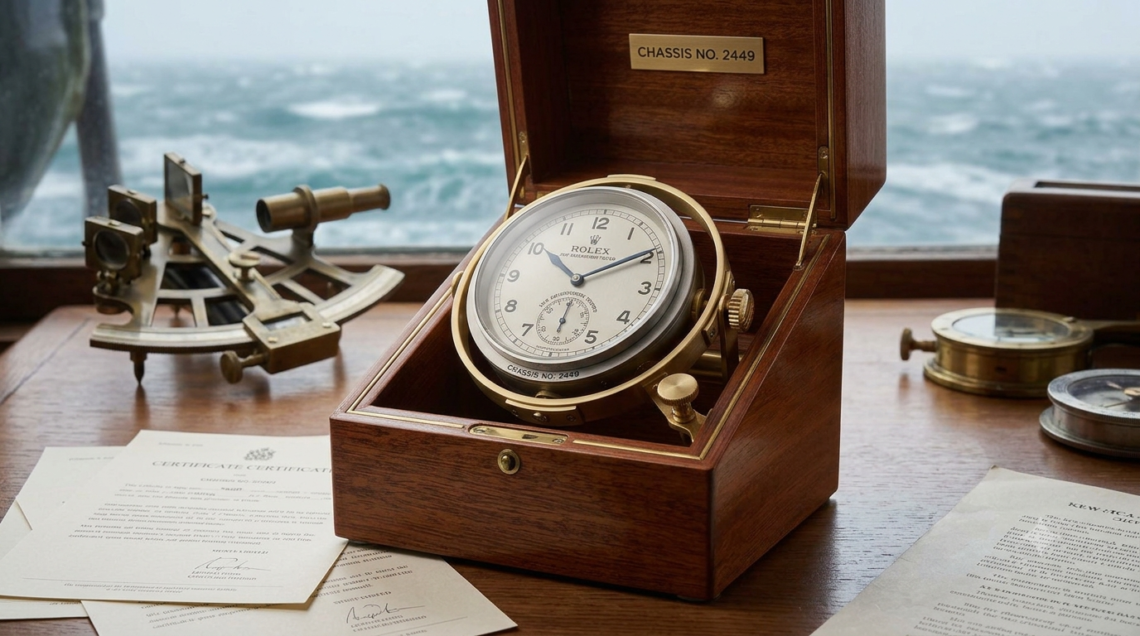
Sea & Time, The Legendary Rolex Marine Chronometer, Chassis No. 2449

In the pantheon of horology, few names command the respect of Rolex. While celebrated for iconic sport watches like the Submariner and Daytona, there exists a lesser-known chapter in Rolex’s history a chapter defined not by status symbols, but by the relentless pursuit of absolute precision. At the heart of this story is the Rolex Marine Chronometer, a spectacular instrument of navigation. And standing above all others is one singular, legendary piece: Chassis No. 2449.

This is not a wristwatch. It is a formidable piece of engineering, built to a time when a captain’s life depended on the accuracy of his clock. This is the story of the watch that conquered the rolling seas, and the magnificent box that made it possible.

The Problem of the Sea and the “Large Box” Solution

Before GPS, determining a ship’s longitude at sea required an exceptionally accurate clock. If your time was off by just one second, your position calculation could be flawed by over 400 meters. The challenges of a marine environment are brutal: constant movement (pitching and rolling), dramatic temperature shifts, and corrosive salt air. These are all enemies of precise timekeeping.

To combat this, Rolex (and other manufacturers) produced large, gimbaled “box chronometers.” These were not meant to be worn; they were the primary scientific timekeeping heart of the ship, mounted securely in the chart room. In the 1940s and 1950s, Rolex sought to prove its mastery by sending a handful of these ultra-precise instruments to the Kew Observatory in England for the world’s most rigorous precision trials. It was here that Chassis No. 2449 earned its legendary status.

Anatomy of an Icon: The Gimbaled Mahogany Box

The chronometer itself is a masterpiece, but its survival and accuracy were entirely dependent on its housing. This is no mere container; it is a vital component of the instrument, designed with an obsessive level of detail.

The box is crafted from the finest, select-grade mahogany. To the eye, it is pristine, with a deep, rich reddish-brown hue that speaks to decades of careful preservation.

The Boss of Mahogany: A Foundation of Substance

The “boss”—the solid wooden base or foundation of the box—is a point of particular interest. In Chassis No. 2449, the thickness of the mahogany boss is substantial. Measuring an estimated 1.5 to 2 inches (approx. 4 to 5 cm) thick, this heavy base provides the crucial ballast and stability. Its sheer mass helps lower the center of gravity of the entire unit, assisting the internal gimbals. This boss is not just for show; it is the structural anchor, over-engineered to withstand the slamming forces of a storm. When properly preserved, this aged mahogany takes on a glassy, almost three-dimensional depth, its grain tight and iridescent.

The Olfactory Signature: Time’s Own Scent

If this box is preserved properly, it should still retain a subtle, complex, and intoxicating scent. This isn’t the raw smell of new wood, but an “aged mahogany” perfume. It is a dry, slightly spicy, and deeply warm aroma, reminiscent of fine cedar, a hint of ancient varnish, and the distinct mineral tang of old brass. This scent is the invisible evidence of its provenance, the smell of time itself captured within the wood grain. To open the lid and inhale this scent is to be instantly transported to the map room of a vintage vessel.

The Brass and Glass: Engineering for the Storm

Within the main mahogany lid (which often features a glass viewing panel), the chronometer face is visible. When the primary lid is fully opened, the intricate engineering is revealed.

The chronometer (the heavy brass cylinder containing the movement) is suspended within a sophisticated two-stage brass gimbal system. This mechanism allows the clock to swing freely in two axes (like a gyroscope), ensuring the dial always remains perfectly level, regardless of how aggressively the ship pitches and rolls. The brass structure is substantial, polished to a dull shine that contrasts with the warm wood.

The complex circular framing that holds the watch face within the gimbal is itself a work of art. The outer brass ring is a thick, robust flange that connects the gimbal mechanism to the main case. Inside this, a slightly raised, polished circular bezel holds the heavy, beveled crystal. A series of fine, exposed screws are visible around the rim, suggesting both its handmade quality and its robust construction. This framing has to be strong enough to support the weight of the massive movement, yet precise enough to allow for perfect balance and zero friction in the gimbals. It frames the stark white dial, the bold Roman numerals, and the proud inscription: “ROLEX” and, most significantly, “KEW OBSERVATORY TESTED.”

Why Chassis No. 2449 is the Legend

While Rolex sent multiple chronometers for testing, Chassis No. 2449 was the best. It was a true “Class A” Kew Chronometer, but its trial results were record-breaking. Fitted with a highly modified movement specifically prepared for this trial, it achieved scores that placed it in the very highest echelon of marine timepieces ever produced.

This specific number, 2449, is known to collectors as the ultimate realization of Rolex’s search for accuracy. It represented the highest mark the company ever achieved in this ultimate, most demanding form of horological competition. It is the “Mount Everest” of Rolex precision.

The Value: What is It Worth Today?

A standard, functional marine chronometer from a respectable maker might sell in the low thousands. A Rolex example is already in a different class, starting in the tens of thousands due to rarity.

However, Chassis No. 2449 is not a “standard” piece; it is a legendary artifact. Its sale history (where it is known to have passed through top-tier auctions) reflects this.

Its value today is a combination of:

  1. The Rolex Name: The most powerful brand in watches.
  2. Rarity: Only a few dozen large-box chronometers were made; fewer were sent to Kew.
  3. Condition: This example is pristine, which is exceptionally rare for maritime tools.
  4. Historical Importance: It is the highest-performing, record-setting example of its kind.

Because of this unique perfect storm of factors, Chassis No. 2449 does not trade at a standard price. Its value has reliably soared past all predictions.

If Chassis No. 2449 were to appear at auction today, a conservative estimate would place it well above $250,000 USD. However, given the current frenzy for historically significant timepieces, competitive bidding from high-level collectors and museums could easily see that price double or triple, potentially reaching or exceeding $750,000 USD.

Chassis No. 2449 is not just a clock. It is the ultimate testament to an era when precision was a matter of survival, and Rolex was determined to be the master of the sea.

Leave a Reply

Your email address will not be published. Required fields are marked *