The recent glimpse into Richard Mille’s gem-setting atelier specifically highlighting the RM 026 Tourbillon serves as a masterclass in how the brand bridges the gap between high-performance engineering and “high jewelry.” While many know Richard Mille for Carbon TPT and Formula 1 partnerships, the “bio film” released yesterday shifts the lens toward the tactile, almost liquid-smooth finish of their precious stone settings.

Here is a look at the artistry behind the “flawless finish” of the RM 026.
The Alchemy of Stone: Defining the “Flawless” Surface
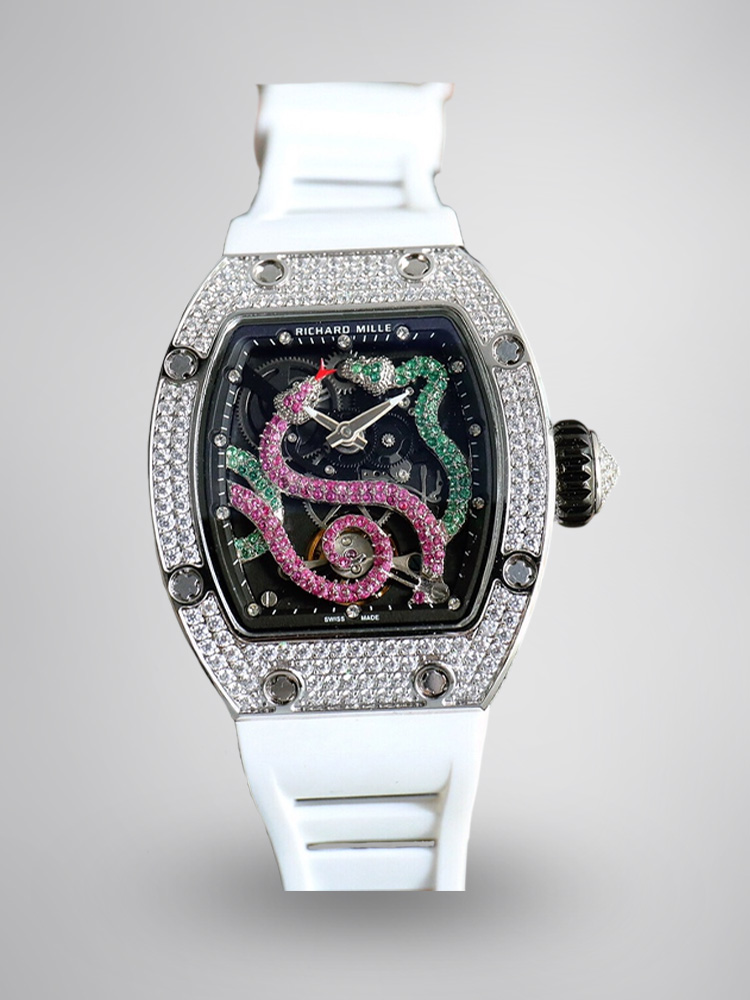
In the world of Richard Mille, a gem-set surface isn’t just about the sparkle; it’s about the aerodynamic flow of the light and the physical sensation of the watch against the skin. The RM 026 series, famous for its intertwined “Serpent” and “Panda” motifs, requires a level of finishing that makes the thousands of stones feel like a single, unified skin.

1. The Seamless “Invisible” Transition
The film highlights a meticulous process where diamonds and sapphires are set so closely together that the underlying metal 18K white gold virtually disappears. This is achieved through a technical variation of snow setting and micro-pave, where stones of varying diameters are mapped out like a topographical puzzle. The goal is a surface that is “flawlessly finished” meaning that if you were to run your finger across the diamond-encrusted body of the RM 026 serpent, you would feel a smooth, continuous texture rather than the sharp edges of individual stones.
2. The Black Onyx Foundation
One of the most striking technical details featured is the use of a Black Onyx baseplate. Because Onyx is a variety of cryptocrystalline quartz, it is notoriously brittle and difficult to machine. The film showcases the grinding and glazing process required to achieve a mirror-polish on the baseplate. This serves as the “dark stage” for the gems, reflecting the light back through the diamonds to increase their internal fire while maintaining a perfectly flat, vibration-dampening surface for the tourbillon movement.
3. Hand-Polished Precision
While the brand utilizes avant-garde tech for its cases, the final finishing of the RM 026 gems remains a human endeavor. The “smooth surface” mentioned in the film is the result of:

- Glazing: A full day of micro-polishing to ensure no prong or grain sits higher than the stone it holds.
- Anglage: Hand-polishing the edges of the gold settings to ensure they catch the light at the same frequency as the gems.
A “Pinkies Down” Approach to Luxury
For the founder of a lifestyle magazine or a collector who values technical sophistication over pretense, the RM 026 represents the ultimate “Pinkies Down” jewelry piece. It rejects the “old money” style of bulky, heavy gem-setting in favor of something that feels like an engineered component.
By treating diamonds with the same tolerances as a carbon-fiber chassis or a 2026 F1 power unit, Richard Mille has turned the RM 026 into a piece of kinetic sculpture. The gems aren’t just “on” the watch; they are part of its mechanical identity finished to a standard where engineering and art are indistinguishable.