For years, the idea of an electric Porsche Boxster sounded almost contradictory.The Boxster was built around the idea of a compact, lightweight sports car with a flat-six or flat-four engine sitting behind the driver. It was about steering feel, balance, sound and mechanical connection.Now Porsche is preparing to replace that formula with electricity.And after years of delays, rumors that the project could be abandoned and a development program that has stretched far longer than originally expected, the electric 718 Boxster is finally looking increasingly real. Porsche’s new CEO Michael Leiters has confirmed the 718 EV project is continuing, while fresh September 2026 spy photography shows an almost production-ready Boxster prototype testing at the Nürburgring. The question is no longer simply whether Porsche will build an electric Boxster.It is what kind of Boxster will it be?The end of the combustion BoxsterThe current-generation 718 Boxster represents the end of an era.Porsche’s existing 718 range includes four-cylinder turbocharged models and the naturally aspirated 4.0-liter flat-six in the GTS 4.0, with the latter producing 400 PS and reaching 62 mph in around four seconds with Sport Chrono. The next generation was originally supposed to move decisively into electric propulsion.That transition has been anything but smooth.The electric 718 program has been delayed repeatedly, with production originally expected much earlier. At one point, speculation became widespread that Porsche might abandon the project altogether. Instead, development continued.Now prototypes are being pushed around the Nürburgring.That’s significant.Porsche doesn’t take the Nürburgring lightly.What will power it?Porsche has not yet released the complete production specification, so this is where we need to separate confirmed information from expectation.The strongest expectation is that the electric Boxster will use an 800-volt electrical architecture, with Porsche’s own research material indicating more than 250 miles of estimated electric range for the 718 EV. That 800-volt system is particularly important.This isn’t supposed to be an electric grand tourer carrying an enormous battery simply to chase range numbers.The Boxster needs to remain a sports car.That means Porsche has to balance:battery size + weight + cooling + power + charging speed + chassis dynamics.And that is much harder than simply installing a huge battery.Single motor or all-wheel drive?This could become one of the most interesting parts of the new range.Current reporting points toward both single-motor and all-wheel-drive configurations. A single rear-mounted motor would make enormous sense for the purist.Rear-wheel drive.Less hardware.Less weight.And, most importantly, the possibility of preserving some of the character that made the 718 special.Then there is the performance version.An all-wheel-drive Boxster could use a second motor on the front axle, giving Porsche enormous freedom when it comes to torque distribution and acceleration.The obvious candidate would eventually be something analogous to a Boxster GTS or Boxster 4S, while a more extreme model could eventually occupy the territory once associated with the Spyder RS.But Porsche hasn’t confirmed those variants yet.Don’t expect it to be slowIf anything, the electric Boxster’s problem could be the opposite.Electric motors deliver maximum torque almost immediately.That means even a relatively modest electric 718 should feel extremely quick.Some unofficial estimates have suggested outputs in the 400-hp range for entry versions and considerably more for higher-performance models, but Porsche has not yet published final production power figures. The temptation will be to create a 500-hp-plus electric Boxster.And Porsche certainly could.But horsepower isn’t necessarily the defining measurement here.Weight is.Porsche’s biggest challenge: weightThis is where the electric Boxster could either become brilliant—or lose something fundamental.Batteries are heavy.Sports cars aren’t.The traditional 718 philosophy depends on keeping mass relatively low and positioning it intelligently.Porsche therefore has to make the battery part of the car’s architecture rather than simply treating it as cargo.The company has already demonstrated with its electric programs that it understands this principle.But the 718 presents a much more difficult challenge because buyers aren’t purchasing it primarily for practicality.They’re buying it because they want a sports car.If Porsche produces a Boxster that weighs dramatically more than today’s car, the numbers may look impressive while the driving experience feels fundamentally different.That is the battle Porsche needs to win.The battery could actually improve the handlingThere is another side to the equation.Although the battery adds mass, it can also place that mass very low in the chassis.That gives Porsche an opportunity.A carefully engineered battery pack can lower the center of gravity dramatically, while electric torque management can provide levels of traction and control that a conventional drivetrain cannot easily reproduce.The question is whether Porsche can make the driver feel that technology rather than simply feeling the weight.That’s where the Nürburgring testing becomes important.The sound problemThere is one thing Porsche cannot engineer away.The flat-six soundtrack.For generations, the Boxster’s personality has been connected to its engine.The intake noise.The rising mechanical pitch.The moment the engine reaches its upper rev range.The electric Boxster will have none of that naturally.Porsche can create artificial sound, but enthusiasts will know the difference.This is perhaps the biggest emotional hurdle facing the car.The electric Boxster has to convince its driver that silence can be part of the experience.The design: familiar, but not revolutionaryThe latest prototype photographs suggest Porsche isn’t attempting to turn the Boxster into a futuristic spaceship.That may be exactly the right decision.The basic proportions remain recognizably 718.Low nose.Wide stance.Short overhangs.Two seats.Long rear deck.The latest prototypes also show revised headlights and rear lighting that appears to draw inspiration from the current 911 design language. Porsche appears to be following the same philosophy it has used repeatedly:evolve the shape rather than destroy it.That is probably important for the Boxster.The people buying this car aren’t necessarily asking Porsche to reinvent the sports car.They’re asking Porsche to reinvent propulsion without destroying the sports car.And yes, the Cayman is coming tooThe Boxster won’t be alone.The electric 718 Cayman is being developed alongside it, although the timing and exact launch sequence remain uncertain. Spy testing has already shown the electric Cayman being pushed through development. The two cars will share much of their technical DNA.But they will serve different purposes.The Cayman will naturally appeal to the driver who wants maximum rigidity and outright performance.The Boxster will remain the emotional choice.Roof down.Electric power.And eventually, perhaps, a very different definition of what a Porsche roadster can be.The charging questionThe 800-volt architecture could become one of the car’s greatest advantages.Porsche’s current high-voltage EV technology allows very rapid charging, and expectations for the 718 EV have centered around charging capabilities in the vicinity of 270 kW or potentially higher, although the final Boxster specification has not yet been confirmed. For a sports car, that’s more important than chasing a 400-mile range.Imagine a Boxster with roughly 250-plus miles of usable real-world capability, followed by a relatively short charging stop.That makes much more sense for the car’s mission than carrying an enormous battery simply to advertise a massive range figure.What happens to the name?This may ultimately be the most important question.The 718 badge has always represented Porsche’s smaller mid-engine sports cars.The electric generation therefore isn’t simply another Boxster.It is the beginning of a new interpretation of the name.And Porsche has already demonstrated that it is willing to make dramatic changes to its electric cars while retaining familiar identities.The Taycan proved that Porsche could make an EV feel like a Porsche.The electric Macan proved it could take an established model name into another propulsion era.The Boxster is harder.Because unlike an SUV, the Boxster exists almost entirely for driving pleasure.When will we see it?The latest evidence points toward the production car arriving around the 2027 model year, with the latest prototype appearing remarkably close to production specification. Porsche is expected to reveal more information during the next phase of the program.And after years of uncertainty, that is perhaps the most important development.The electric Boxster isn’t dead.It’s coming.The real Porsche testThe numbers will eventually arrive.Horsepower.Torque.0–60.Range.Charging time.Price.All of them will matter.But none will answer the question Porsche enthusiasts actually care about.Does it still feel like a Boxster?Because Porsche isn’t merely replacing a gasoline engine with electric motors.It’s attempting something much more difficult:to take one of the purest driver’s cars in its lineup and convince an entirely new generation that electricity can deliver the same emotional connection as combustion.If Porsche gets the weight, steering, braking, throttle response and chassis balance right, the electric Boxster could become one of the most important electric sports cars of the decade.If it doesn’t, it could simply become another extremely fast EV.And Porsche knows the difference.The Nürburgring will be where we find out.
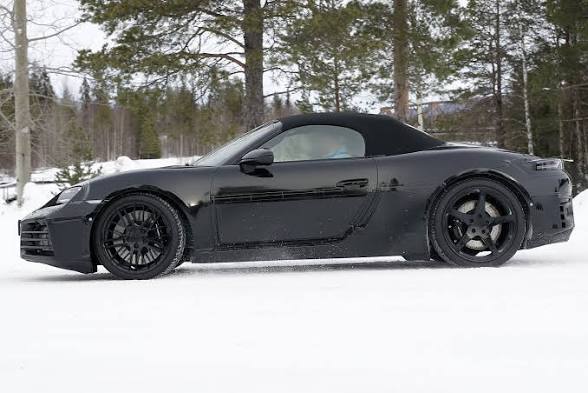
Porsche’s Electric Boxster Is Finally Coming — And It Could Change the Sports Car
September 12, 2026
- By Jojo