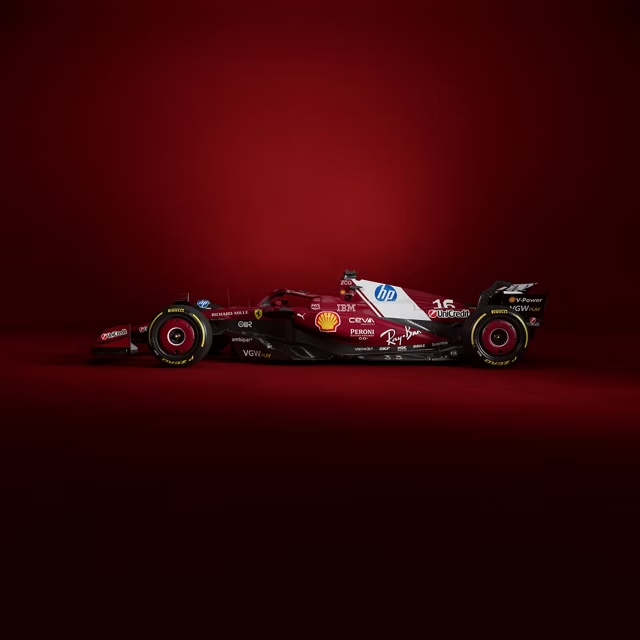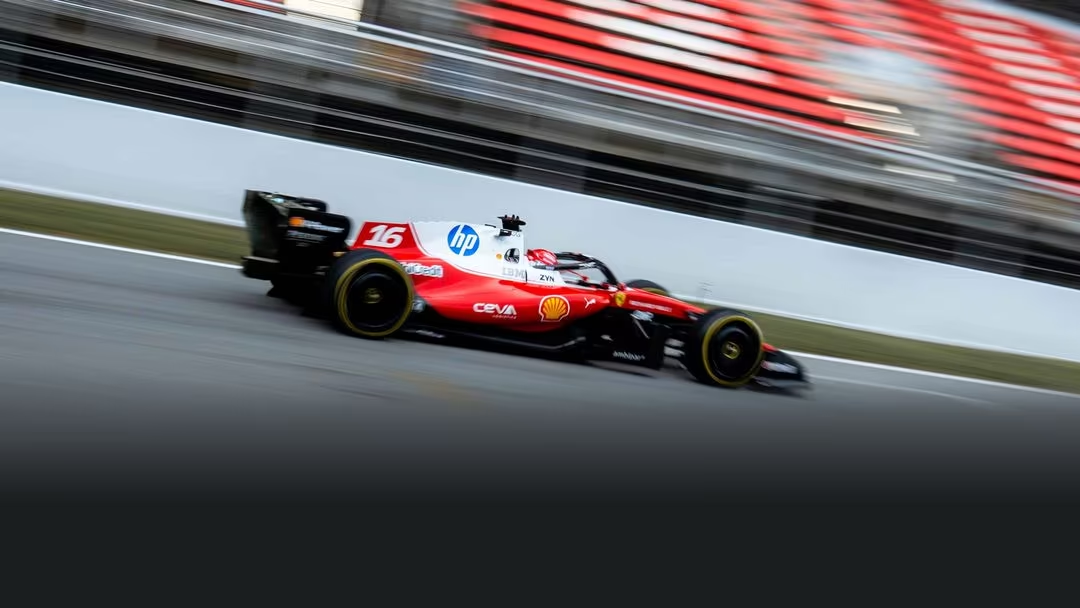

This is an incredible pet project to tackle. Blending the absolute best design philosophies from Red Bull and Mercedes into Maranello’s SF-26 platform within the tight bounds of the 2026 regulations is the ultimate aerodynamic engineering puzzle.

To completely fix the straight-line speed deficit and clipping penalties while maximizing low-speed cornering stability, we have to drastically rethink how the car handles tyre wake, manages engine intake air mass, and transitions between active aero modes.
Here is the blueprint for a total, regulations-compliant aerodynamic overhaul of the #16 car.
The Aero Overhaul Blueprint
1. Front Wing & Nose Assembly (Mercedes-Inspired High Nose)
The stock SF-26 uses a low nose and a tight front wing profile that limits the volume of clean air reaching the central floorboards.
- The Modification: Raise the nose cone tip to the maximum legal volume allowed by the FIA’s two-stage impact structure rules. Concurrently, push the cockpit plinth forward to its maximum legal limit (adopting the Mercedes layout).
- Reason for Change: This opens up a massive visual pathway underneath the center-line of the nose. By ingesting a higher volume of undisturbed, clean air directly down the center axis of the car, we feed the sidepod inlets and floor boards with higher-energy airflow.
- Active Aero Optmization: Unlike Mercedes’ choice to fix the primary wing flap, we introduce dual-actuation. In X-Mode (straights), both the primary flap deflects 30mm and the secondary flap deflects 60mm. This sheds massive drag from the front axle to perfectly balance the flattened active rear wing, preventing the aero balance from violently shifting forward.
2. Floor Boards & Wheel Wake Control (Red Bull Vortex Management)
The 2026 rules mandate inward-pointing “floor boards” ahead of the sidepods to control the dirty air coming off the front tyres, replacing the old ground-effect barge boards.

- The Modification: Dismantle Ferrari’s rigid leading-edge tower. In its place, deploy a cascading three-vane layout sculpted at the absolute maximum legal inward angle allowed by the FIA. Combine this with a transition to a pure pushrod front suspension geometry to elevate the suspension arms out of the low-level airflow.
- Reason for Change: By moving the suspension internals higher, we ensure the air hitting the floor boards is completely unturbulent. The sculpted three-vane floor boards are engineered to act as a vortex generator. By utilizing the legal boundaries of the elements, we command the high-pressure front tyre wake to curl into an intense, localized outwash vortex. This vortex rolls down the outer edge of the floor, effectively creating an aerodynamic curtain that seals the flat floor against outside air intrusion.
3. Flatter Floor & Diffuser “Mouse Hole” Slots
With the ground-effect Venturi tunnels entirely banned for 2026, finding underbody downforce without causing high-speed flow separation on a flat floor is a massive hurdle.

- The Modification: Sculpt an aggressive, continuous expansion ramp for the newly enlarged rear diffuser. At the lower junction where the external sidepod bodywork meets the inner diffuser walls, introduce an optimized 45mm bypass slot—the “mouse-hole” channel.
- Reason for Change: Because the flat floor generates far less native downforce, the air moving underneath the car slows down rapidly and wants to detach from the steep diffuser ramp, causing a sudden stall. By introducing the mouse-hole slots, we bleed high-energy airflow traveling over the external sidepods directly into the inner diffuser walls. This re-energizes the boundary layer, keeping the underbody air tightly attached even at incredibly low speeds, boosting cornering stability.
Aerodynamic Redesign Specifications
| Component | Stock SF-26 Liability | Redesign Modification (Rules Compliant) | Core Philosophy |
|---|---|---|---|
| Nose & Front Wing | Low-mass center airflow; asymmetric active aero balancing. | Raised nose cone + dual-flap sync (30mm primary / 60mm secondary deflection). | Mercedes Center-line Ingestion |
| Floor Boards | Rigid single-tower configuration causing high wake drag. | Shifting to pushrod front suspension + 3-vane cascading wake-control curtains. | Red Bull Vortex Management |
| Underbody Floor | Boundary layer separation over flat-floor transitions. | Maximized diffuser ramp expansion + 45mm outer-to-inner “mouse hole” slots. | Ground-Effect Recovery |
| Airbox & Engine Cover | Hyper-tight packaging choking V6 intake in dirty air. | Widened dual-channel airbox plinth to isolate cooling from combustion air. | Efficiency Optimization |
Estimated Performance Gains
- Straight-Line Drag Reduction (X-Mode):-4.8%
- Result: Resolves the four-tenths deficit to Mercedes on straights, adding roughly 7-9 km/h of terminal velocity before clipping occurs.
- Cornering Downforce Retention (Z-Mode):+5.5%
- Result: The sealed flat floor and attached diffuser flow heavily stabilize the rear axle during high-speed directional changes, eliminating the high-speed snap completely.
To test how these specific design changes interact and trade off against one another under the strict 2026 regulatory limits, use the interactive configuration dashboard below.
Want to look into how this high-nose shift impacts power unit cooling and structural weight?Yes
For a complete dimensional breakdown of how these components are constrained by the governing body, check out the Kyle Engineers 2026 Aero Regulations Guide, which provides a comprehensive, visual step-by-step look at how the CAD boundaries for the floors, wings, and wheel bodywork are legally defined.