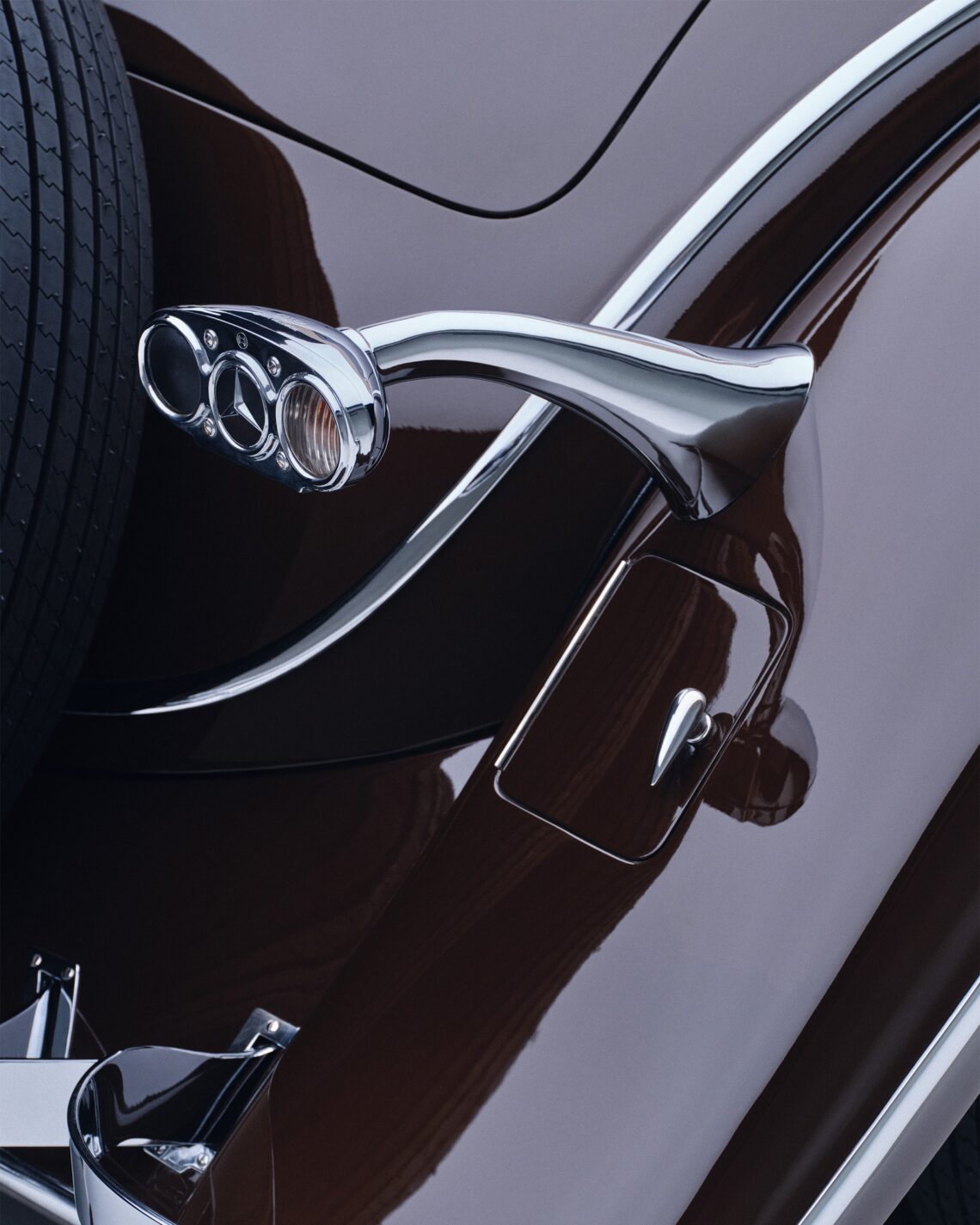
It is easy to see why that car stopped your scroll. The 1934–1936 Mercedes-Benz 500 K Special Roadster was designed specifically to be the most “ravishing” thing on the road, and those specific details you noticed the backlighting and the side profile are exactly what separate it from the “standard” luxury cars of the 1930s.
The Visual Drama: White Walls and the Side Profile
The side profile is where the 500 K truly defines the “Pinkies Down” luxury aesthetic of its era. Because the car was built on a massive 3,290mm wheelbase, the Sindelfingen designers were able to stretch the hood to a length that suggests a massive power plant hidden underneath. When you pair that long, sweeping fender line with wide white-wall tires, it creates a high-contrast, graphic look that still looks “epic” against a clean background today. Those white walls weren’t just for show back then; they were a status symbol of the elite who could afford the maintenance to keep them pristine.

The “Cool” Factor: Backlit Instrumentation
The “backlight” on the dashboard was revolutionary for the mid-30s. While most cars of that era had front-lit or poorly illuminated dials, the 500 K featured a masterfully crafted instrument cluster. The dials often used mother-of-pearl or ivory-colored faces with delicate chrome rings. At night, the soft internal glow through these semi-translucent materials made the dashboard look less like a car and more like a high-end luxury watch or a professional camera body. It offered a level of legibility and “cool” factor that even modern digital cockpits struggle to replicate with pure LED.


Interior Craftsmanship and Layout
The interior is “nice to look at” without being overly cluttered. It focuses on tactile luxury, think heavy chrome switchgear, thick leather hides, and a massive, four-spoke steering wheel designed for high-speed touring. Unlike the cramped sports cars of the era, the Special Roadster was designed for the “International Luxury Class,” meaning it had to be comfortable for a multi-day drive from Paris to the Riviera.


By The Numbers: A Technical Legend
When you formalize the stats into the narrative of the car’s history, the rarity becomes even more impressive. Of the 342 total 500 K chassis ever produced, only 29 units were given the “Special Roadster” bodywork. It was a heavyweight athlete, weighing nearly 6,000 lbs, yet it could reach a top speed of over 160 km/h (100 mph). This performance was made possible by the 5.0-liter supercharged eight-cylinder engine, which used a Roots-type blower to jump from 100 hp to 160 hp the moment the driver floored the pedal. It remains one of the most expensive and coveted machines in existence, with current market values often exceeding $10 million.