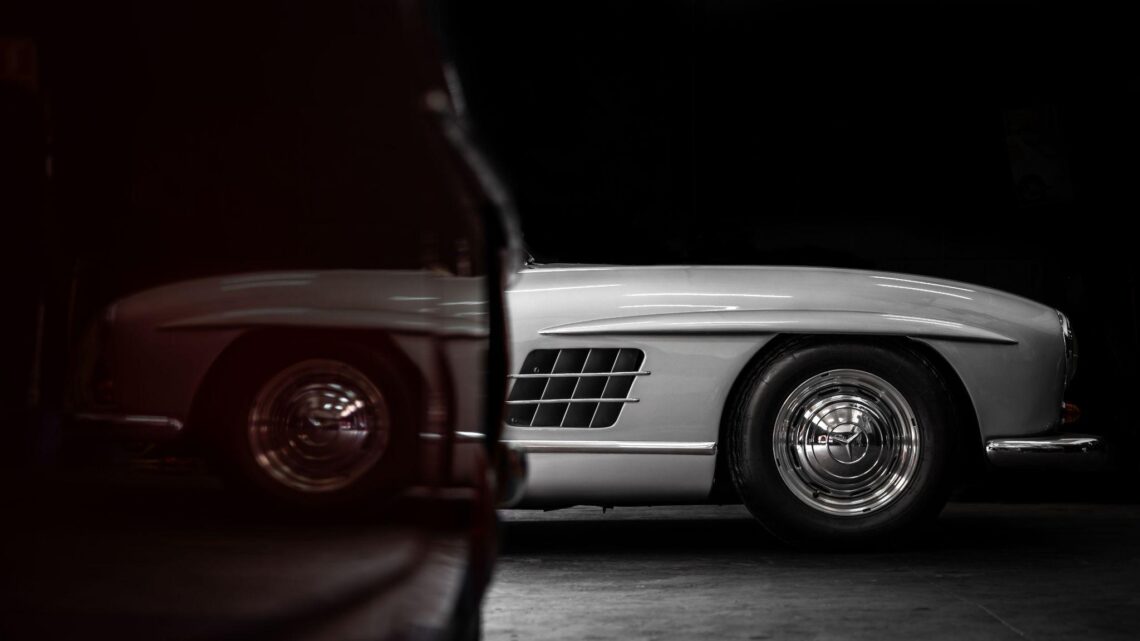
Imagine it is 1954. The world is still shaking off the gray dust of World War II, and automotive design is dominated by heavy, chrome-laden cruisers. Then, like a visitor from another dimension, the Mercedes-Benz 300 SL bursts onto the scene.
With doors that swing toward the heavens and a silhouette that looks like wind tunnel art, it didn’t just turn heads—it changed the trajectory of automotive history forever.
Born on the Track, Bred for the Street
Unlike most cars of its era, which were designed for comfort first and speed second, the 300 SL (standing for Super-Leicht or Super-Light) was a purebred racer forced into a tuxedo. In 1952, the racing version of the 300 SL was dominating track fields globally, securing legendary victories at the 24 Hours of Le Mans and the grueling Carrera Panamericana. Mercedes-Benz had no intention of selling it to the public. It was a rolling testbed, built strictly for corporate glory.

Enter Max Hoffman.
As the official U.S. importer for Mercedes-Benz, Hoffman was a visionary businessman who understood the wealthy, post-war American appetite for performance. He cornered the board of directors in Stuttgart and made a daring guarantee:
“Build a road-going version of this racer, and I will personally order 1,000 of them.”
Mercedes took the gamble. It paid off spectacularly.
Why the Iconic “Gullwing” Doors Exist
While those roof-hinged doors are widely celebrated as a masterstroke of aesthetic genius, they were actually a desperate engineering hack.

The 300 SL used an advanced, ultra-lightweight tubular spaceframe chassis. This intricate web of steel tubes provided incredible rigidity, but it ran incredibly high along the sides of the cabin.
- The Problem: The side sills were so high that traditional front-hinged doors were physically impossible to install.
- The Genius Solution: Engineers hinged the doors on the roof.
To actually get into the car, drivers had to step over a massive, leather-wrapped sill. Mercedes even had to design a tilt-away steering wheel just so the driver’s legs could clear the column during entry and exit.
Groundbreaking Engineering Under the Hood
The Gullwing wasn’t just a pretty face with quirky doors. Beneath its long, sculpted hood lay engineering that made contemporary sports cars look like steam engines.

- The World’s First Fuel Injection: It was the first production car to feature direct fuel injection, adapting technology previously reserved for Messerschmitt fighter planes.
- The Tilt Engine: To keep the car’s nose low and aerodynamic, the massive inline-six engine was tilted to the side at a sharp $45^{\circ}$ angle.
- Mind-Bending Speed: While the average family sedan struggled to hit 70 mph, the 300 SL topped out at a staggering 163 mph ($263 \text{ km/h}$), making it the undisputed fastest production car of its day.
The Legacy of a Legend
Today, a pristine 300 SL Gullwing is a holy grail for collectors, easily fetching between $1.5 million and $3 million at auction.
It remains a masterclass in how rigid technical limitations can breed timeless artistic design. The Gullwing didn’t just push the boundaries of what a car could do; it defined the very concept of the modern “supercar” decades before the word was even coine