In the upper echelons of custom superyacht construction, a rapid build is often a compromised one. True engineering mastery the kind that prioritizes rugged capability over superficial marketing fluff takes time.

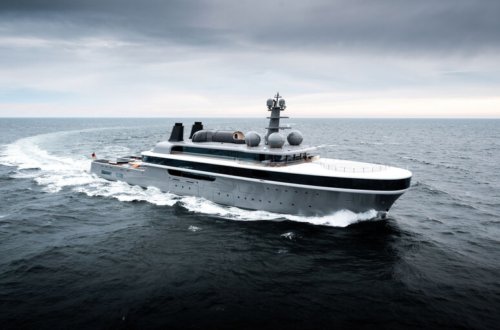
Nowhere is this more evident than in the recent delivery of the 109-meter Lürssen explorer yacht O3 (formerly known to industry insiders as Project Icecap and Project Shackleton). After nearly a decade in development and build, this $350 million behemoth has finally left Germany, establishing a new benchmark for what a true global expedition vessel should be.
The 10-Year Evolution: From Icecap to O3
The story of O3 is an epic of engineering persistence. The project was first conceived around 2017, with the keel officially laid in late 2018 at Lürssen’s Peene-Werft yard in Wolgast. Initially commissioned under the name Project Icecap, the build was shrouded in extreme secrecy, designed from the ground up to conquer the most hostile marine environments on Earth.
However, custom yacht building on this scale rarely follows a straight line. In 2022, the vessel was resold in-build to its current owner, American-British billionaire Len Blavatnik. Rather than simply finishing the existing blueprint, the project underwent a radical transformation managed by Occam Marine.
[2017: Conception] ➔ [2018: Keel Laid (Icecap)] ➔ [2022: Resale & Major Redesign] ➔ [2025: Launched as O3] ➔ [2026: Delivery]
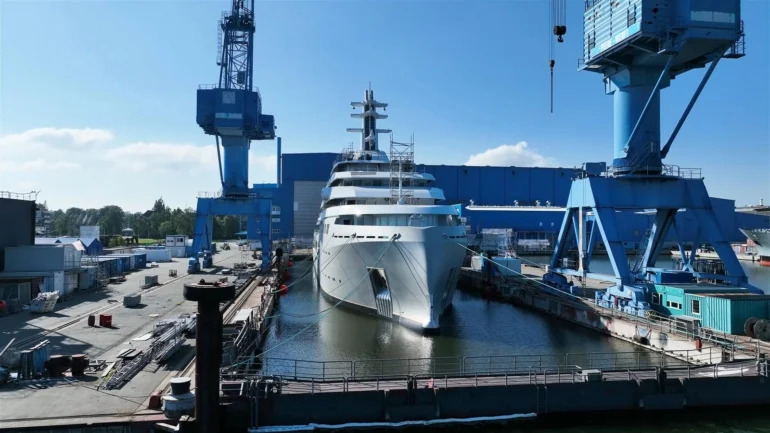
To accommodate the new owner’s specific operational needs, the yacht was physically extended. The aft section was heavily modified and heightened to integrate a massive, commercial-grade elevated helideck. In late 2022, the hull was transferred to Lürssen’s Hamburg facilities, where final systems integration and outfitting took place inside a floating drydock before her official 2026 delivery.
The Design Alliance: Heavy-Metal Function Meets High-End Tailoring
What makes O3 visually arresting is how it balances raw commercial utility with refined proportions. This is the result of a brilliant, multi-studio design evolution:
- Salt Ship Design (Naval Architecture & Original Exterior): Crucially, Lürssen bypassed traditional yacht designers for the initial platform, turning instead to the Norwegian commercial specialists at Salt Ship Design. They gave O3 its defining characteristic: a striking, inverted axe-style bow and a superstructure pushed aggressively forward. This hull form maximizes waterline length, slices through heavy seas to minimize vibration, and provides the volume needed for an Ice Class 1B steel hull.

- Espen Øino International (Exterior Refinement): Brought in during the 2022 ownership transition, legendary designer Espen Øino was tasked with softening the vessel’s commercial edges without disrupting its rugged DNA. Øino introduced long, continuous horizontal bands of dark glazing that sweep across the superstructure, visually leaning the yacht out and breaking up the massive 6,561 GT internal volume into elegant, terraced decks.
- Cristina Gherardi Design (Interior): Replacing the original layout by Adam Lay, the Parisian studio CG Design stepped in to craft the living quarters. While the interior remains intensely private, it is designed to comfortably accommodate 20 guests across 10 suites (including a massive owner’s deck and four VIP cabins) alongside a 30-person crew.
What Sets O3 Apart From the 2026 Hybrid Fleet?
This year has already seen some of the most technologically advanced hybrid launches in maritime history—most notably Lürssen’s own 114.2-meter Nausicaä (Project Cosmos), which grabbed headlines with its cutting-edge methanol fuel-cell system designed for zero-emission, silent hotel mode.
So, where does O3 stand against these alternative-fuel trail-blazers? It comes down to mission profile and raw mechanical endurance.
Feature | Lürssen O3 | Typical 2026 Hybrids (e.g., Nausicaä) |
|---|---|---|
Primary Mission | High-latitude, multi-month remote exploration. | Scientific innovation and near-shore emission-free cruising. |
Propulsion Strategy | Heavy-duty Diesel-Electric (3 x Wärtsilä 9L20 engines). | Fuel-Cell / Battery-heavy configurations. |
Hull Capability | Ice Class 1B (Engineered for thick, moving ice floes). | Light Ice Class or standard steel displacement. |
Top Speed | An impressive 24 knots (Extraordinary for a 6,500+ GT vessel). | Typically optimized around 14–17 knots. |
1. Hardcore Ice Classification
While many of this year’s hybrids are built for the Mediterranean “Riviera Run” or light seasonal cruising, O3 is a true polar conqueror. Armed with an Ice Class 1B hull, its steel structure is heavily reinforced to withstand moving ice floes in places like the Northwest Passage or Antarctica. Every component, from the sea chests to the rudder linkages, is insulated and heated against catastrophic freezing.
2. A Pure Diesel-Electric Powerhouse
While Nausicaä relies on experimental hydrogen-from-methanol fuel cells superb for silent anchoring but heavily reliant on specialized shore-side chemical infrastructure—O3 chooses unpretentious, bulletproof reliability.

Its hybrid powertrain utilizes three heavy-duty Wärtsilä 9L20 marine engines powering an advanced diesel-electric grid. This setup feeds variable-speed electric drives paired with massive battery banks for peak-shaving and energy recovery. It allows O3 to run its hotel loads silently for extended periods without starting a generator, while retaining the ability to burn standard marine distillate available in the most remote corners of the globe.
3. Sports-Car Speed in a Battleship Hull
Perhaps the most shocking metric of O3 is its top speed. Most heavy displacement explorers of this volume max out around 15 to 17 knots. Thanks to the hydrodynamic efficiency of that Salt Ship axe-bow and the sheer torque of its electric drives, O3 can hammer down to reach 24 knots.
The Takeaway: O3 is the antithesis of “marketing fluff” luxury. It didn’t spend a decade in a drydock for a lack of effort; it spent ten years being over-engineered into a vessel that treats global exploration as a mandate, not a aesthetic choice.