
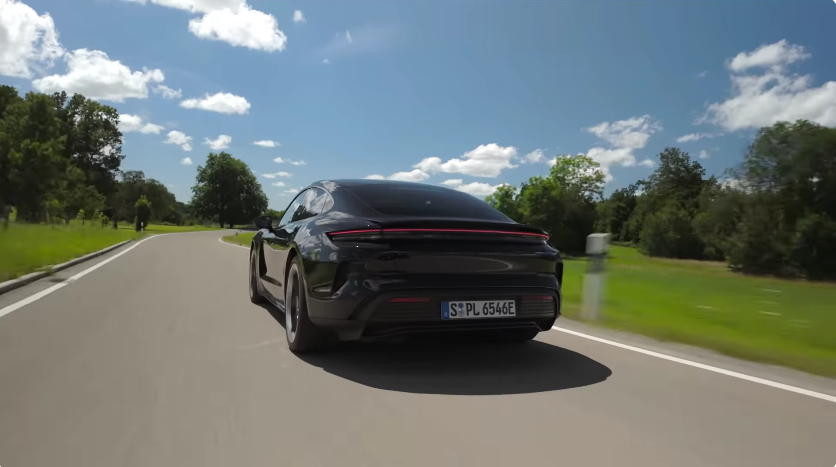
There is a telling moment in Porsche’s recent technical showcase for the updated Taycan. As the camera tracks across the car’s distinctive, aerodynamic black-and-white rims, the host points out a strict prerequisite for hitting the brand’s headline charging speeds: you must use a terminal that delivers a minimum of 320 kW.

It is an undeniably impressive feat of traditional engineering, but it highlights a massive bottleneck in the luxury EV space. Porsche has optimized the aerodynamics down to those striking black-and-white wheels, yet the car remains entirely at the mercy of the grid. If you pull up to an older, standard 150 kW terminal the actual backbone of the European road network the car cannot magically force the post to give more. It simply waits.
But what if the vehicle didn’t just passively accept whatever a lower-tier charger offered? The next major leap in electric mobility isn’t about building a bigger, dumber pipe to push more raw kilowatts. It is about making the battery itself smarter engineering an onboard architecture intelligent enough to optimize the charging logic from the inside out, squeezing a hyper-efficient 15-minute splash-and-go out of a lesser terminal.
The Shift Toward Chemical Intelligence
To understand what a smarter battery looks like, look at the technology AutoTrader recently highlighted in their European review of the Denza Z9GT. BYD’s premium sub-brand is introducing its “Flash Charging” architecture, and its core philosophy completely flips the script on how a car interacts with older infrastructure.
Instead of demanding a pristine, lab-grade power supply to look good, Denza’s second-generation Blade battery focuses on internal chemical intelligence.

By utilizing an advanced “Flash-Through” ion transport chemistry and a 1000V architecture, the battery pack actively manages its own internal resistance and thermal profile in real time.
- Sustaining the Peak: Traditional EV batteries accept a high peak wattage for a few minutes before thermal buildup forces the car to throttle the intake, resulting in a steep drop-off.
- Flattening the Curve: A smart battery cell allows the lithium ions to move with vastly reduced resistance. This means that even when plugged into an older 150 kW European terminal, the car can hold that terminal’s absolute maximum output across nearly the entire charging cycle, rather than dropping down to a crawl.
In practice, a smart battery treats a lower-tier station not as a bottleneck, but as an asset to be fully and efficiently drained. It shifts the burden of performance from the utility provider to the vehicle’s internal software.
Squeezing 15 Minutes Out of What You’ve Got
When the battery chemistry handles the heavy lifting, the real-world logic for the driver changes completely. If you only have 15 minutes to spare at a standard regional terminal, a smarter battery architecture ensures that every single second of that window is utilized at maximum efficiency.
| Philosophy | Engineering Focus | The Infrastructure Dependency | The 15-Minute Reality on a 150 kW Post |
| The Peak-Power Approach (e.g., Porsche) | Optimizing for absolute mechanical perfection under ideal 320 kW+ conditions. | High. Requires specific, ultra-rapid hardware to maintain headline speeds. | Slower initialization; the car cannot maintain its peak curve because it expects a higher voltage feed. |
| The Smart Battery Approach (e.g., Denza Flash) | Advanced ion transport and internal resistance management to maximize any input. | Low. Engineered to flatten the charging curve across a wide variety of terminals. | Highly Efficient. The battery safely absorbs the maximum available current for the entire duration of the stop. |
Additionally, this chemical adaptability solves the environmental variables that typically cripple charging times. In recent European cold-weather benchmarking, this smarter architecture allowed the battery to charge from 20% to 97% in just 12 minutes even after being cold-soaked at -30°C a drop-off of only three minutes compared to room temperature.
The New Definition of Modern Luxury
True luxury on a long-distance journey is the luxury of time. It is the peace of mind that comes from knowing you don’t have to micromanage your route around a handful of ultra-rare, high-output chargers just because your car demands it.

Porsche has built an incredible piece of performance machinery, wrapped in iconic design details like those high-contrast aero rims. But as the global grid catches up to the EV transition, the ultimate engineering flex won’t be how much power a car can take under perfect laboratory conditions. It will be how intelligently the battery adapts to an imperfect world, giving the driver a flawless, rapid top-up using exactly what they’ve got.