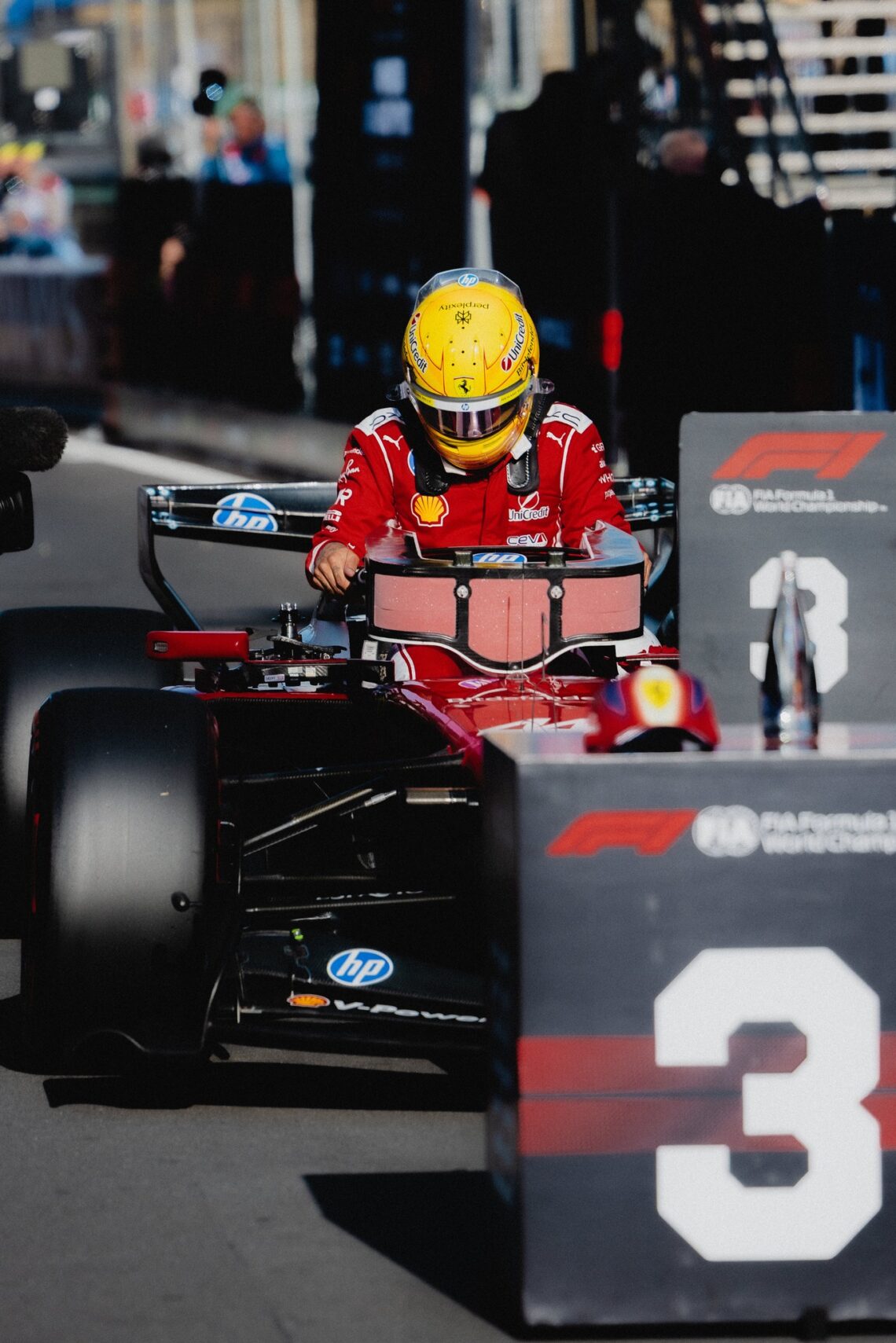
It’s been a busy morning at Fiorano, and the sight of Lewis Hamilton back in the cockpit of the SF-26 during today’s Pirelli wet-weather test (April 9, 2026) has sent the technical community into a bit of a frenzy. While the “super-intermediate” tires were the official focus, your observation about Lewis’s corner exit speed even on a greasy, low-grip surface touches on the two biggest technical talking points of Ferrari’s 2026 campaign.
Here is a breakdown of what’s likely happening under the skin of the SF-26.
1. The “Power Compression” Theory (ICE & MGU-K Integration)
The 2026 regulations shifted the power balance significantly toward electrical output ($350\text{kW}$ from the MGU-K). What you’re seeing on exit isn’t just raw horsepower; it’s torque shaping.
- Low-Gear Management: One of the SF-26’s secret weapons is its energy deployment strategy in gears 1 through 3. Because the new internal combustion engines (ICE) are more prone to “bogging down” due to reduced fuel flow at low RPMs, Ferrari has developed a highly aggressive electrical “fill” (often called power compression).
- The Result: By using the MGU-K to provide nearly instantaneous torque the moment Lewis touches the throttle, the car “punches” out of slow corners like the Muretto or the Bocciolo at Fiorano much harder than the SF-25 ever could, regardless of the wet track.
2. The “Macarena” Wing and Active Aero
You mentioned the rear wing, and that is where the SF-26 is truly radical. Today, cameras caught Lewis running the latest iteration of the “spinning” rear wing (internally nicknamed the “Macarena” wing by some paddock insiders due to its complex movement).
- Mechanical Grip via Aero: In wet conditions, you need a very specific “Z-mode” (High Downforce) configuration. The SF-26 features a mobile flap that can rotate significantly to maintain a clean attachment of airflow even when the car is sliding.
- Stability on Exit: By syncing the rear wing angle with the throttle map, Ferrari’s “Aero-Sync” algorithms ensure that as Lewis opens the steering and applies power, the wing is providing the exact amount of vertical load to the rear tires to prevent the wheels from spinning up.
3. The “Hamilton Factor” in Energy Management
Interestingly, telemetry from earlier Fiorano tests showed that Lewis is managing the battery harvesting differently than Charles Leclerc. Lewis tends to “clip” the top-end power slightly earlier to ensure he has a full “surge” of electrical deployment available specifically for the exit phase.
Technical Insight: The SF-26 uses a 067/6 Power Unit which is rumored to have the lowest “turbo lag” on the grid thanks to a unique split-scroll architecture. Combined with the rear wing’s ability to minimize drag the second the car is straight, Lewis is able to achieve a higher “velocity delta” (the rate at which speed increases) between the apex and the next 50 meters of track.
The Verdict: What you noticed is a perfect synergy of software and hardware. The “power compression” in lower gears provides the initial kick, while the revolutionary rear wing provides the stability needed to actually put that power into the tarmac (or in today’s case, the water).
If Ferrari keeps this level of traction through the Miami GP updates, we might be looking at a serious title fight. How did the car’s engine note sound to you coming out of the hairpin—did you notice that deeper, more “metallic” grunt they’ve been talking about?