The history of automotive engineering is filled with names that are instantly recognizable, but few figures have exerted such a profound, yet quiet, influence over the industry as Franz Xaver Reimspieß. He was a man who worked primarily in the shadows of drawing boards and engineering workshops, yet his technical brilliance and sharp eye for design shaped the visual and mechanical landscape of global car culture.
To understand how a young Austrian boy became the man who drew the identity of modern motoring, one has to look at the relentless pursuit of engineering excellence that defined his journey.
Born in Wiener Neustadt: The Cradle of Engineering
Franz Xaver Reimspieß was born on November 28, 1900, in Wiener Neustadt, a bustling industrial city located just south of Vienna, Austria. At the turn of the 20th century, Wiener Neustadt was rapidly evolving into a premier hub for mechanical innovation, locomotives, and early aviation. Growing up in an environment saturated with industrial progress, Reimspieß developed an innate fascination with mechanics and drafting from a young age.

He pursued rigorous technical training, honing a meticulous approach to drafting that would define his entire career. By the time he was a young man in the 1920s, his precise talent caught the attention of Austro-Daimler, one of the most prestigious luxury and performance automotive manufacturers in Europe at the time.
It was at Austro-Daimler that Reimspieß’s path would irrevocably cross with a volatile, brilliant, and demanding engineering director: Ferdinand Porsche.
The Road to Volkswagen: Following the Visionary
When Ferdinand Porsche left Austro-Daimler to establish his independent design and engineering bureau—the Dr. Ing. h.c. F. Porsche GmbH—in Stuttgart in 1931, he knew he needed an elite circle of talent to execute his avant-garde ideas. Porsche valued raw technical execution above all else, and he remembered the sharp, meticulous Austrian draftsman from his days in Wiener Neustadt.
In 1934, Reimspieß received the call to join the Porsche office in Stuttgart. He entered a high-pressure environment tasked with a monumental objective: developing a reliable, mass-producible, and affordable “People’s Car” (Volkswagen) under a government contract.
[Austro-Daimler] ➔ [Porsche Stuttgart Bureau (1934)] ➔ [The KdF-Wagen / Volkswagen Project]
Reimspieß immediately went to work on the vehicle’s mechanical core. While other engineers had experimented with early prototypes of opposed four-cylinder engines, it was Reimspieß who took those raw concepts and completely re-engineered them. He refined the layout, optimized the airflow for cooling, and established the definitive blueprint for the air-cooled, four-cylinder boxer engine.
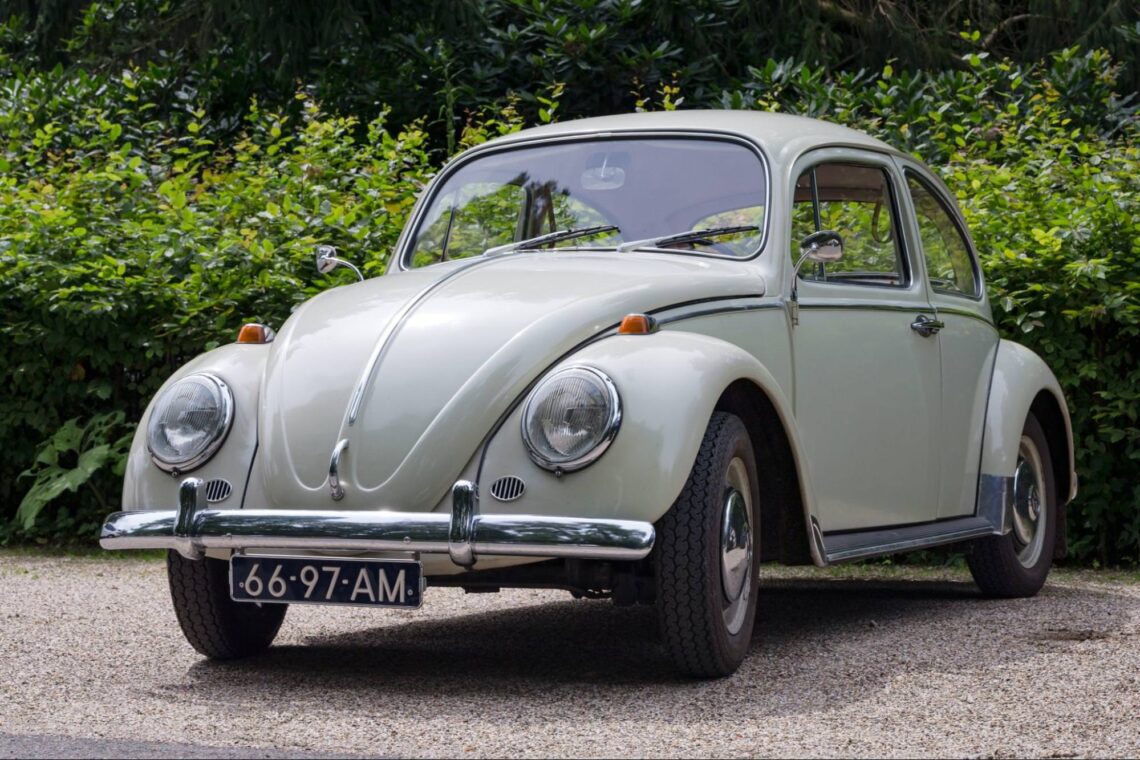
His mechanical adjustments provided the exact blend of reliability and simplicity required for the car that would eventually become the legendary Volkswagen Beetle.
The 100-Reichsmark Masterpiece
While Reimspieß’s days were consumed by suspension geometries and engine cooling calculations, his most enduring contribution to the Volkswagen project came from a brief creative detour.

As the Volkswagen project moved toward production, the vehicle needed a powerful, distinct corporate identity. A design competition was held within the Porsche bureau to create a trademark. Armed with his drafting tools and an innate sense of clean, industrial geometry, Reimspieß sketched a powerful graphic: a bold, stylized “V” stacked cleanly on top of a “W,” all neatly enclosed within a perfect circle.
[ V ]
[ W W ]
His design was chosen as the winner. For creating what would become one of the most universally recognized corporate logos in human history, Reimspieß was reportedly awarded a one-off bonus of just 100 Reichsmarks.
Key Milestones: From Wiener Neustadt to Wolfsburg
Year | Milestone | Impact on Automotive History |
|---|---|---|
1900 | Born in Wiener Neustadt, Austria | Raised in a premier European industrial and mechanical hub. |
1920s | Enters Austro-Daimler | Refines his drafting skills and connects with Ferdinand Porsche. |
1934 | Joins Porsche Stuttgart Bureau | Becomes a core mechanical asset for early Volkswagen development. |
1936 | Designs the Volkswagen Logo | Creates the iconic stacked “VW” circle emblem for 100 Reichsmarks. |
1930s–Post-War | Perfects the Air-Cooled Boxer | Engineers the mechanical heart that powered over 21 million Beetles. |
“He was an engineer who thought in shapes, and a designer who calculated in tolerances.”
From his humble beginnings in an Austrian industrial town, Franz Xaver Reimspieß engineered his way into the inner sanctum of automotive royalty. By the time the Volkswagen Beetle began its journey toward conquering the global automotive market, both its mechanical heart and its iconic face bore the unmistakable, permanent imprint of the boy from Wiener Neustadt.