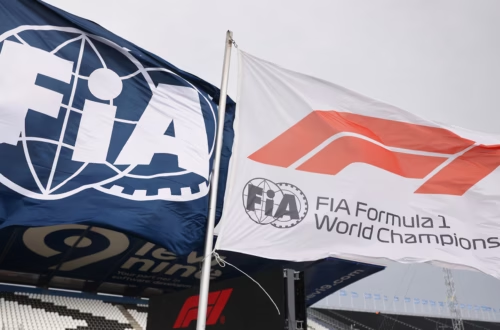
The Fédération Internationale de l’Automobile (FIA) finds itself in the crosshairs of an intense political firestorm following its decision to restore Russian and Belarusian national symbols in global motorsport. Following an August World Motor Sport Council vote, the ruling body abruptly dismantled emergency restrictions that had governed paddock participation since March 2022.
The choice has sparked a passionate clash between governing bodies, legal frameworks, and national sports federations worldwide.
The Ruling: What Was Decided?
The FIA’s updated directive strips away emergency neutrality measures, establishing a dramatic shift in how Russian and Belarusian competitors engage with sanctioned competitions.
                  FIA POLICY FRAMEWORK COMPARISON
                  --------------------------------
   PREVIOUS RULES (2022–AUG 2026)  |  REVISED RULES (AUGUST 2026 ONWARD)
   ------------------------------  |  ---------------------------------
   • Neutral "FIA Flag" mandatory  |  • Full National Identity (Flags/Colours)
   • Signed Neutrality Pledge      |  • Neutrality Requirement Scrapped
   • Anthems Strictly Banned       |  • National Anthems Permitted
   • Event Hosting Ban Active      |  • Event Hosting Ban REMAINS ACTIVE
While drivers are no longer forced to race under neutral licenses or sign political neutrality agreements, the FIA maintained its strict ban on hosting international events within the physical borders of Russia and Belarus.
The Supporting Side: Why Proponents Approve
Those in favor of the FIA’s policy shift anchor their argument in precedent, athlete rights, and political non-interference:
- The Olympic Precedent: The FIA explicitly aligned its stance with the International Olympic Committee’s (IOC) decision to provisionally lift the suspension of the Russian Olympic Committee, framing the move as a standardized alignment across global sports.
- Triumph of Athlete Rights: Boris Rotenberg, president of the Russian Automobile Federation (RAF), publicly celebrated the verdict, declaring that “justice has triumphed” and that athletes can now race without “artificial barriers or compromises.”
- Individual vs. State: Proponents argue that individual sportspeople should not bear career-ending penalties for the actions of state leadership, advocating that national identity in sport remains separate from geopolitical conflict.
The Opposing Side: Why Critics Condemn the Move
The opposition—led directly by the Automobile Federation of Ukraine (FAU) and Ukrainian Minister of Youth and Sports Matvii Bidnyi—argues that the FIA is actively facilitating “sportswashing.”
                 UKRAINIAN SPORTS MINISTRY DATA
                 ------------------------------
   Athletes & Coaches Killed : 770+ since February 2022
   Sports Facilities Destroyed: 925+ across Ukraine
- Normalizing Aggression: Minister Bidnyi strongly condemned the shift as a “blatant disregard for international law,” emphasizing that allowing national symbols effectively converts international podiums into tools for state propaganda while the war continues.
- Ethics & Fair Play: The FAU filed an urgent appeal to FIA President Mohammed Ben Sulayem, contending that reinstating state symbols undermines the foundational principles of Fair Play while imposing deep ethical and safety risks on Ukrainian competitors.
- Divergent Governing Bodies: Critics point out that other major sports bodies—including World Athletics and the International Motorcycling Federation (FIM)—have rejected the IOC’s lead, choosing instead to enforce absolute bans on Russian representation.
The Legal Wildcard: Local Host Nation Laws
Despite the FIA’s global rule change, Russian and Belarusian competitors face a major legal catch: transnational and national jurisdiction.
[FIA Global Approval] ---> Subject To ---> [Host Nation Visa & Sanctions Laws]
The FIA’s official circular explicitly notes that driver participation remains strictly bound to local host country regulations. This means nations with existing sanctions, visa restrictions, or border bans—such as the UK, Poland, or several Baltic states—retain the absolute authority to block Russian and Belarusian drivers from physically entering their territory or competing in local events, creating a fragmented, patchwork landscape for international motorsport.