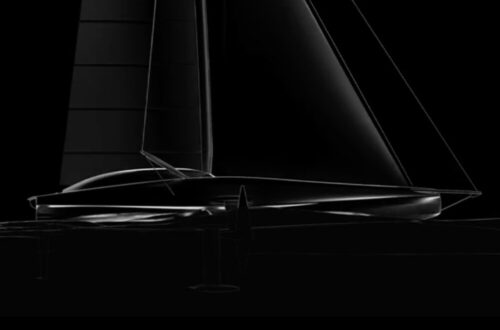
Ferrari is moving from the tarmac to the open ocean with Project Hypersail—a groundbreaking 30-meter (100-foot) full-foiling monohull racing machine. Rather than building a traditional luxury yacht, Ferrari’s Maranello tech team, in collaboration with famed naval architect Guillaume Verdier, is constructing a zero-combustion-engine, carbon-fiber speed weapon.
Here is a breakdown of how this cutting-edge vessel achieves complete renewable self-sufficiency and the historic competition it is designed to conquer.
How Ferrari Hypersail Works: Complete Energy Autonomy
Offshore racing yachts typically rely on diesel generators to power their complex electronics, hydraulic pumps, and massive sail-trimming winches. Hypersail throws out the combustion engine entirely, making it the first trans-oceanic foiling monohull to achieve 100% energy self-sufficiency.
It handles its intense power demands using a closed-loop renewable ecosystem:
- Winch-by-Wire (Human Kinetic Energy): In a brilliant bit of technology transfer, Ferrari replaces traditional mechanical or hydraulic winch handles with “Winch-by-Wire” grinding pedestals. When the crew spins these pedestals, their muscle power is converted directly into electricity using the exact same electric motors found in the suspension systems of the Ferrari Purosangue and F80 hypercar. This energy powers the sail winches and hydraulic pumps in real time.
- Integrated Solar Matrix: The yacht features 100 square meters of highly specialized solar panels molded right into the deck and hull sides. Ferrari ran extensive solar exposure simulations to maximize output. To keep the crew safe, the panels are fully walkable, treated with a high-grip texture, and secured with technical fastening clips.
- Removable Stern Wind Turbines: At the back of the boat, modular wind turbines harvest air currents. These can be deployed or completely stripped down and reconfigured depending on the immediate weather conditions and aerodynamic drag requirements.
- 800-Volt Battery Architecture: Any surplus electricity harvested from the sun, wind, or crew grinds is stored in dual 800-volt battery packs, mirroring the high-voltage tech found in modern motorsport.
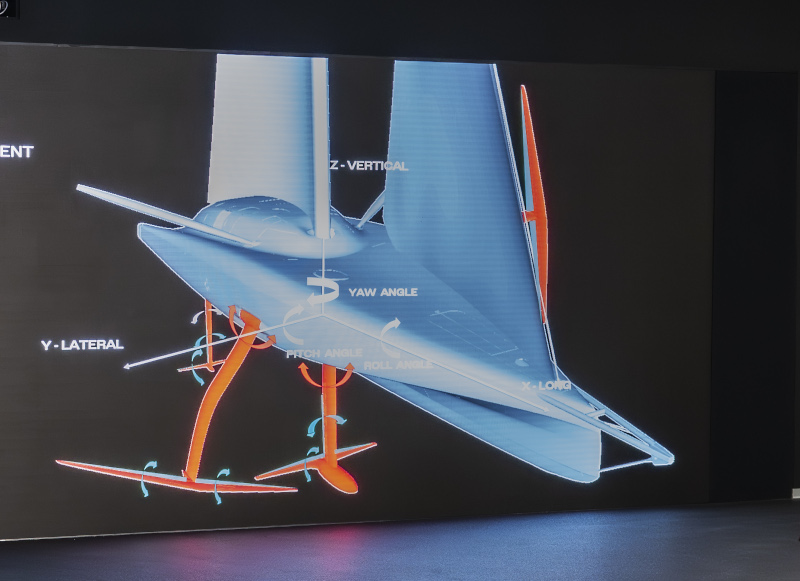
To slice through the water, the boat relies on a unique three-point flight control system. While traditional America’s Cup style foiling is highly unstable in rough ocean swells, Hypersail stabilizes its flight by linking one of its massive T-shaped foils directly to an innovative canting keel, working in tandem with the rudder foil and two lateral foils. The flight dynamics are guided by a custom-coded flight control system born out of Ferrari’s Scuderia F1 and Le Mans Hypercar programs.
The Competition: The Ultimate Endurance Hunt
Ferrari is not entering a standard regatta circuit. Led by legendary Italian ocean navigator and Team Principal Giovanni Soldini, the Hypersail project is taking on the ultimate crown of offshore sailing endurance: The Jules Verne Trophy.
The Jules Verne Trophy is a prize awarded for the fastest circumnavigation of the globe by any type of yacht, with no stopovers and no assistance.
[Start/Finish: Ushant, France] ➔ [Cape of Good Hope] ➔ [Cape Leeuwin] ➔ [Cape Horn] ➔ [Return to France]
This is a brutal, high-stakes sprint around the planet. Historically, this record has been the exclusive playground of massive, ultra-stable multihulls (giant trimarans). Ferrari and Soldini are planning to do the unthinkable: hunt down this outright global speed record using a monohull that literally flies across the water.
With the hull already pulled from its mold in Pisa, Italy, and a launch slated for late 2026, the Prancing Horse is gearing up for sea trials ahead of its historic, fossil-fuel-free record attempt.
For a deeper visual dive into how Maranello’s engineering team is adapting Le Mans and Formula 1 aerodynamics to the ocean, check out the Ferrari Hypersail Deep Dive Video. This video breaks down the full-foiling mechanics, the canting keel innovation, and the specific design details crafted by the Ferrari Design Studio.