When Maranello first announced its entry into offshore ocean racing, the initial reaction across the motorsport world ranged from jaw-dropping excitement to healthy skepticism.
At first glance, a 100-foot flying monohull sporting the Prancing Horse emblem feels like the ultimate high-seas vanity project—a billionaire-backed show pony built for glamorous photo ops. But as the engineering details trickle out of Maranello, one thing becomes crystal clear: if this is a show pony, buy your tickets now, because it is shaping up to be the most spectacular spectacle in modern racing history.
The Tech: Cutting-Edge Engineering or Complete Madness?
Ferrari isn’t just slapping a red coat of paint and a yellow badge onto a conventional sailboat. Approximately 90% of the prototype’s components are being manufactured in the exact same Maranello factory responsible for the Daytona SP3, the Purosangue, and the F80 hypercar.
                 HYPERSAIL vs. CONVENTIONAL OFFSHORE FOILERS
                 -------------------------------------------
   Foiling Contacts : 3-Point Balance (Keel Foil + Rudder + Lateral Foil)
   Energy Source    : 100% Self-Sufficient (Solar + Wind + Kinetic)
   Pedestal Tech    : "Winch-by-Wire" utilizing Purosangue/F80 Motors
   Patents Filed    : 15 Total (6 Pending) across Aero & Kinetic Systems
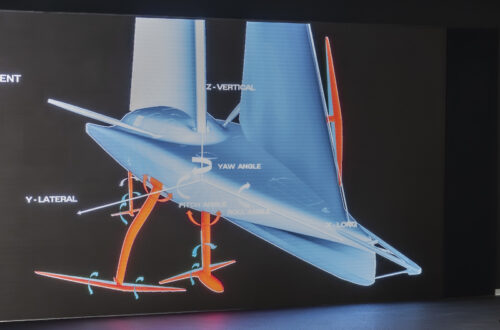
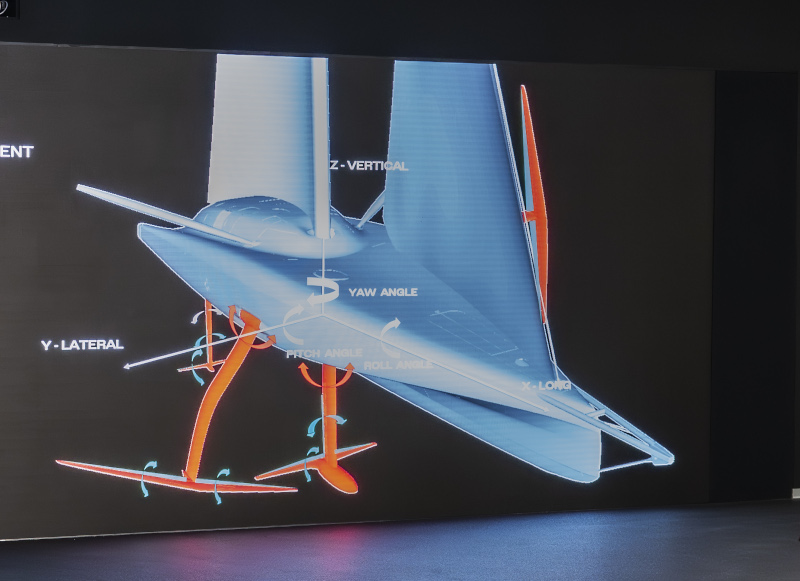
The headline innovation is its three-point full-foiling layout. Designed alongside naval architect Guillaume Verdier, Hypersail uses a T-foil integrated directly into its canting keel to lift the 30-meter hull completely clear of the water.
Even more insane is the “Winch-by-Wire” system. The onboard human grinders don’t turn physical winches attached to ropes; their physical labor spins electric motors—borrowed directly from the active suspension systems of the Ferrari Purosangue—to generate onboard power that controls 9-ton sail loads in real-time.
The Timeline: When Does It Hit the Water?
- Late 2026: Official hull launch and sea trials in Italy (construction is currently underway near Pisa).
- 2027 Delivery & Campaign Start: Full operational handover to the racing crew for record attempts and offshore regattas.
Who Is on the Racing Team?
The crew is built around an elite blend of open-ocean legends and Maranello brainpower:
- Team Principal / Skipper: Giovanni Soldini — The legendary Italian ocean racer who famously won the Around Alone solo race and transformed MOD70 multihulls into flying offshore monsters.
- Chief Technology Officer: Matteo Lanzavecchia — Heading up the cross-transfer of Ferrari’s automotive engineering into marine dynamic systems.
- Design & Naval Architecture: Guillaume Verdier — The genius behind the fastest IMOCAs and America’s Cup foilers on Earth.
- The Crew: Soldini is assembling an international crew of roughly 10 offshore specialists who will manage the vessel during high-speed ocean sprints.
Where Are They Racing in 2026–2027?
Unlike America’s Cup vessels that zip around short coastal courses, Hypersail is built for brute-force offshore endurance.
                     THE HYPERSAIL MISSION MAP
                     -------------------------
   [2026] Launch & Shakedown Trials (Tyrrhenian Sea)
   [2027] Offshore Record Sprints & Transatlantic Benchmarking
   [Target] The Jules Verne Trophy (Crewed Round-the-World Record)
Ferrari’s Long-Term Goal for Watersports: Why Maranello Cares
Why is a supercar brand spending tens of millions to build a boat?
According to Ferrari Executive Chairman John Elkann, it comes down to R&D and zero-emission extreme endurance.
Formula 1 gives Ferrari a testing ground for hybrid thermodynamics, and Le Mans tests 24-hour powertrain durability. Ocean racing provides Maranello with an unfiltered testbed for 100% self-sufficient, closed-loop energy management. The algorithms created for Hypersail’s active flight control, drag reduction, and kinetic energy recovery are already generating patents that will feed directly back into future Ferrari road cars and hypercars.
If Maranello pulls this off, Hypersail won’t just be a show pony—it will be the boat that changed sailing forever.
Is Ferrari Hypersail the Most Exciting Project in Sport?
This deep-dive analysis details the extreme scale, 100-foot monohull proportions, and groundbreaking fly-by-wire engineering behind Ferrari’s Hypersail project, explaining why it bridges the gap between Maranello’s hypercars and ocean racing.