MARANELLO, Italy As the dust settles on the Miami Grand Prix, the Formula 1 landscape has shifted yet again. The FIA has officially signaled the end of the experimental 50/50 power split for 2027, moving instead toward a 60/40 ratio that favors the Internal Combustion Engine (ICE). This 50kW swing increasing ICE output while trimming the MGU-K is a direct response to the “energy starvation” issues that have plagued the 2026 generation of cars.

But while the regulations look toward 2027, the immediate battle is happening in the simulator and on the test tracks of Maranello, influenced heavily by technological breakthroughs in the hypercar sector and the rising power of “Agentic AI.”
The Leclerc Return: Solving the SF-26 Puzzle
Fresh from the launch of his new bespoke Riva 102’ Corsaro Super yacht, Sedici, Charles Leclerc has wasted no time returning to Maranello. While his new 30-meter vessel represents the pinnacle of luxury, his focus in the SF-26 simulator is far more granular.

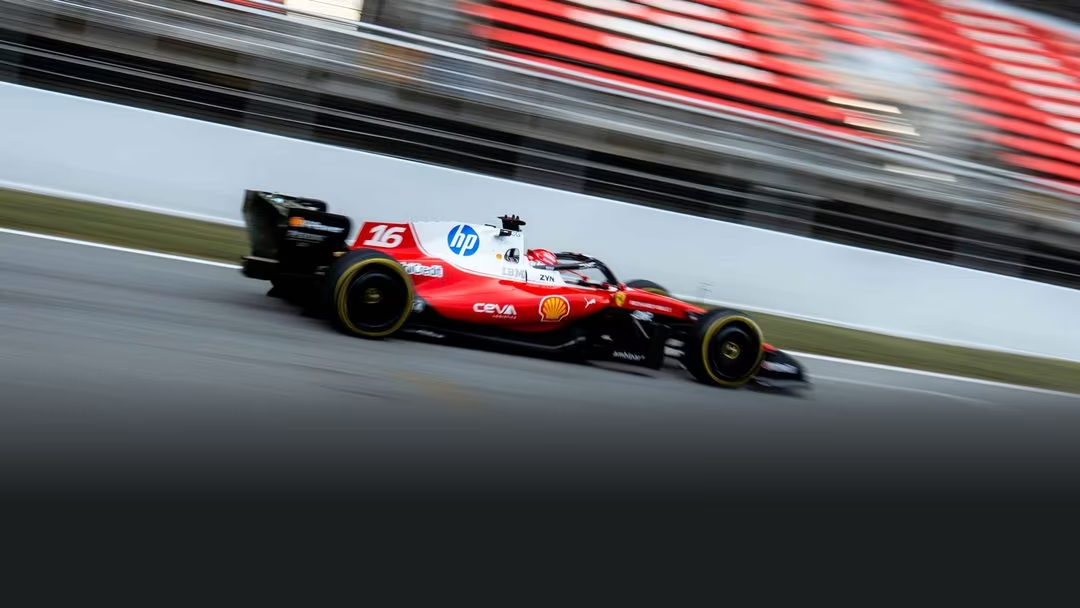
Telemetry from the early rounds of the 2026 season suggests that while the #16 Ferrari is far from underpowered, it is suffering from a fundamental “equilibrium crisis.” The car struggles to balance massive electrical deployment with chassis stability in technical, slow-speed sections.
The central question remains: What is the plan for the high-torque exit zones?
Leclerc’s testing program is hyper-focused on three specific sector pairings where this question must be answered:
- Corners 12 and 13: These are the primary high-torque exit zones where the transition from battery recovery to ICE power often upsets the rear-axle stability. The plan here involves a radical recalibration of the “anti-squat” geometry and a non-simultaneous active aero strategy opening the rear wing slightly before the front to shift the aero balance rearward precisely as the torque peaks.
- Corners 3 and 4: Sequences requiring a “flow-turning” approach where the SF-26’s compact turbo gamble is being pushed to its limit to minimize lag and ensure the power delivery doesn’t arrive in a disruptive “spike.”
- Corners 8 and 9: Critical areas where finding the balance between mechanical grip and the car’s “draggy” aerodynamic profile is essential for maintaining minimum corner speed.
The Hypercar Blueprint: Lamborghini’s Fenomeno and McLaren’s MCL-HY
While Ferrari searches for balance, the industry is reeling from the technological “trickle-up” from recent hypercar projects. Lamborghini has recently showcased its Fenomeno “Few-Off” series a strictly limited 15-car set that represents the most advanced engineering to ever leave Sant’Agata. With its 1080 CV V12 hybrid system, the Fenomeno represents the most advanced “physical” engineering to ever leave Sant’Agata. F1 teams are looking at how Lamborghini manages the “equilibrium” of such massive power without the car becoming an unpredictable monster in slow corners.

Simultaneously, McLaren has utilized the tech from their MCL-HY (the pinnacle of their World Endurance Championship hypercar development) to “work the tech” into their F1 program. This cross-pollination of WEC-grade hybrid efficiency has allowed Woking to simulate the 60/40 shift ahead of its rivals, potentially solving the energy management riddle that Ferrari is currently fighting in the SF-26.
The 60/40 Reality Check: Material Science and Airflow AI
The shift to 60/40 is intended to make the cars more “intuitive” for drivers, balancing distinct energy forms and aggressive aero shifts. However, a significant fault remains: many systems are designed to “learn the track” rather than the driver.
McLaren’s advantage here is rooted in their infrastructure. By utilizing NVIDIA’s AI infrastructure and Rescale’s digital engineering platform, they have moved beyond simple track-mapping. They are using AI-driven physics to test complex airflow characteristics and material resilience at an unprecedented scale.
This platform allows McLaren to run thousands of iterations on carbon composite durability and aerodynamic “fluidity” within hours. Instead of just learning where to deploy power on a GPS map, the car is developed as a viable platform where every material choice is optimized for the next step forward. This “AI data fabric” enables them to create a car that doesn’t just finish the race, but serves as a living laboratory for the 2027 regulations.
As Leclerc swaps the helm of the Sedici for the wheel of the SF-26, the mission is clear: Ferrari must find a way to make the car learn the man, not just the asphalt, before the hypercar-derived efficiency of his rivals becomes an insurmountable lead.