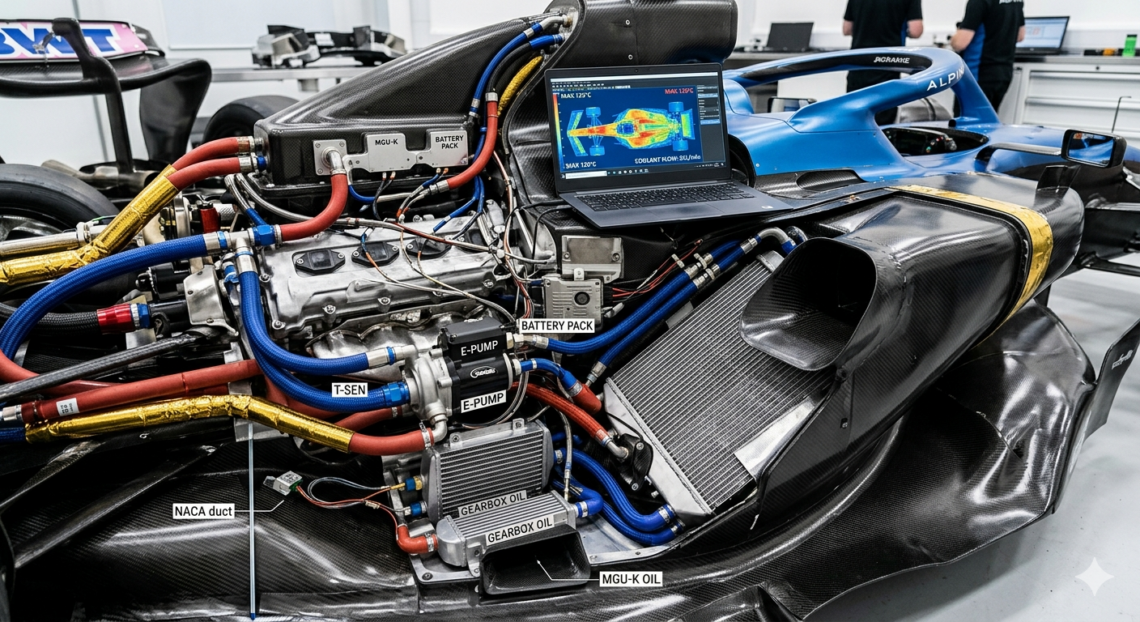
If the digital converter is the “brain” of the 2026 Power Unit, then the cooling system is its “circulatory system”—and right now, that system is under cardiac arrest.
As we move into this new era, the removal of the MGU-H (Heat) has simplified the engine, but it has created a localized “inferno” elsewhere. Specifically, the MGU-K (Kinetic) has jumped from a 120kW output to a massive 350kW. This nearly threefold increase in electrical energy creates a thermal byproduct that current sidepod designs are struggling to vent.
1. The Physics of the “Inferno”
In F1, heat is essentially “lost speed.” When the MGU-K harvests or deploys 350kW, even a highly efficient system (98%) leaves 7kW of waste heat per unit.
- The “Heat Soak” Effect: Because the MGU-H is gone, the turbo no longer acts as a heat energy “sponge.” All that thermal energy now stays within the engine block or must be dumped through the exhaust and radiators.
- The Active Aero Paradox: F1’s new Active Aerodynamics (switching between Z-mode and X-mode) creates a nightmare for thermal engineers. When the car “thins out” for low drag on straights, the airflow into the cooling ducts drops significantly—precisely when the MGU-K is deploying maximum power and generating peak heat.
2. Recent DNF Report: The 2026 “Engine Killers”
The start of the 2026 season has been a graveyard for several high-profile teams. The “abnormal vibrations” and “thermal excursions” have led to a string of high-profile engine failures.
| Race | Driver/Team | Issue Type | Description |
| Australia | Fernando Alonso (Aston Martin) | Energy Store / Vibration | Honda’s new PU suffered “crippling vibrations” that led to a double DNF for Aston Martin. The battery and converter literally shook themselves apart. |
| Australia | Lance Stroll (Aston Martin) | Thermal Overload | After attempting to open “extra cooling gills” in the bodywork, the car still suffered a terminal ERS failure. |
| China | Oscar Piastri (McLaren) | Control Electronics | A “silicon-melt” event in the digital converter. The car failed to start the race after a heat-soak issue during the formation lap. |
| China | Lando Norris (McLaren) | MGU-K Failure | Suspected thermal failure of the permanent magnets in the motor due to insufficient oil-jet cooling. |
Analyst Note: The “Honda Crisis” is currently the talk of the paddock. Alonso has reported that they are forced to run at lower RPMs just to manage the battery vibrations, sacrificing massive straight-line speed just to see the checkered flag.
3. The “Thermal Expansion” Controversy
There is a brewing political war over a “thermal loophole.” Rumors suggest that Mercedes and Red Bull Powertrains (Ford) have designed engine components that are technically legal (16:1 compression ratio) when measured at ambient (cold) temperature by the FIA.
However, once the engine hits its 100°C+ operating temperature, these “special materials” expand, effectively shrinking the combustion chamber and increasing the compression ratio to a much more powerful (and theoretically illegal) level.
- The Conflict: Audi, Ferrari, and Honda have formally queried the FIA, claiming this “variable geometry via heat” is a breach of the spirit of the rules.