There are superyachts that are built to impress, and then there are yachts that seem to have been designed to challenge the very definition of what a superyacht should look like.
Lürssen’s NAUSICAÄ is firmly in the second category.
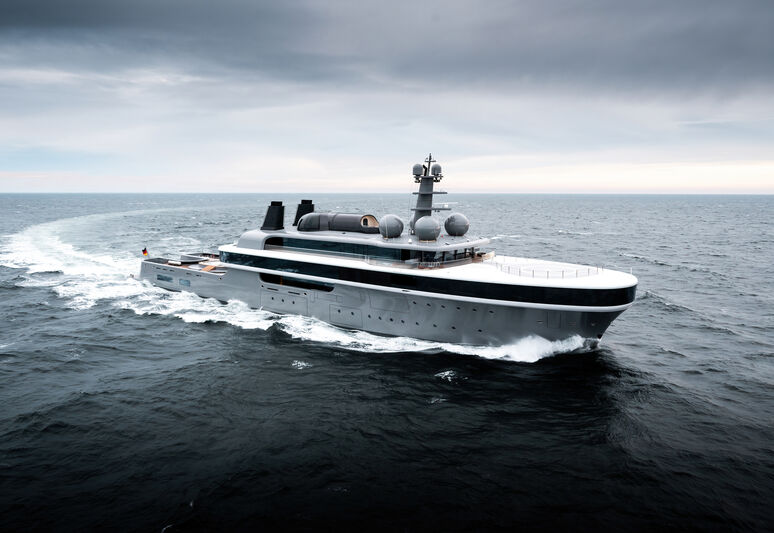
For years, the yacht was known simply as Project COSMOS, one of the German shipyard’s most intriguing projects. Now, after launch, sea trials and delivery, the 114.2-metre vessel has emerged under a new name and with a design that is every bit as unconventional as the original project promised.
Lürssen officially announced the delivery of NAUSICAÄ on May 23, 2026, closing the chapter on COSMOS and beginning a new one for the yacht.
COSMOS Becomes NAUSICAÄ
Project COSMOS first captured attention because it looked unlike the conventional Lürssen superyacht.
The concept was developed around the vision of Australian industrial designer Marc Newson, whose influence extends from the exterior architecture through to the yacht’s interior spaces. Rather than simply decorating a conventional yacht, Newson was given extraordinary creative freedom to rethink the vessel as an entire object.
The result is a yacht with remarkably few conventional visual cues.
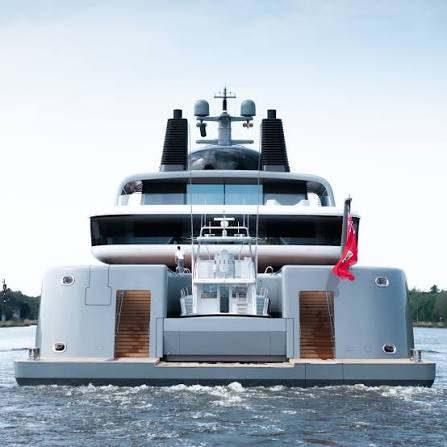
There are sweeping surfaces, extensive glass, unusual proportions and a distinctive upper structure that almost makes NAUSICAÄ appear more like a piece of futuristic architecture than a traditional yacht.
Lürssen describes the finished 114.20-metre yacht as being designed for world cruising, with an Ice Class 1D hull allowing operation in light ice conditions.
That gives the yacht a rather different purpose from simply moving between Mediterranean anchorages.
NAUSICAÄ was conceived to go much farther.
A Yacht Designed Around Exploration
One of the most fascinating aspects of NAUSICAÄ is how much of the design is dedicated to observation.
At the top of the yacht sits the extraordinary Skydome, a glass structure made from seven panes. It gives the owner an elevated panoramic space while becoming one of the yacht’s most recognizable external features.
Forward, an observation lounge sits beneath the helipad, while a glass band wraps around the upper deck.
Inside, the architecture continues the same philosophy.
A two-level atrium creates an unusual sense of vertical space, while the main deck incorporates an art gallery. The yacht also features a large owner’s suite, Japanese-inspired elements, entertainment spaces and areas that can change function depending on how the yacht is being used.
It is less about filling every available metre with conventional luxury and more about creating experiences around space, light and movement.
The 12.5-Metre Tender Has Its Own Garage
Perhaps one of the most extraordinary practical features is hidden at the stern.
NAUSICAÄ has a large dry dock capable of carrying a 12.5-metre sportfishing tender.
Rather than simply placing a tender on an exposed deck, Lürssen developed a bespoke launch-and-recovery system. The tender can be moved in and out of the yacht using a dedicated sledge system, after which the space can effectively become another sheltered outdoor area.
It is exactly the kind of feature that makes the yacht feel less like a floating hotel and more like a private expedition platform.
And Then There Was the Fuel-Cell Question
This is where the COSMOS story becomes particularly interesting.
The project had originally been associated with the idea of becoming one of the most ambitious demonstrations of alternative propulsion technology in a large private yacht.
The final NAUSICAÄ incorporates a methanol fuel-cell research installation, but the yacht’s primary propulsion architecture is described as a diesel-electric hybrid system, supplemented by a 2MW battery system. The fuel-cell installation converts methanol to hydrogen for onboard electricity generation.
That distinction matters.
COSMOS was frequently discussed in the context of methanol and fuel-cell technology, but the delivered yacht represents something more nuanced: rather than betting the entire vessel on one emerging technology, NAUSICAÄ combines established marine propulsion with electrification and an experimental fuel-cell installation.
For a yacht expected to travel across the world’s oceans, that may prove to be a more flexible technological strategy.
Built for the World
The Ice Class 1D reinforcement is another indication of the yacht’s intended range.
NAUSICAÄ is designed to operate in light ice conditions, while Lürssen says the vessel is capable of reaching all five major oceans and all seven continents.
That makes the yacht’s extraordinary size easier to understand.
This isn’t simply 114 metres of accommodation.
It is a platform for taking its owner almost anywhere.
The combination of the reinforced hull, substantial tender capability, helipad, observation spaces and expedition-oriented architecture makes NAUSICAÄ a particularly interesting example of where the modern explorer yacht has gone.
From German Shipyard to Japanese Owner
NAUSICAÄ was commissioned for Japanese entrepreneur Yusaku Maezawa, and even the name carries a personal cultural reference.
The yacht is named after the heroine of Nausicaä of the Valley of the Wind, the celebrated Studio Ghibli film.
It is an appropriate choice.
The character is associated with exploration, nature and a world where humanity exists in a complicated relationship with the environment — themes that resonate rather strongly with a yacht designed for global exploration while incorporating alternative-energy technology.
Where Is NAUSICAÄ Now?
And this is where the story gets particularly interesting for anyone who followed COSMOS.
After delivery, NAUSICAÄ crossed the Pacific. Public AIS tracking shows the yacht departing Honolulu on August 24, 2026, and arriving in Yokohama, Japan, on September 5 after a voyage of roughly 3,389 nautical miles. A subsequent AIS position placed her at Shinko Dock in Yokohama, where she was reported moored.
Public tracking also recorded NAUSICAÄ in Hawaiian waters shortly before that Pacific crossing. A superyacht tracker’s September 7 database listed the 114-metre yacht at rest in Hawaii.
So the former COSMOS has already begun doing exactly what she was designed to do: crossing oceans rather than simply appearing in one familiar cruising ground.
The End of COSMOS — and the Beginning of Something Else
Perhaps the most compelling part of the NAUSICAÄ story is that the yacht didn’t simply emerge as another enormous Lürssen.
COSMOS represented an idea.
NAUSICAÄ is the finished experiment.
The yacht combines Marc Newson’s almost architectural approach to design with Lürssen’s engineering, an Ice Class hull, an enormous tender facility, experimental fuel-cell technology, battery storage and a propulsion architecture capable of taking the vessel around the planet.
And despite all of that technology, it is the design that may ultimately become NAUSICAÄ’s defining legacy.
At 114.2 metres, she is enormous. Yet the yacht doesn’t rely on the traditional language of superyacht excess.
Instead, it tries something considerably harder: to make a yacht look like nothing that came before it.
COSMOS may have been the project name.
But NAUSICAÄ is the yacht that finally made the idea real.
—
DLifestyle Magazine Package
Title: From COSMOS to NAUSICAÄ: Lürssen’s 114-Metre Explorer Finally Reveals Herself
SEO Slug: lurssen-cosmos-nausicaa-superyacht-marc-newson
Tags: Lürssen, NAUSICAÄ, Project COSMOS, Marc Newson, Superyachts, Explorer Yachts, Yachts, Yachting, Luxury, Maritime Technology, Hybrid Propulsion, Yusaku Maezawa
Meta Description:
Lürssen’s former Project COSMOS has become NAUSICAÄ, a 114.2-metre Marc Newson-designed explorer yacht combining Ice Class capability, hybrid propulsion and futuristic design.
Featured Image Concept:
NAUSICAÄ underway in open ocean, photographed from an elevated three-quarter angle showing the yacht’s sweeping glass upper structure, distinctive Skydome and massive proportions, with dramatic open water surrounding the vessel.