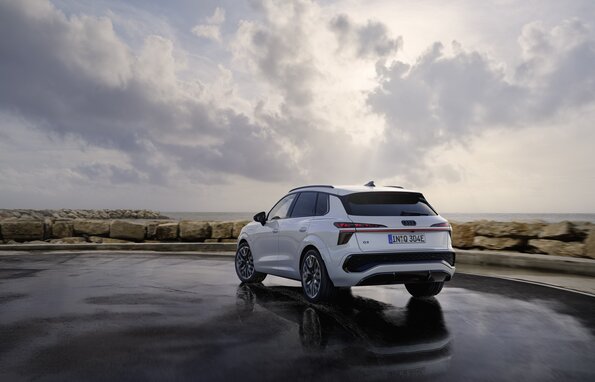
The premium subcompact crossover segment is hyper-competitive, but a recent review of the Audi Q3S on Driving Sports TV highlighted a crucial reality check: just because a vehicle wears an all-wheel-drive badge doesn’t mean it’s ready to conquer the wilderness. While the Q3 shines as an urban commuter and a tech-forward sanctuary, taking it into the rough stuff quickly exposes its mechanical boundaries.

If you are eyeing this crossover with visions of weekend trail-blazing, a few distinct engineering limitations along with some standout interior features deserve a closer look.
The Off-Road Reality Check
While the Q3 handles foul weather with aplomb, proper off-roading reveals three major pain points:
- Fixed Ride Height: The Q3 lacks an adjustable air suspension. Your ride height is entirely static. When attempting to clear steep banks, deep ravines, or jagged obstacles, you run a constant risk of scraping the front end. Over time, this structural vulnerability means you will inevitably chip away at the front bumper an expensive penalty for misjudging a trail.
- The “Three-Wheel” Struggle: The crossover’s suspension geometry isn’t fond of extreme articulation. When navigating uneven topography that forces one wheel completely off the ground, the Q3 reacts with a jarring, weird jerking motion as it moves forward. Whether this mechanical hesitation stems from driver input fighting the vehicle or the onboard software aggressively intervening to claw out of the spot, the transition is far from seamless.
- Software Glitches in the Dirt: Engaging the dedicated Off-Road mode reveals a frustrating tech oversight. Drivers have noted that the central inboard monitor can begin flashing awkwardly right over the speedometer area. While this visual distraction is far from ideal when navigating tricky terrain, it is a digital anomaly that Audi could easily remedy via a future firmware update.

A Masterclass in Ergonomics
Move inside, however, and the narrative flips entirely. The Q3’s cabin architecture is brilliantly executed, anchored by a subtly curved inboard monitor that anchors the digital cockpit.
[ Left Instrument Cluster ] —> ( Subtle Curve ) —> [ Central Inboard Monitor ]
(Speedometer) (Infotainment/Nav)
^ ^
└────────────────── Driver’s Field of View ──────────┘
By angling the display toward the driver, Audi has created a genuinely complete cockpit feel. Ergonomically, this means you are turning your head significantly less to check navigation or change settings. More importantly, the deliberate angling works wonders against ambient lighting, allowing you to fight far less glare when daylight streams through the side windows. It keeps critical data exactly where it should be: right in your field of view.
Under the Hood: How the Quattro System Handles the Power
To understand why the Q3 jerks when a wheel lifts, you have to look at how it manages traction. Because the Q3 is built on a transverse-engine architecture (where the engine sits sideways), it doesn’t use the permanent, mechanical center differential found in larger Audis. Instead, it relies on an electro-hydraulic, multi-plate clutch system commonly known as a Haldex coupling.
[ Transverse Engine ]
│
▼
[ Front Axle (Default 100% Power) ]
│
├─── [ Propeller Shaft ] ───► [ Haldex Multi-Plate Clutch ]
│
▼
[ Rear Differential ] ──► [ Rear Wheels ]
Under normal driving conditions, the system is fundamentally front-wheel drive, routing nearly 100% of the engine’s torque to the front axle to maximize fuel efficiency. The moment the onboard computer detects front-wheel slip—or senses aggressive throttle input—an electric pump instantly builds hydraulic pressure to compress the clutch pack in the rear differential unit. This engagement seamlessly redirects up to 50% of the available power to the rear wheels.

When a wheel leaves the ground entirely, the system must suddenly rely on the Electronic Stability Control (ESC) and brake-based torque vectoring. It clamps the brake on the airborne wheel to force power across the open axle to the tire with actual grip. That aggressive braking and sudden redirection of power is exactly what causes that unrefined, jerking motion on the trail. It is an engineering compromise: a system optimized for lightning-fast road stability, pushed past its comfort zone in the dirt.