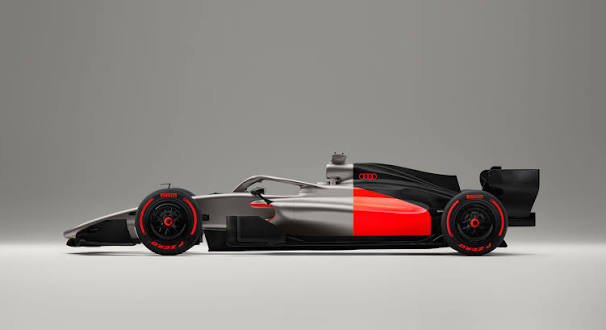
The transition into Formula 1 was supposed to be a masterclass in corporate precision, yet Audi’s takeover of Sauber has felt more like navigating a high-velocity minefield. With sweeping 2026 technical regulations reshaping the grid, the German titan finds itself in a trial by fire. Between corporate restructures, engine development hurdles, and token deployments, Audi’s inaugural campaign is testing every inch of its legendary motorsport lineage.
The Executive Pivot: Enter ADUO
At the heart of Audi’s operational reboot is the streamlining of its leadership umbrella under the high-performance ADUO framework the dedicated entity driving Audi’s strategic, commercial, and technical F1 operations.
                   AUDI F1 MANAGEMENT FRAMEWORK (ADUO)
                   ----------------------------------
   [Strategic Oversight]  ---> Mattia Binotto (COO & CTO)
   [Trackside & Race Ops] ---> Jonathan Wheatley (Team Principal)
   [Corporate Integration]---> Direct Audi AG Board Reporting Line
Replacing the fragmented dual-head structure of the early Sauber transition days, former Ferrari boss Mattia Binotto and ex-Red Bull sporting director Jonathan Wheatley now run the operational show. ADUO was established to slice through corporate red tape, allowing the race team in Hinwil and the engine facility in Neuburg to make real-time decisions without waiting on board meetings in Ingolstadt.
The Power Unit: Neuburg’s Maiden Engine & Token Strategy
Unlike legacy rivals who iteratively evolved existing hybrid architectures, Audi entered 2026 as a true works engine manufacturer. Their inaugural power unit—developed entirely in-house at the Audi Formula Racing facility in Neuburg an der Donau—features a 50/50 split between internal combustion energy and a massive 350kW MGU-K electrical deployment.
                 2026–2027 ENGINE & TOKEN ALLOCATION
                 -----------------------------------
   [Engine Manufacturer] ---> Audi Formula Racing GmbH (Neuburg)
   [2026 Development]    ---> Baseline Reliability & Active Aero Energy Maps
   [Token Deployment]    ---> 60% Consumed in Initial Homologation
   [2027 Upgrade Reserve]---> 40% Retained for ICE Thermal Efficiency & MGU-K Re-design
Under the FIA’s updated power unit homologation and performance-balancing framework, manufacturers utilize a token-based system to register structural upgrades. Audi strategically deployed roughly 60% of their allocated development tokens leading up to the 2026 season opener to ensure baseline reliability and software integration for the new active-aerodynamics modes.
Recognizing that raw electrical harvesting is where the gaps lie, Audi has explicitly banked its remaining token reserve for late-2026 and early-2027. This reserve is slated for a massive cylinder-head redesign and an upgraded MGU-K casing aimed at shedding weight and boosting thermal efficiency for their second-season engine specification.
Drivers’ Campaign: 2025 vs. 2026 Reality Check
Navigating a works transformation requires driver patience, but comparing 2025’s transition year under Kick Sauber to 2026’s official Audi debut highlights both step-by-step progress and the brutal depth of the midfield fight.
                   NICO HÜLKENBERG: SEASON COMPARATIVE
                   -----------------------------------
   2025 (Haas/Sauber Transit) : 11 Points | Peak Finish: P8 (Qualifying Specialist)
   2026 (Audi Works So Far)   :  6 Points | Peak Finish: P9 (Reliability Anchor)
Nico Hülkenberg has served as Audi’s steadying anchor. In 2025, driving for a transitioning squad, Hülkenberg squeezed every ounce of single-lap speed out of his machinery, routinely popping up in Q3 to snatch sporadic points finishes. In 2026, his role has pivoted to pure engineering feedback. While the Audi power unit suffers from early-stage battery deployment lag on longer straights, Hülkenberg’s veteran tire preservation and sharp racecraft have allowed him to salvage hard-fought P9 and P10 finishes.
                   GABRIEL BORTOLETO: SEASON COMPARATIVE
                   -------------------------------------
   2025 (F2 Champion / Rookie) : Champion Title | High-Downforce Dominance
   2026 (Audi Works So Far)    : 2 Points       | Steep Active-Aero Learning Curve
For Gabriel Bortoleto, the contrast is even starker. Entering F1 fresh off a brilliant 2025 Formula 2 championship campaign, the young Brazilian went from dominating high-downforce spec cars to wrestling a brand-new hybrid power unit under active-aero rules. While 2025 was about aggressive overtakes, 2026 has been an intense masterclass in energy management and harvest mapping. Despite a couple of early-season electrical retirements, Bortoleto scored his maiden F1 points with an impressive, measured drive in wet conditions, proving his raw ceiling remains sky-high.
The Horizon
Audi’s entry into Formula 1 was never going to yield overnight podiums. Yet, with ADUO providing organizational clarity, a clear token deployment strategy for 2027, and a driver pairing that balances elite experience with youth, the foundation is quietly hardening behind the scenes. The road to the front is long, but the rings have officially arrived.