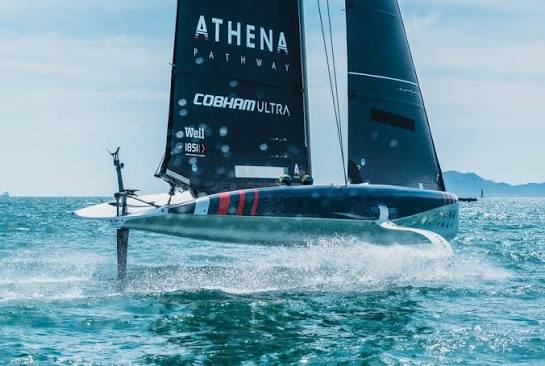
There is something different about watching Athena Pathway race.
This isn’t traditional yacht racing.
There is no leisurely sail around the course, no long offshore passage where endurance is measured in hours and days. Athena Pathway operates in the much more aggressive world of high-performance foiling, where an AC40 can lift itself above the water and travel at speeds approaching 100 km/h.
And heading into the second Preliminary Regatta of the 38th America’s Cup cycle, the British women’s and youth programme has already shown that it belongs in the conversation.
But there is a bigger story developing behind the racing.
Athena Pathway is becoming a technology and talent pipeline.
And the next time we see the team race, it will be under a new name.
Athena Pathway Has Evolved
The programme was established by Hannah Mills and Sir Ben Ainslie in 2022 with a very specific objective: create a pathway for British female and youth sailors into the highest levels of foiling competition.
That programme has now evolved.
In August 2026, the women’s America’s Cup team was given a new identity:
Cobham-Ultra GB2.
Athena Pathway remains the development programme behind the operation, while GB2 becomes the home of Britain’s elite women’s America’s Cup athletes.
That change isn’t simply cosmetic.
It creates a clearer structure between the development programme and the elite racing operation, with the ultimate goal of creating a pathway from youth sailing into GB2, GB1 and even the Emirates GBR SailGP team.
And the next opportunity to see that pathway operating at full speed is coming very soon.
The Next Race: Naples
The second Preliminary Regatta of the 38th America’s Cup takes place in Naples from September 24–27, 2026.
Thursday, September 24 is the official practice day, with fleet racing beginning Friday. Racing continues through Saturday before the final fleet races and winner-takes-all match race on Sunday.
This is particularly significant because Naples isn’t just another stop on the calendar.
It is the venue for the 2027 America’s Cup.
The teams aren’t simply racing there.
They’re learning it.
The wind.
The waves.
The geography.
The timing of the breeze.
The best lines around the course.
Every piece of information gathered now potentially becomes useful next year.
For Athena Pathway, this makes September’s regatta much more than another competition.
It is reconnaissance at racing speed.
Sardinia Gave Us the First Real Look
Athena’s first major test of the new America’s Cup cycle came in Cagliari, Sardinia, in May.
The results were mixed—but extremely encouraging.
The team suffered a capsize early in the regatta, but then recovered strongly enough to take a fleet-race victory.
Hannah Mills and Ellie Aldridge were at the controls, with Matt Beck and youth programme graduate Sam Webb trimming.
The victory was particularly significant because the women and youth sailors were racing on equal footing against the senior America’s Cup squads in identical AC40 machinery.
In other words, Athena wasn’t there simply to make up the numbers.
They were racing.
And winning races.
Hannah Mills Remains the Benchmark
If one sailor continues to define Athena Pathway, it is Hannah Mills.
The Olympic champion brings something to the programme that cannot simply be reproduced in a simulator or generated by data.
Experience.
Mills was already one of the world’s elite sailors before Athena existed, and she now combines that experience with the unique demands of foiling America’s Cup racing.
She is also part of the championship-winning Emirates GBR SailGP programme, giving her exposure to another of sailing’s most technologically advanced racing environments.
That makes Mills more than a helm.
She is effectively one of the links between Olympic sailing, America’s Cup racing and SailGP.
And that experience is being transferred down through the programme.
Ellie Aldridge Could Be the Difference
Then there is Ellie Aldridge.
Her background is particularly interesting because she didn’t arrive through a conventional America’s Cup route.
Aldridge became the first Olympic champion in women’s Formula Kite at Paris 2024, bringing a completely different understanding of foiling and high-speed boat control.
That matters.
The AC40 isn’t sailed like a conventional yacht.
The sailor is effectively managing a flying platform, where balance, ride height, control systems, wind shifts and crew communication have to work almost simultaneously.
Aldridge’s experience with high-speed foiling gives Athena another dimension.
The team itself describes her Formula Kite background as an important part of the combination of skills being developed within the programme.
And if Mills supplies the experience, Aldridge may represent part of the next generation of Britain’s high-speed sailing talent.
Watch Sam Webb
If you’re looking for someone who has quietly made an impression, I’d keep an eye on Sam Webb.
He is only 20.
And his route into the AC40 was remarkably quick.
Athena’s 2026 trial programme began with 158 applicants. Twenty-one were selected for simulator trials, with 13 eventually forming the core development squad.
Webb emerged from that process and earned his place aboard the AC40 for Sardinia.
What makes him interesting isn’t simply his age.
It’s his approach.
Webb describes himself as highly technical and heavily interested in data. As a trimmer, he is constantly working with the numbers behind the boat, particularly its heel and balance.
That may sound like a small detail.
It isn’t.
When an AC40 is flying above the water at high speed, maintaining the correct platform is everything.
A tiny change in trim can alter the boat’s balance.
A poor manoeuvre can cost metres.
A small loss of ride height can become a complete loss of flight.
Webb is learning to interpret those changes in real time.
That is exactly the kind of sailor modern America’s Cup programmes are trying to create.
The Boat Is Becoming a Computer
This is where Athena Pathway gets particularly interesting.
From the outside, the AC40 looks like an extraordinarily fast sailing yacht.
Inside, it is something else entirely.
Boat Captain Sophie Heritage has described an environment containing extensive hydraulic and electronic systems, GPS, high-tech compasses and three large lithium batteries.
There is relatively little traditional rope work compared with conventional sailing.
Instead, the sailors are interacting with a highly automated and electronically managed platform.
That means the modern America’s Cup sailor increasingly needs to understand engineering.
Not necessarily become an engineer.
But understand the machine.
Know what the hydraulics are doing.
Understand the electronics.
Read the data.
Recognise when something isn’t behaving normally.
And communicate that information immediately.
That is a very different definition of a sailor.
Ride-Height Control Is One of the Biggest Technological Changes
One of the most fascinating pieces of technology surrounding the AC40 is its automated ride-height control.
The 38th America’s Cup preliminary regattas are being sailed in equalised AC40s with ride height controlled by an autopilot system.
That is important because foiling is fundamentally a balance problem.
The boat has to fly.
But it cannot simply fly higher and higher.
Too low and the hull risks touching the water.
Too high and stability and control become compromised.
The control system therefore becomes another part of the racing equation.
The sailors still have enormous influence over performance, but the boat’s control architecture is doing something that would have been almost unimaginable in traditional sailing.
It is effectively helping manage a flying yacht.
Simulation Is Now Part of the Athlete
Athena’s use of simulation is another area worth watching.
The programme has used simulator-based selection and training from the beginning, with candidates tested before being placed into the AC40 environment.
That isn’t simply about learning which button does what.
It allows sailors to make mistakes without destroying a £1 million-plus racing platform.
The simulator also allows the team to examine decision-making, reactions and performance before moving those sailors onto the real boat.
Athena has previously described its simulator as a critical part of developing the skills required before getting on the AC40.
And now that the programme has a larger pool of young sailors moving through the system, that technology becomes even more valuable.
Data Is Becoming the New Tactician
Another major change across high-performance sailing is the amount of information being collected.
Wind.
Boat speed.
Heading.
Heel.
Ride height.
Foil behaviour.
Hydraulic pressure.
Battery status.
System performance.
The modern America’s Cup boat generates an enormous amount of information.
The difference between teams increasingly isn’t simply who has the fastest boat.
It is who understands the information fastest.
Athena’s emphasis on young sailors who are comfortable with data is therefore no accident.
The next generation isn’t being trained simply to pull harder on a rope.
They’re being trained to interpret a machine.
And the Technology Doesn’t Stop at the Boat
Athena Pathway is also developing people for roles away from the helm.
The programme specifically identifies opportunities in electronics, engineering, data analysis and boat building.
That may ultimately be one of the programme’s most important achievements.
The America’s Cup needs sailors.
But it also needs people who can design, maintain, repair, analyse and improve the machines.
Three young people were recently embedded within the elite British America’s Cup shore crew, gaining direct experience with AC40 hydraulics, electronics and technology.
That’s a very different kind of sporting academy.
It’s part sailing team.
Part engineering school.
Part technology incubator.
What About Changes to the Vessel?
This is where we have to be careful.
Unlike a Formula 1 team, Athena cannot simply turn up to Naples with a completely redesigned AC40.
The AC40 is a one-design platform, and the preliminary regattas are deliberately structured around equalised boats.
That means Athena’s biggest gains are more likely to come from setup, crew configuration, technique, software/control understanding, data analysis and operational efficiency than from simply producing a secret new hull.
The programme itself has not publicly announced a major new Athena-specific AC40 hardware package ahead of Naples.
And that is important.
If you see claims that Athena has suddenly produced a radically redesigned AC40, treat them carefully.
The real development is happening in how the team operates the boat.
The Hidden Weapon: The Shore Team
Sophie Heritage might not be the name casual fans immediately associate with Athena.
But her role is crucial.
As Boat Captain, she is responsible for ensuring the AC40 is ready to perform, including system checks and coordination across departments.
She describes herself as a “specialised generalist”—someone who understands enough of the hydraulics, electronics, maintenance and boat systems to connect the different departments together.
That is exactly what a modern high-performance race programme needs.
Because when you’re racing a machine this complicated, the race doesn’t begin when the starting gun fires.
It begins hours earlier.
The Technology Race Is Bigger Than Athena
And this is where the wider America’s Cup becomes fascinating.
The AC40 and AC75 programmes are part of a broader movement in marine racing toward:
foiling.
automated control systems.
composite structures.
advanced sensors.
real-time data analysis.
high-performance batteries.
hydraulic systems.
simulation.
computational modelling.
Even SailGP’s F50 programme demonstrates how far this technology has progressed. SailGP’s F50s exceed 100 km/h, while the league continues to develop carbon structures, control systems and sophisticated technical support operations.
The technology is moving quickly enough that sailing is beginning to look less like traditional yacht racing and more like motorsport on water.
And that’s probably the most interesting thing about Athena Pathway.
They’re not simply learning how to sail faster.
They’re learning how to operate the next generation of racing machines.
Naples Could Tell Us a Lot
The Sardinia result proved Athena could win.
Naples needs to show whether they can repeat it.
That is a very different challenge.
One race win can come from conditions.
A championship campaign requires consistency.
The Bay of Naples will also give the teams their first serious competitive look at the waters where the 2027 America’s Cup will ultimately be decided.
The pressure will be higher.
The fleet will be deeper.
And the data collected will be more valuable.
For Athena, this is another step toward the Women’s and Youth America’s Cup competition in 2027.
And for the programme itself, it represents something bigger.
The goal isn’t simply to create one successful women’s team.
It’s to create a pipeline.
From youth sailor.
To AC40 sailor.
To Women’s America’s Cup.
To senior America’s Cup.
To SailGP.
That is why Athena Pathway deserves attention beyond the race results.
The Verdict
Athena Pathway has already done something significant.
It has taken sailors from backgrounds including Olympic sailing, Formula Kite and youth racing and placed them inside one of the most technically demanding racing environments in the world.
Hannah Mills remains the established benchmark.
Ellie Aldridge brings elite foiling experience.
Matt Beck provides continuity from the previous youth programme.
And Sam Webb is exactly the kind of young, technically minded sailor the programme was designed to uncover.
Now comes Naples.
September 24–27.
The boats will fly.
The data will pour in.
The crews will be pushed to their limits.
And for the first time, we will get another serious indication of whether Athena’s development work is translating into genuine America’s Cup performance.
The fascinating part is that the future of sailing may already be sitting inside that cockpit.
Not just in the sailors.
Not just in the boat.
But in the relationship between the two.
The America’s Cup is becoming a battle between people and machines—and Athena Pathway is building a generation that understands both.