To understand the Apollo EVO’s exhaust, you have to look past the aesthetics and realize it is a geometrical impossibility made real through additive manufacturing. It isn’t just an exhaust; it’s a heat-exchanging structural component.
The “Dragon Skin” Micro-Geometry
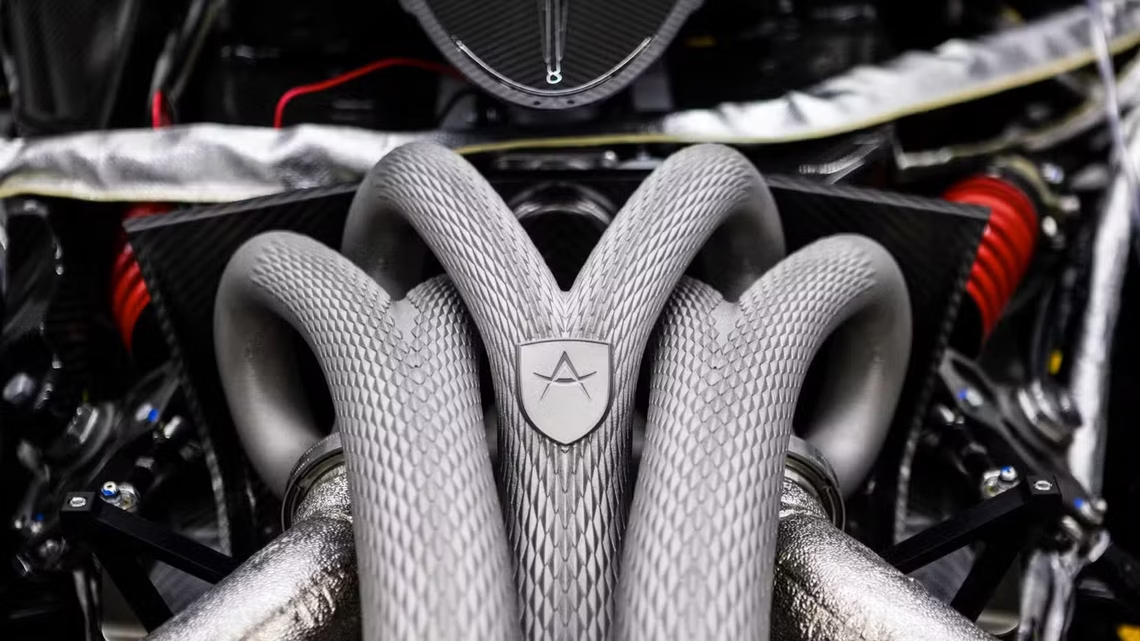
The texture on the tubes is a proprietary laser-sintered finish. While it mimics the scales of a reptile to fit the “Dragon” design language of the car, its primary function is Thermal Management via Surface Area Maximization.

- Boundary Layer Turbulence: By creating a non-smooth surface, the scales create “micro-vortexes” in the air passing over the exhaust. This prevents a stagnant layer of hot air from clinging to the titanium, effectively “scrubbing” the heat away more efficiently than a smooth pipe.
- Radiant Cooling: The “peaks” and “valleys” of the scales increase the total surface area of the exhaust by roughly 25-30% compared to a flat cylinder of the same diameter. This allows the aerospace titanium to shed heat faster, protecting the surrounding carbon-fiber subframe from the 1,000°C V12 exit temperatures.
The Central Emblem: The Heart of the “Hydra”
The most striking feature is how the six-into-one collectors from each cylinder bank converge at the rear center. This isn’t just a junction; it’s a structural anchor for the car’s visual identity.

- The Convergence: The 12 individual headers (six per side) are routed with millimeter precision to meet at a central point. Because the system is 3D-printed as a monoblock, there are no heavy flanges or ugly clamps at this junction. It looks like the tubes are “growing” out of the central emblem.
- The Apollo Insignia: The logo isn’t just glued on it is often integrated into the printed structure itself. It sits at the absolute “heart” of the rear fascia, framed by the six-tip exit array.
- Thermal Expansion Logic: By centering the “snake” bundle around a single focal point, engineers can more easily predict and manage the thermal expansion of the metal. As the titanium heats up and expands, the symmetrical “tangle” allows the metal to move outward from the center without putting uneven stress on the engine mounts.
Backpressure and the “Sonic Signature”
The length of those “snakes” is calculated to a specific frequency. By weaving the tubes into that tangled shape, Apollo’s engineers achieved the optimal primary tube length required for exhaust scavenging.

This ensures that the pulses from the V12 don’t just exit the car; they pull the following pulse along with them. The result is a high-pitched, F1-adjacent “scream” that is amplified by the resonant properties of the thin-walled, 3D-printed titanium. It’s grounded, technical luxury that sounds like a mechanical banshee.