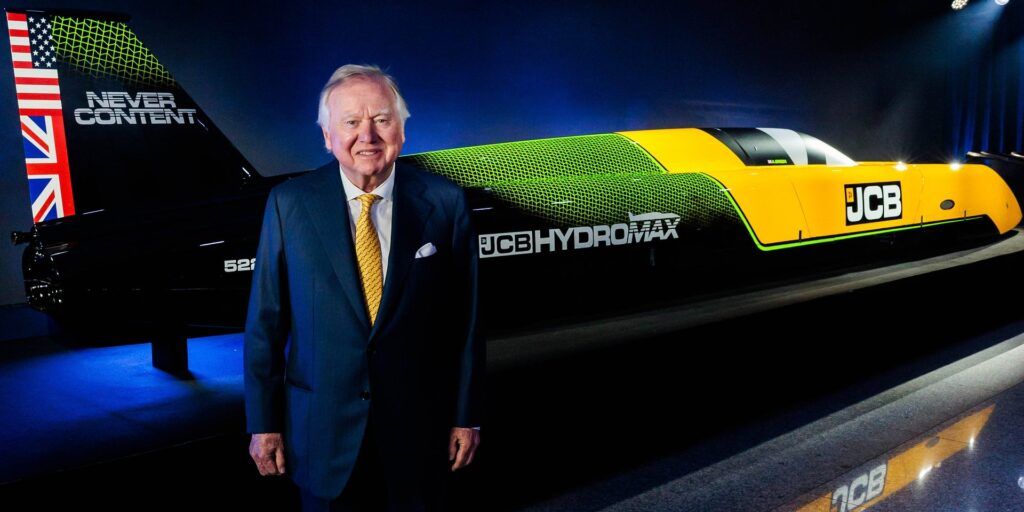
Twenty years after the JCB Dieselmax etched its name into the salt crust of Utah, the Bamford family and the “fastest man on earth,” Wing Commander Andy Green, are returning to the Bonneville Salt Flats. This isn’t just a nostalgic lap; it’s an engineering offensive. The target is the world land speed record for a hydrogen-powered vehicle, utilizing a machine that pushes the limits of zero-emission internal combustion.
The Engine Makeup: 1,600bhp of Elemental Power
At the heart of the new JCB Hydromax are two production-based hydrogen internal combustion engines. This is a critical distinction from fuel-cell technology (which uses hydrogen to create electricity); these are high-performance variants of the engines JCB has spent £100 million developing for their heavy machinery.

- Twin-Power Configuration: The 32-foot streamliner houses two modified hydrogen units, delivering a combined 1,600bhp.
- Production Roots: By using production-based blocks, JCB is proving that hydrogen isn’t just a laboratory curiosity but a robust, high-torque solution for heavy-duty applications.
- Dual-Engine Sync: Much like the original Dieselmax, the Hydromax utilizes a dual-engine setup to drive both the front and rear axles, effectively providing a four-wheel-drive platform to maximize traction on the slick, unpredictable salt surface.
The Body: Designed for a “Zero-Drag” Profile
To exceed 350mph, horsepower is only half the battle; the rest is a war against the atmosphere. The Hydromax is a 9.75-meter (32-foot) streamliner designed with a singular focus on piercing the air with minimal disturbance.

- Lighter & Leaner: The Hydromax is significantly lighter than the 2.7-ton Dieselmax. Modern composites and advanced material testing likely utilizing the same airflow simulation tech seen in F1 and high-end automotive circles have allowed for a more agile chassis.
- The “Ice-Box” Cooling: To eliminate the massive drag created by traditional radiators, the vehicle likely retains the “total loss” cooling system pioneered by its predecessor. This involves a tank filled with water and ice to cool the engines during the high-intensity, five-mile sprint, removing the need for air intakes that would ruin the aerodynamic profile.
- Straight-Line Stability: The ultra-long wheelbase and vertical tail fin are essential for keeping the car tracking true. At 350mph+, any minor oscillation can lead to a catastrophic “tank-slapper” on the salt.
The Standing Record: The Ghost of 2006
The primary motivation for this return is the unfinished business of the JCB Dieselmax. On August 23, 2006, Andy Green piloted that yellow beast to a speed of 350.092 mph.
“Twenty years ago, JCB took two of its diesel engines, sprinkled some magic engineering dust on them and put them into a racing car… today, that car is still the fastest diesel-engined vehicle in history.” Andy Green
The FIA-governed diesel record set that day remains the last major standing record from JCB’s initial Bonneville era. The Hydromax isn’t just chasing the current hydrogen record (currently held by the fuel-cell Buckeye Bullet 2 at 302mph); it is aiming to eclipse the internal benchmark set by its diesel ancestor. By smashing through the 350mph barrier with hydrogen, JCB aims to prove that the shift to sustainable power doesn’t mean leaving the era of raw, mechanical speed behind.