The Lifestyle

The Unfilled Gap: Fashion’s Quest for the New Chimère

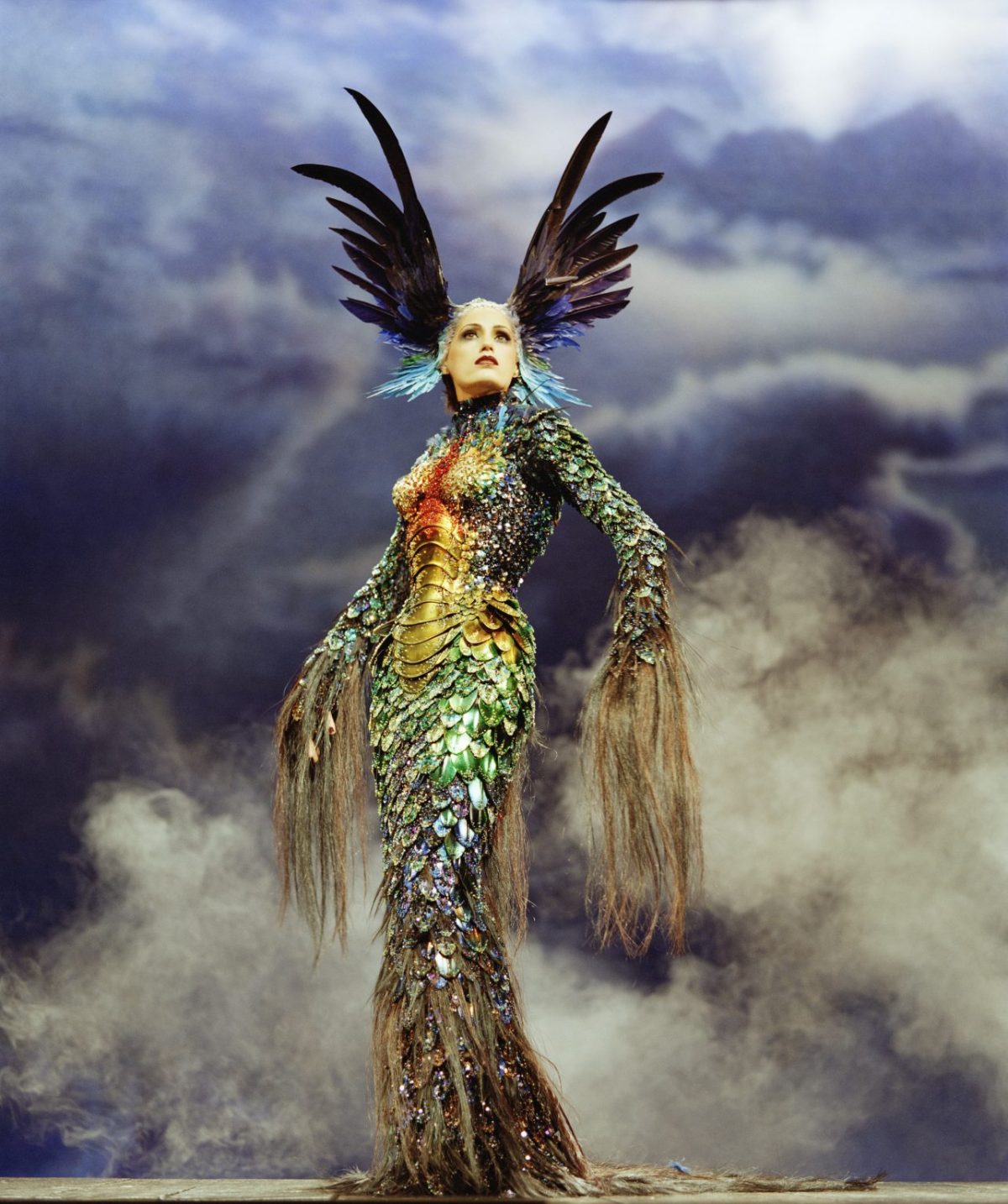
In the pantheon of haute couture, few garments achieve the status of legend. Thierry Mugler’s “Le Chimère” is one such artifact a masterpiece that redefined the boundaries of human form and wearable art. As one observer poignantly noted, the garment remains an enigma of visual storytelling:

“The Chimère rival… I’ve never seen anything quite like it. It’s The Fifth Element meets Angelina Jolie’s Maleficent. The colors remind me of a harpies angel.”

This description captures the exact friction that made the 1997 creation so jarringly beautiful: the collision of high-concept sci-fi, dark fairy-tale villainy, and the avian ferocity of a mythical harpy. It was a synthesis of the organic and the synthetic that took two years of painstaking craftsmanship to build and present.

Yet, decades later, a void persists. In an era of viral “fast-couture” and digital spectacles, the industry is still searching for a successor someone to fill the gap left by that specific brand of metamorphic beauty.

The McQueen Inheritance

If anyone had the currency to “fill the gap,” the industry consensus often lands on the late Alexander McQueen. McQueen didn’t just design clothes; he built mythologies.

From the aquatic, extraterrestrial silhouettes of Plato’s Atlantis (Spring/Summer 2010) to the haunting, ethereal fragility of the Bird’s Nest headdress (Autumn/Winter 2006), McQueen possessed the specific alchemy required to rival the Chimère. Like Mugler, he understood that fashion is at its best when it feels “truly never before seen” when it moves beyond the garment and into the realm of the biological.

Plato’s Atlantis, with its digitally printed reptilian patterns and the iconic Armadillo boots, felt like the spiritual evolution of the Chimère’s scales. Meanwhile, his obsession with taxidermy and feathers echoed the “harpy angel” aesthetic, blending the divine with the predatory.

The Modern Curators: Who Can Fill the Gap?

The question remains: “How much longer will the gap go unfilled?” While the legends have passed, a new generation of curators is alive and well, currently building the foundations for what might be the next “two-year masterpiece.”

  • Iris van Herpen: Perhaps the most direct successor to the “sci-fi/organic” hybrid. Van Herpen uses 3D-printing and “magnetic motion” to create gowns that look like they are breathing. Her work captures the Fifth Element aesthetic better than anyone alive, turning the wearer into a trans-human entity.
  • Daniel Roseberry (Schiaparelli): Roseberry has reclaimed the “villainous” power of the runway. By blending anatomical gold casts with surrealist taxidermy, he channels the same intimidating energy as Maleficent. He understands that couture must be an object of display and dislocation.
  • Robert Wun: A rising titan in the couture world, Wun creates “cinematic” fashion. His work, which often features “burnt” silks and “blood-splattered” crystals, captures the emotional intensity McQueen was known for. He builds worlds, not just collections, and his “harpy-like” sculptural silhouettes suggest he has the patience to chase a legend.
  • Casey Cadwallader (Mugler): As the current steward of the Mugler house, Cadwallader is bridging the gap by using architectural technology and fabric development to bring the “Chimère” energy back to earth, making the impossible silhouettes of the past wearable for the modern “robot woman.”

The Two-Year Standard

The challenge for these modern houses is the “Chimère Metric.” “Le Chimère” took two years to construct, involving thousands of scales and feathers applied by hand. In today’s accelerated fashion cycle, few designers are afforded the luxury of time to let a concept gestate so completely.

However, over the next 20 years, as technology merges further with traditional hand-craft, the gap may finally close. Until then, we wait for that singular moment where craftsmanship and “monstrous” beauty align perfectly once more.