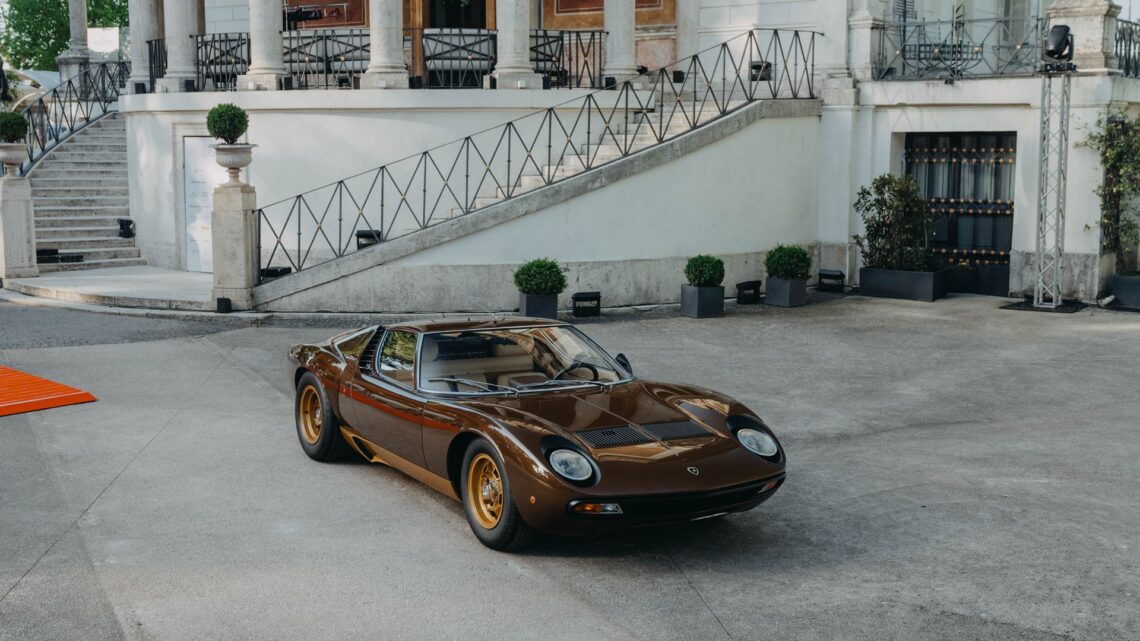
There is a specific kind of madness reserved for the restoration of a 1972 Lamborghini Miura SV. It is not merely about fixing a car; it is an archaeological dig into the peak of Italian automotive history. When a late-model SV undergoes a meticulous, three-year ground-up restoration, it isn’t just returning to the road it is reclaiming its title as the most important supercar ever built.

For the “Pinkies Down” enthusiast, the ’72 SV represents the perfect intersection of raw, mid-engine violence and refined, heritage-driven luxury. Here is why this specific year, and the grueling journey to restore it, matters.
The “Split-Sump” Grail: Mechanical Perfection
The primary focus of any serious 1972 restoration is the legendary split-sump lubrication system.
In earlier Miuras, the engine and gearbox shared the same oil a design flaw that meant metal shavings from the gears could circulate through the V12’s delicate internals. By 1972, Lamborghini solved this. A three-year restoration ensures that this split system is calibrated to modern tolerances. It allows for different oil viscosities for the transaxle and the $385$ hp engine, making the ’72 models the only Miuras that can truly be driven hard without the constant ghost of mechanical failure over your shoulder.
The Aesthetic Reset: Losing the “Eyelashes”
A true restoration honors the SV’s departure from the “eyelashes” of the earlier P400 models. While some miss the black slats around the headlights, the SV restoration focuses on that cleaner, more aggressive front fascia.

More importantly, a three-year project spends months perfecting the wide-body stance. The rear fenders of the SV were flared by 13 centimeters to fit wider Pirelli rubber. Getting those lines perfect requires a level of metalwork that borders on sculpture; it’s about capturing that “Coke-bottle” silhouette that defines 1970s masculine modernity.
Interior: The “Invisible Luxury” of 1972
Restoring a ’72 SV interior is an exercise in restraint. The goal isn’t to make it look “new,” but to make it look correct.
- The Materials: Utilizing period-correct leathers that lack the over-processed shine of modern luxury cars.
- The Tech: In 1972, factory air conditioning became a viable option. Restoring these systems to work in modern climates (like the humidity of the Caribbean) is a feat of engineering in itself.
It’s the automotive equivalent of a perfectly worn-in Visvim jacket—it looks effortless, but the quality is undeniable.
Why the Three-Year Timeline?
You cannot rush a legend. A three-year timeline usually breaks down into:
- Year 1: The Strip & Scan. Every nut, bolt, and weld is documented. The magnesium wheels (fragile by nature) are X-rayed for cracks.
- Year 2: The Heartbeat. The 3.9L V12 is blueprinted. The four triple-choke Weber carburetors are rebuilt to ensure that iconic, visceral scream at $7,850$ RPM.
- Year 3: The Marriage. The body is reunited with the chassis. This is where the “relaxed yet refined” spirit comes to life, ensuring the car doesn’t just sit in a museum but is capable of a 1,000-mile rally.
The Verdict: Substance Over Hype
The 1972 Miura SV is the “mic drop” of the Miura line. It was the fastest production car in the world at its launch, hitting 290 km/h (180 mph), and only about 150 were ever made.
A restored SV is a rejection of the “new money” obsession with wings, screens, and plastic. It is raw, it is loud, and it is authentic. It’s a reminder that while modern tech is impressive, nothing beats the soul of a split-sump V12 screaming through a winding coastal road.