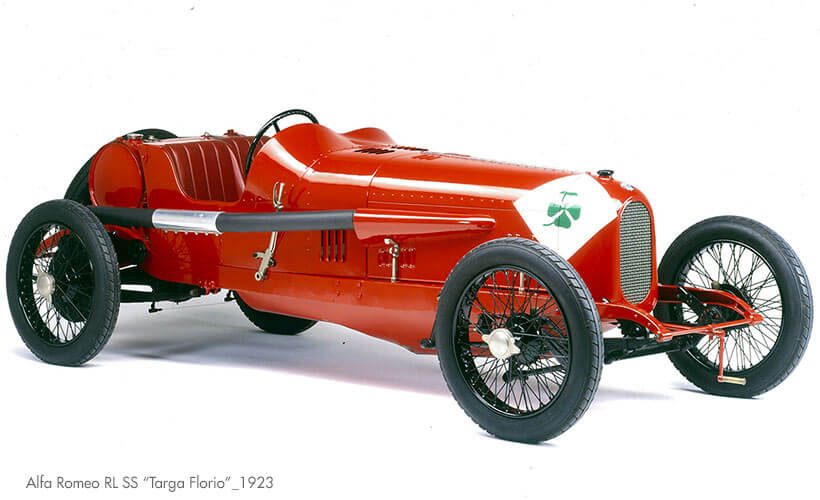
In the 1920s, Enzo Ferrari did not just drive for Alfa Romeo; he learned to speak its language. It was a dialect of cast iron, burning castor oil, and the high-tension shriek of an inline-eight at full song. But for Enzo, the language of the driver was never quite enoughhe wanted to be the one who wrote the script.
The Driver’s Patois: 1920–1924
When Enzo first pulled on his leather helmet at Alfa Romeo, he was a man of action. To be a driver in the wake of the Great War was to be a translator of violence. On the white-knuckle gravel of the Targa Florio, the “language” was one of physical feedback: the vibration through the steering column, the smell of a slipping clutch, and the gut-check of a late-braking corner.

Enzo was a good translator taking second in 1920 but he was frustrated by the limitations of the role. A driver was merely a user of a machine. He began to realize that while the driver felt the car, the engineer knew the car.
The Engineer’s Syntax: 1925–1929
As the decade progressed, Enzo pivoted. He spent less time in the cockpit and more time in the Portello workshops in Milan. He began to master the syntax of the factory floor. He wasn’t a formal engineer by degree, but he possessed a predatory instinct for talent.

He learned that a race was won months before the green flag, in the way a crankshaft was balanced or how a carburetion jet was tuned. He became the bridge between the visceral needs of the pilot and the cold calculations of the designer. By luring the brilliant Vittorio Jano away from Fiat to Alfa Romeo, Enzo proved he understood the most important language of all: the language of power. He had moved from being a “speaker” of the car to being its “author.”
The Birth of the Scuderia: A New Vocabulary
By 1929, the internal politics of Alfa Romeo began to feel like a cage. Enzo had a vision for a team that didn’t just represent a manufacturer, but lived for the sport itself. He wanted a “Scuderia” a stable where he could combine his driver’s soul with his engineer’s brain.

He founded Scuderia Ferrari in Modena while still tethered to Alfa. It was a revolutionary concept: a private racing arm that would handle the logistics, the tuning, and the “dirty work” for the factory. This was the moment the language changed forever. No longer was he just an employee; he was a proprietor.
When Alfa Romeo eventually pulled out of direct racing due to financial strain in 1933, they handed the keys of their racing department to Enzo. He had inherited the throne because he was the only one who spoke the language of victory fluently. He took the “Prancing Horse” a symbol of a fallen fighter pilot and pinned it to the red flanks of his Alfas.
It was no longer just an Alfa Romeo engine. It was an engine tuned by Ferrari, driven for Ferrari, and destined to eventually bear only the name Ferrari. The dialect of the student had finally become the language of the master.