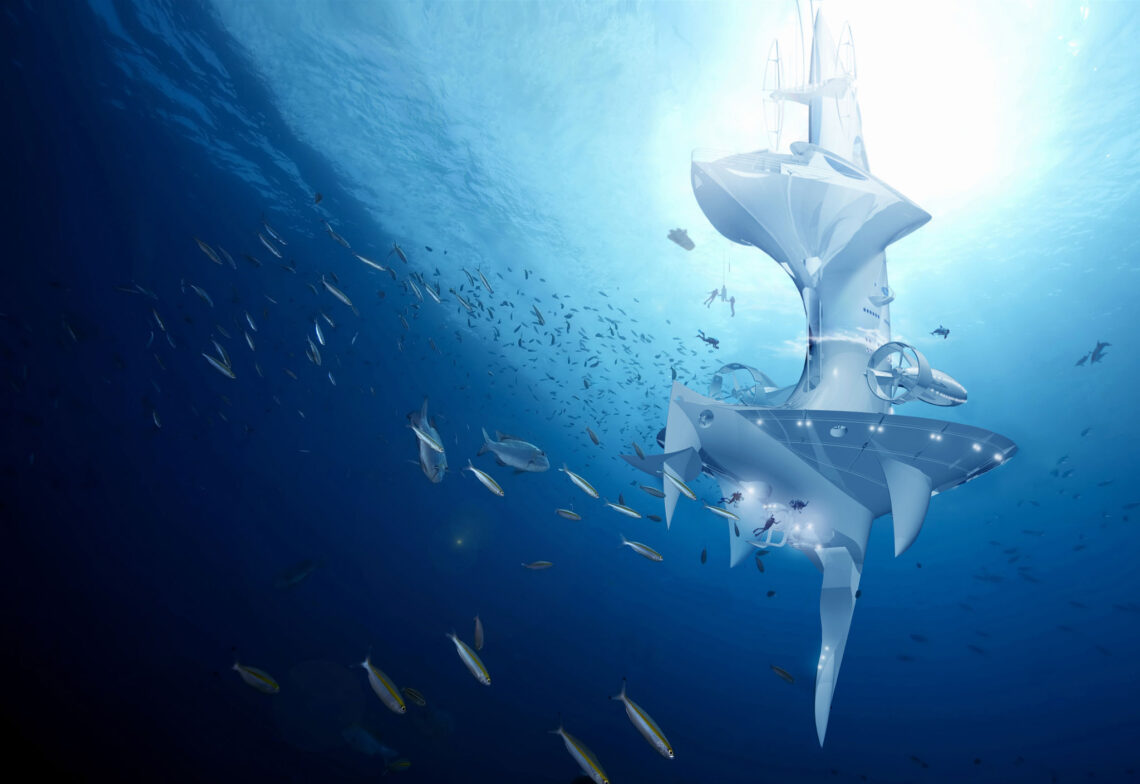
In the high-stakes world of ocean exploration, the SeaOrbiter stands as a radical departure from everything we know about naval engineering. While traditional vessels fight the ocean’s surface, the SeaOrbiter conceived by visionary French architect and academician Jacques Rougerie is designed to inhabit the water column itself.

Often described as a “cross between a skyscraper and a space station,” this vertical nomad is redefining the “transmersible” category: a vehicle that doesn’t just pass through the water, but exists in a permanent state of semi-submersion.
The Architecture of the Abyss
The SeaOrbiter’s design is as much about biological mimicry as it is about engineering. Standing at 58 meters (190 feet) tall, more than half of the structure (31 meters) remains submerged at all times.


- Vertical Stability: Unlike a traditional horizontal hull that rolls with the waves, the SeaOrbiter’s verticality and deep ballast allow it to remain remarkably stable even in heavy seas. It drifts with the great ocean currents like a giant, controlled piece of plankton.
- The Pressurized Frontier: One of its most innovative features is the hyperbaric living quarters. A segment of the crew (often called “aquanauts”) can live at a pressure equal to the depth of the ocean outside. This allows them to exit the vessel directly into the water for research and re-enter without the need for time-consuming decompression a “locked-in” lifestyle similar to astronauts on the ISS.
- Eyes Under the Waves: The submerged levels feature massive, high-pressure panoramic windows that offer a 24/7 view of marine ecosystems, providing a continuous observational window that traditional submarines cannot match.
Recent Updates: The Path to 2026
While the SeaOrbiter has faced significant funding hurdles over the last decade (with a price tag exceeding $50 million), 2024 and 2025 saw a resurgence in momentum.


- The “Eye” and Technical Readiness: The “Eye of SeaOrbiter” the vessel’s massive upper communication and observation block was completed as a proof of concept. As of early 2026, the Jacques Rougerie Foundation has been leveraging this technical milestone to secure new maritime partnerships.
- Renewed Focus on Blue Carbon: With the global shift toward “Blue Economy” initiatives, the project is being repositioned as a critical tool for studying carbon sequestration in the deep ocean.
- The “Year of the Sea” (2025-2026): Jacques Rougerie has recently been active at major international forums, including the UN Ocean Conference in Nice, advocating for the SeaOrbiter as a “sentinel of the seas.” The project has also integrated with the 2026 International Architecture and Innovation Competition, inviting a new generation of engineers to help refine its sustainable energy systems (wind, solar, and wave power). Find out more.
Why It Matters
The SeaOrbiter represents a bridge between two worlds. It uses a recycled aluminum-magnesium alloy for its hull, pushing the boundaries of sustainable “extreme environment” architecture. For a publication like yours that focuses on the intersection of luxury and cutting-edge lifestyle, the SeaOrbiter isn’t just a research boat; it’s a prototype for future submerged real estate.
If the 20th century was about conquering the surface, the SeaOrbiter suggests that the 21st will be about living within the blue.