The Lifestyle - Travel

Splash down!

SAN DIEGO, CA – Humanity has officially crossed the threshold of a new lunar age. At 5:07 p.m. PDT today, April 10, 2026, NASA’s Orion spacecraft, nicknamed Integrity, safely splashed down in the Pacific Ocean off the coast of San Diego, marking the triumphant conclusion of the Artemis II mission.

The successful return of the four-member crew Commander Reid Wiseman, Pilot Victor Glover, Mission Specialist Christina Koch, and the Canadian Space Agency’s Jeremy Hansen ends a 10-day, 694,000-mile journey that took humans around the Moon for the first time in over 50 years.


The Final Descent: A “Bullseye” Landing

The mission’s final hour was a masterclass in precision engineering. After separating from its service module, the Orion capsule slammed into Earth’s atmosphere at speeds exceeding 25,000 mph.

  • Peak Heating: The capsule’s heat shield endured temperatures of nearly 5,000°F—roughly half as hot as the surface of the sun—during a high-stakes re-entry that tested modifications made after the uncrewed Artemis I flight.
  • The Blackout: For six tense minutes, a plasma sheath surrounding the capsule cut off all communications, leaving Mission Control and the world in a “hushed quiet.”
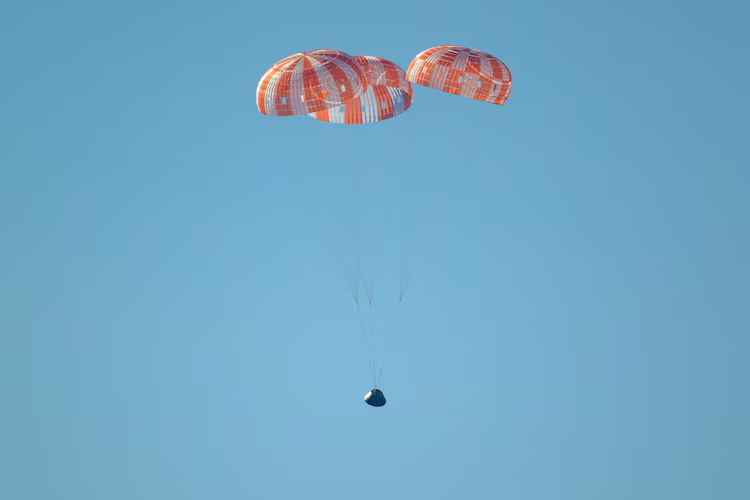
  • Parachute Sequence: At 23,400 feet, the drogue chutes deployed, followed by the three massive main parachutes at 5,400 feet. The spacecraft slowed to a gentle 17 mph before hitting the water.

“Houston, Integrity. Splashdown,” Commander Wiseman radioed shortly after the capsule stabilized in the water. He later reported the crew was in excellent spirits, confirming “four green crew members” ready for extraction.


Recovery Operations

The USS John P. Murtha, a U.S. Navy recovery ship, was positioned just miles from the splashdown site. Recovery teams utilized an inflatable “front porch” platform to assist the astronauts out of the hatch.

The crew will now undergo preliminary medical checks aboard the ship before being airlifted to San Diego and eventually returning to Houston’s Johnson Space Center for a long-awaited reunion with their families.


Why This Matters

Artemis II was more than just a flyby; it was the ultimate stress test for the systems that will eventually land the first woman and first person of color on the lunar surface.

MilestoneAchievement Details
Distance RecordTraveled 252,756 miles from Earth, the farthest any human has ever flown.
Lunar ReturnFirst crewed lunar mission since Apollo 17 in 1972.
Technical ValidationConfirmed the viability of Orion’s life support and next-gen radiation shielding.

Looking Ahead to Artemis III

With the data gathered from Integrity’s flight, NASA is now clearing the path for Artemis III, currently scheduled for 2028. That mission aims to land astronauts near the lunar South Pole, a region believed to contain water ice that could sustain future deep-space exploration.

As NASA Administrator Bill Nelson noted during the live broadcast, “This is just the beginning. We are returning to the Moon, and this time, we are staying.”