In the world of elite sailing, the “chase boat” has traditionally been a gas-guzzling necessity—heavy catamarans with four massive outboards burning hundreds of liters of fuel an hour just to keep up with the racing yachts. That era is officially ending.
1. Emirates Team New Zealand: The Catalyst (Chase Zero)
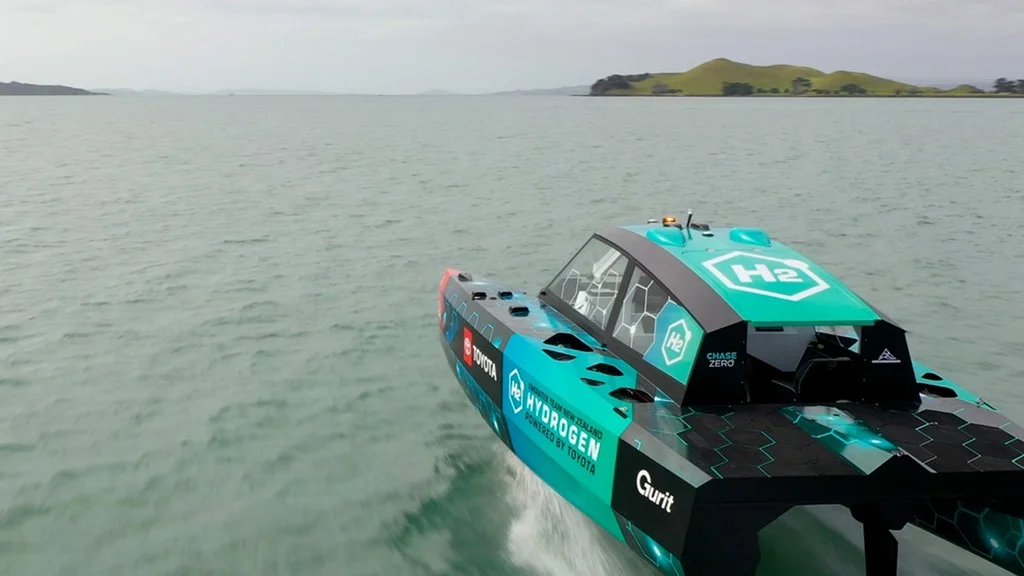
The defenders of the Cup didn’t just write the rules; they built the benchmark. Chase Zero was the first hydrogen-powered foiling catamaran to hit 50 knots.
- The Tech: It utilizes two 80kW Toyota fuel cells (one in each hull). These units take hydrogen gas and convert it into electricity to power twin 220kW motors.Find out more.
- Performance: It “takes off” onto its foils at 19 knots and cruises comfortably at 35.
- The Efficiency: On a typical race day, Chase Zero uses zero fossil fuels, emitting only pure water vapor. If the team used a traditional 11-meter chase boat, they would have burned over 800 liters of petrol in the same timeframe.
2. Bluegame (Sanlorenzo): The Luxury Standard
While Team New Zealand built their own, the American and French teams turned to Bluegame (a brand of the Sanlorenzo Group) to build the BGH-HSV (Hydrogen Support Vessel).
- The Teams: Both NYYC American Magic and Orient Express Racing Team utilize this 10.8-meter carbon fiber masterpiece.Find out more.
- The Tech: It uses EODev REXH2 fuel cells paired with three 63kWh batteries.
- The Commercial Leap: Unlike a pure racing prototype, the Bluegame BGH is designed with a “luxury” eye. It features a high-end interior, proving that hydrogen tech can be packaged into a product that high-net-worth individuals would actually want to buy.
3. Why This Matters: The “Only One in the Circle” Rule
The America’s Cup protocol added a brilliant incentive: Hydrogen chase boats are the only support vessels allowed inside the racecourse area. This gives the hydrogen pioneers an massive advantage—their coaches and cameras can get closer to the AC75 racing yachts than ever before, all while creating zero wake (since they are foiling) and zero emissions.
The Comparison: Chase Zero vs. Bluegame BGH
| Feature | Chase Zero (ETNZ) | Bluegame BGH (HSV) |
| Length | 13.0 Meters | 10.8 Meters |
| Fuel Cell | 2 x 80kW (Toyota) | 2 x 70kW (EODev REXH2) |
| Top Speed | 50.3 Knots | 50 Knots |
| Range | 100+ Nautical Miles | 150-180 Nautical Miles |
| H2 Storage | 33.6kg @ 350bar | 33kg @ 350bar |
The Verdict
The America’s Cup has successfully turned a “regulatory headache” into a massive technological leap. By 2027, the tech currently being thrashed around the Mediterranean by these teams will likely be the standard for the next generation of luxury tenders and high-speed ferries.
Would you like me to look into the Luna Rossa Prada Pirelli team’s specific hydrogen setup? They’ve been more secretive about their chase boat development in Cagliari compared to the other teams.