As we stand in 2026, it is hard to believe that twenty years have passed since a cerulean sweater and a pair of Chanel boots changed the cultural lexicon forever. When The Devil Wears Prada debuted in 2006, it wasn’t just a movie about a demanding boss; it was a masterclass in ambition, the “invisible grind” of the creative industry, and the high cost of a “job that a million girls would kill for.”
Two decades later, the film’s grip on our collective imagination hasn’t loosened it has only tightened. Here is why we are still obsessed with the halls of Runway after all this time.

The Monologue That Defined an Industry
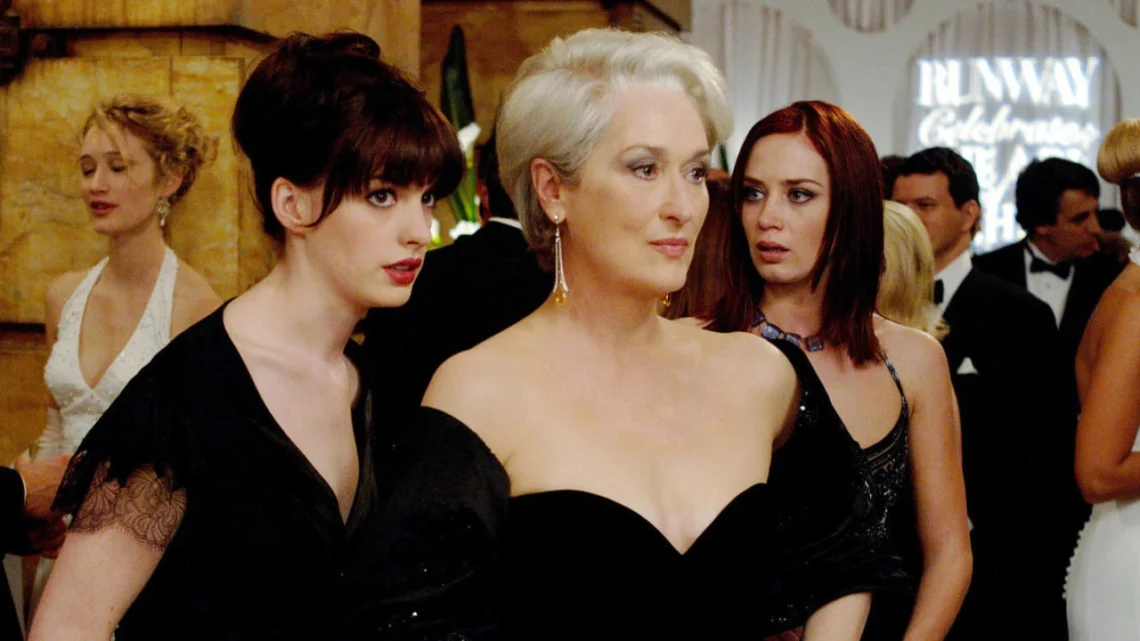
You know the one. Before 2006, “cerulean” was just a word in a crayon box. After Miranda Priestly (Meryl Streep) delivered her devastatingly calm takedown of Andy Sachs’ (Anne Hathaway) “lumpy” blue sweater, it became a thesis on how fashion actually works.


That scene did something radical: it democratized high fashion by explaining the “trend-to-retail pipeline.” It proved that even if you think you’re above the “stuff” in the room, the people in that room have already chosen your clothes for you. Today, that monologue is still used in fashion schools to explain the value chain from couture to the clearance bin.
The Career That Launched a Thousand Memes
While Meryl Streep was already a legend, The Devil Wears Prada gave us a new kind of villain: the quiet one. Miranda didn’t scream; she whispered, and that was far more terrifying.
- “That’s all.”
- “Gird your loins!”
- “By all means, move at a glacial pace. You know how that thrills me.”
These lines didn’t just stay on screen; they migrated into our office Slack channels and TikTok sounds. The film captured the “joy bomb” of workplace camaraderie through Nigel (Stanley Tucci) and the relentless, cheese-cube-fueled ambition of Emily (Emily Blunt). It humanized the hustle while making us laugh at the absurdity of it all.
A 20-Year Evolution: From Print to Digital
Looking back from 2026, the original film feels like a beautiful time capsule. It was an era of DSLRs, frantic sourcing of physical manuscripts, and the absolute authority of the print magazine editor.
In the 2006 version, Andy had to sprint through New York with physical coffee and “The Book.” Today, as the sequel approaches, we see a landscape where authority is fragmented and algorithms drive the reach. Yet, the core truth of the original remains: success requires sharp observation and the ability to survive under immense pressure.
The Legacy of Andy Sachs
Perhaps the most enduring part of the film is Anne Hathaway’s portrayal of Andy. We didn’t just watch a makeover; we watched a woman find her voice by learning a language she initially despised. Hathaway recently reminisced about meeting Emily Blunt for the first time on set, calling her an “instant movie star.” That chemistry—between the “smart girl” and the “fashion girl”—is what gave the movie its heart.
As we look toward the 2026 sequel, the original stands as a reminder that fashion isn’t just about what we wear; it’s about who we decide to become when the world is watching.
The “Prada” Impact: By the Numbers
- Box Office: $326 Million (on a modest $35M budget).
- Oscars: 2 nominations (including Best Actress for Streep).
- The “Emily” Effect: Propelled Emily Blunt to international superstardom.
- Cultural Longevity: The “cerulean” sweater is now a permanent fixture in film fashion history.