Las Vegas: Cold Nights, Hot Engines and the SF-26’s Final Test
There are circuits that reward outright performance, circuits that reward aerodynamic efficiency, and then there is Las Vegas, where the temperature of the asphalt could become just as important as the performance of the car itself.
As Formula 1 prepares for the 2026 Las Vegas Grand Prix, teams are approaching one of the more unusual technical challenges of the season. Night-time temperatures are expected to fall between 10°C and 15°C, with Saturday’s race potentially taking place in conditions closer to 10°C.
For Scuderia Ferrari, this presents an interesting problem.
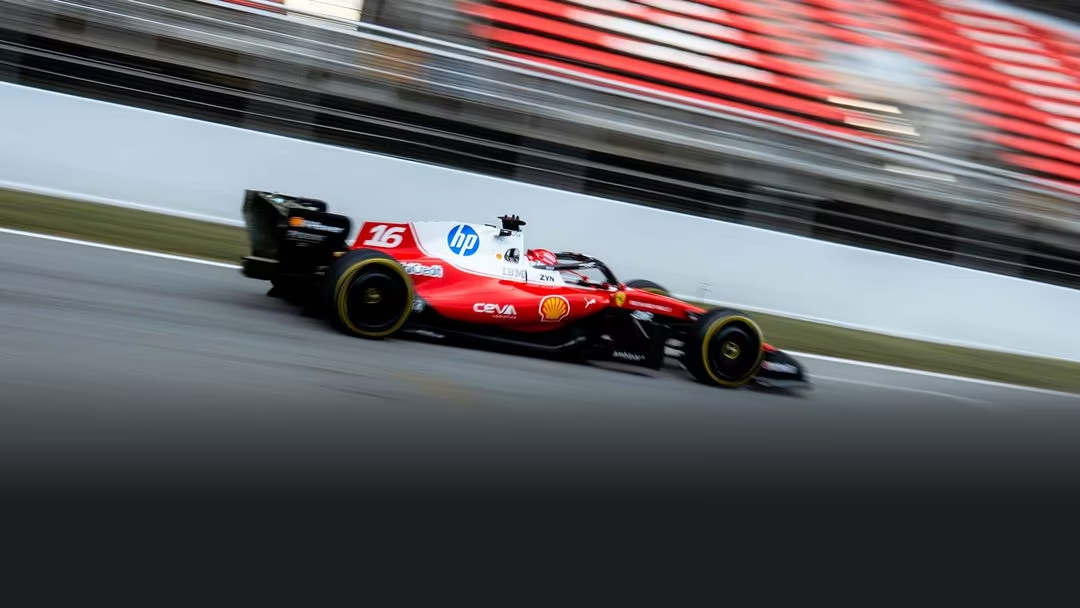
The SF-26 has already demonstrated that it can be competitive, but its ability to extract consistent performance from its tyres, manage cooling requirements and make the most of its existing power unit will be under scrutiny.
And with Ferrari’s major development programme for this season effectively concluded, the question becomes less about what Maranello can introduce and more about what it can extract from what is already running.
The tyre problem: Getting heat into the rubber
Pirelli has selected its softest available compound range for Las Vegas:
– C3 – Hard
– C4 – Medium
– C5 – Soft
The selection is particularly interesting because the Las Vegas Strip Circuit is not especially demanding on tyres in terms of sustained lateral loading.
Its 6.201-kilometre layout features 17 corners and three exceptionally long straights. Those straights allow the tyres to lose temperature, while the relatively limited number of demanding corners provides fewer opportunities to bring them back into their operating window.
This creates a rather unusual situation.
A driver can have a car capable of producing considerable aerodynamic performance but still struggle to extract grip because the tyres are not sufficiently warm.
Qualifying could become particularly difficult. Teams may have to reconsider their preparation laps, potentially using consecutive laps to maintain temperature rather than allowing the tyres to cool during a conventional preparation sequence.
Pirelli has also identified graining as a potential concern. When a tyre is operating below its ideal temperature range, the surface can struggle to generate the necessary grip. Sliding then produces additional surface damage, which can compromise performance further.
The problem is not necessarily excessive tyre wear. It is getting the rubber to work consistently in the first place.
There is another complication: the undercut.
Normally, fresh tyres provide an immediate advantage over an opponent running an older set. In Las Vegas, however, the long run from the pit exit towards the more demanding sections could leave newly fitted tyres struggling to generate temperature.
Consequently, an early pit stop may not deliver the immediate performance advantage teams would normally expect.
Pirelli believes a one-stop strategy is likely to be the quickest approach, although all three compounds could have a role to play.
The 2026 wet-weather warning
There is a further concern following the Brazilian Grand Prix.
Max Verstappen and Isack Hadjar raised questions about the operating window of the new wet-weather tyres, particularly their behaviour when cold.
Verstappen described the cold tyres as feeling almost like a rock, highlighting the difficulty of generating grip before reaching their working temperature.
Lando Norris also expressed concern about the prospect of racing in Las Vegas with insufficient tyre temperature.
Although the dry and wet compounds are different, the underlying concern is relevant: how quickly can the tyres generate temperature, and how consistently can they retain it?
If rain arrives, the challenge could become considerably more complicated.
Source: Pirelli’s official Las Vegas preview and GPblog’s reporting following the Brazilian Grand Prix.
Ferrari’s ADUO advantage: What does it actually mean?
The other major talking point is Ferrari’s power unit.
The FIA’s Additional Development and Upgrade Opportunities system, better known as ADUO, was introduced to give manufacturers falling behind in internal combustion engine performance an opportunity to close the gap.
Ferrari, Audi and Honda were placed in the category eligible for two additional homologation upgrades in 2026 and two in 2027 following the first assessment period.
Mercedes received one additional homologation in each of those seasons.
However, there is an important development to consider.

On 10 November, the FIA published the results of its third assessment period, covering races 12 to 18. No additional homologations were granted to any manufacturer during this review.
That does not remove Ferrari’s original ADUO entitlement. It means the latest assessment did not award another round of upgrades.
It is also important to understand that ADUO is not a blanket permission to change anything on the engine. It operates within the homologation framework and applies to specified power-unit development opportunities.
The question for Las Vegas is therefore not whether Ferrari suddenly has another engine upgrade available, but whether its existing power-unit package can operate effectively in a very different thermal environment.
Cold weather and power-unit behaviour
Cold ambient temperatures can be beneficial for certain aspects of power-unit cooling.
Lower temperatures increase the potential for heat rejection through the cooling systems. However, that does not automatically translate into more horsepower.
An engine still needs to operate within its designed temperature ranges.
Running too cold is not necessarily beneficial. Oil temperature, coolant temperature, combustion conditions and the thermal requirements of electrical components all need to be managed.
The MGU-K and battery systems also have their own operating requirements.
Ferrari will therefore be balancing two competing objectives: extracting the maximum available performance while ensuring that the power unit and its supporting systems remain within their intended thermal windows.
ADUO provides development opportunities, but it does not eliminate the need for effective thermal management.
The louvre question: Could Ferrari close them in Las Vegas?
This is perhaps one of the more interesting details to watch on the SF-26.
During the hotter races, Ferrari has been seen using more extensive cooling louvre openings along the side of the car.
These openings help extract hot air from the internal cooling areas, allowing the radiators and associated systems to manage the heat generated by the power unit.
Mexico was a particularly demanding example. The high altitude reduces air density, making cooling more difficult despite the lower aerodynamic drag.
Ferrari’s cooling configuration had to account for those conditions.
Las Vegas presents almost the opposite environment.
With ambient temperatures potentially falling towards 10°C, Ferrari may have less need for extensive cooling openings.
Could we see the team reduce the number or size of its cooling louvres?
Absolutely. It is a plausible circuit-specific adjustment.
However, there is a distinction worth making: Ferrari would not be trying to maximise engine temperature. It would be trying to maintain the correct operating temperatures while avoiding unnecessary heat extraction.
Closing or reducing the openings could also offer an aerodynamic benefit.
Cooling openings are not free. They influence the way air travels around the bodywork and can contribute to aerodynamic drag and disturbances in the airflow.
Reducing unnecessary cooling capacity can therefore help the car’s aerodynamic efficiency.
But closing them too aggressively could create overheating problems, particularly if the car spends extended periods in traffic or experiences higher-than-expected power-unit temperatures.
The final configuration will depend on Ferrari’s simulations, telemetry and cooling requirements.
We should therefore expect a different cooling configuration to be considered, rather than assume that every louvre will simply be closed.
No major new SF-26 package: What is Ferrari bringing?
Ferrari’s Austin upgrade was reported as its final major aerodynamic development package of the season.
That package included revisions to the floor, sidepods and diffuser, with the objective of improving airflow and extracting more performance from the existing aerodynamic concept.
Following Austin, development was expected to concentrate on circuit-specific adaptations rather than another substantial redesign.
This is particularly important heading into Las Vegas.
The SF-26 will need to make the most of its existing aerodynamic platform. Ferrari cannot simply introduce another significant floor or sidepod concept to address a weakness that becomes apparent during the weekend.
Instead, attention will turn towards:
– Cooling configuration and louvre positioning.
– Front and rear wing levels to balance straight-line speed and cornering performance.
– Brake temperature management.
– Tyre preparation and temperature retention.
– Power-unit deployment and energy management.
– Mechanical setup to help generate grip in the slower sections.
The long straights make aerodynamic drag particularly important, but the middle sector still requires sufficient downforce and confidence through its faster corners.
Finding that compromise will be crucial.
What should we expect from Ferrari?
The Las Vegas weekend could become a useful examination of Ferrari’s ability to adapt its existing package.
The cold conditions might offer some relief to its cooling requirements, potentially allowing smaller cooling openings and a more efficient aerodynamic configuration.
But the same conditions could expose one of the car’s more difficult challenges: getting sufficient temperature into the tyres.
For Lewis Hamilton and Charles Leclerc, the preparation of the tyres could become just as important as outright qualifying pace.
A car that looks competitive over a long run might struggle to deliver a single decisive lap if the tyres are outside their operating window.
And with the major development work for 2026 largely behind Maranello, there is little room for another fundamental correction.
Las Vegas is not necessarily about finding more performance. It is about finding the performance Ferrari already has, and making it work in conditions that are anything but ordinary.
For the SF-26, the final question is whether Ferrari can make its existing package work as a complete system: tyres, aerodynamics, cooling and power delivery.
That is where this weekend could become particularly revealing.