FIA Bans Journalist for the Rest of 2026 After Attack on Charles Leclerc: Where Does Criticism End and Personal Targeting Begin?
Subtitle: Jonathan McEvoy’s accreditation has been withdrawn following a controversial Daily Mail column about Ferrari’s Charles Leclerc. But with speculation surrounding Frédéric Vasseur, questions about the FIA’s authority and a divided reaction among Formula 1 fans, the controversy has become about considerably more than one journalist’s choice of words.
Formula 1 has never been short of controversy, and criticism of its drivers comes with the territory. Every race brings questions about judgement, performance, team decisions and the personalities behind the wheel. But the latest confrontation between the FIA and the media has raised a different question: when does criticism of a driver cross the line into a personal attack, and who gets to decide where that line is drawn?
Jonathan McEvoy, the Daily Mail’s long-serving Formula 1 correspondent, has had his media accreditation withdrawn for the remainder of the 2026 season following an opinion column targeting Ferrari driver Charles Leclerc.
The decision means McEvoy will miss the final three rounds of the championship in Las Vegas, Qatar and Abu Dhabi. It also places the FIA in an uncomfortable position, facing accusations of restricting press freedom over an article that has generated considerable discussion both inside and outside the paddock.
At the centre of the controversy is a description McEvoy used for Leclerc following the confrontation between the two Ferrari drivers at the Mexican Grand Prix. The journalist referred to the Monegasque as a “sneaky little bastard”, language that would ultimately become the focus of the FIA’s decision.
However, the circumstances surrounding the article deserve closer examination, particularly given the wider atmosphere at Ferrari and the increasingly complicated relationship between Lewis Hamilton and his teammate.
The incident that started it all
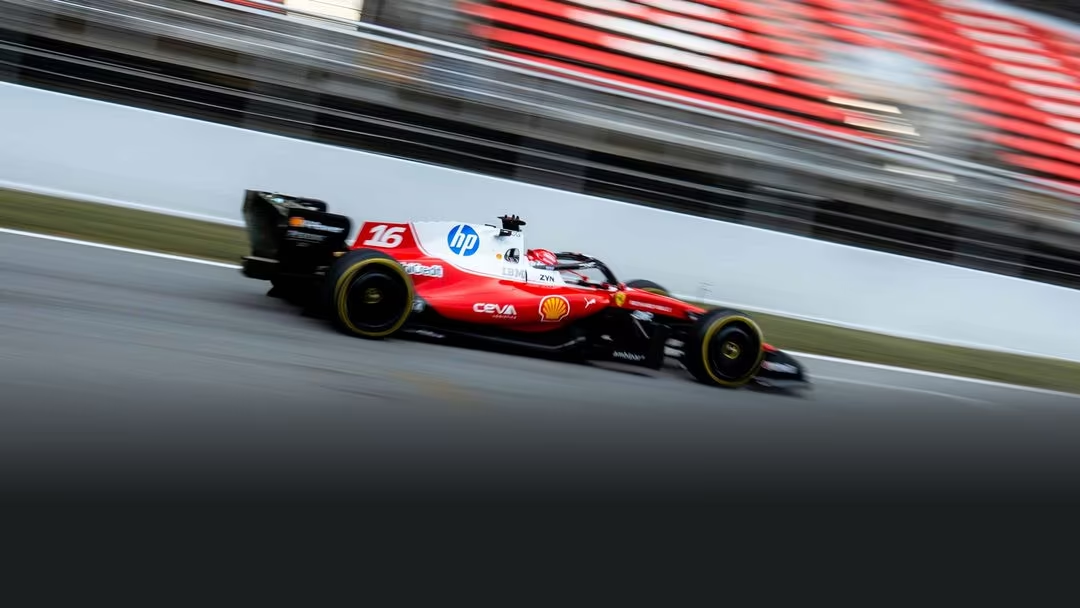
The disagreement can be traced back to the opening lap of the Mexican Grand Prix, where Hamilton and Leclerc found themselves fighting for position.
Hamilton had started from pole position, and the battle between the two Ferrari drivers became one of the defining talking points of the race. Their confrontation raised questions about Ferrari’s approach to allowing its drivers to compete against one another, particularly when a potential one-two finish was at stake.
The incident carried into the post-race discussions, with Hamilton expressing frustration over the circumstances and the team subsequently holding discussions to address the situation.
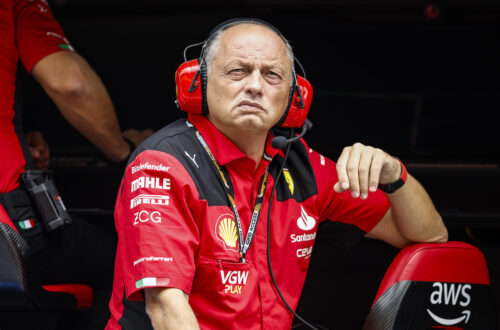
Ferrari team principal Frédéric Vasseur maintained that the team’s rules had not changed: the drivers were permitted to race, but were expected to respect one another and the interests of the team.
Reuters reported on November 6 that Ferrari had held discussions following the costly incident, with Vasseur saying the drivers had clarified their positions and moved on ahead of the Brazilian Grand Prix.
Hamilton and Leclerc had also indicated that the matter had been addressed.
But while the drivers were attempting to move forward, the subject remained alive in the media.
McEvoy’s subsequent column took a distinctly personal direction, not simply questioning Leclerc’s decision-making on track but using language that questioned the driver’s character.
That distinction is important.
Lewis Hamilton has hardly escaped criticism
There is no shortage of criticism directed at Lewis Hamilton throughout his Ferrari campaign.
His performances have been scrutinised, his ability to extract the maximum from the car questioned, and his transition into the Scuderia has provided plenty of material for commentators and fans.
Questions have also been raised about his leadership within the team, his relationship with Ferrari’s engineers and whether his arrival would fundamentally alter the way the organisation operates.
There have even been claims and speculation about Hamilton wanting greater influence over the direction of Scuderia Ferrari, including suggestions that he wanted to take control of aspects of the team’s operation.
Whether discussing his driving, his ability to lead, his relationship with the engineering department or his influence over Ferrari’s internal structure, Hamilton has been subjected to a considerable amount of scrutiny.
Much of that criticism, however, has centred on his professional performance and position within the team.
The McEvoy column was different.
Rather than concentrating on Leclerc’s driving ability, racecraft or the consequences of his decisions in Mexico, the language used was directed squarely at the driver’s character.
That is where the debate becomes more complicated.
A journalist should be able to question a driver’s judgement, challenge their decisions and investigate their conduct. But there is a difference between holding a sporting figure accountable and reducing an assessment of their actions to a personal insult.
Leclerc is not exempt from criticism because he drives for Ferrari, nor should Hamilton be protected from scrutiny because of his seven world championships.
Both drivers should be subject to the same standards of journalistic examination.
The question is whether the language used in this instance met the standards expected of an accredited journalist.
Ferrari, Frédéric Vasseur and the unanswered question
The controversy took another turn when McEvoy suggested that Frédéric Vasseur had brought his article to the FIA’s attention.
In his follow-up column, McEvoy accused the Ferrari team principal of having effectively reported him to the governing body. He also directed further personal insults towards Vasseur.
This has fuelled speculation that Ferrari may have been involved in the events leading to the withdrawal of his accreditation.
However, it is essential to separate an allegation from an established fact.
There is currently no independently verified official source confirming that Ferrari, Frédéric Vasseur or any member of the Ferrari organisation formally lodged a complaint against McEvoy.
The accusation originates from McEvoy himself. Neither the FIA’s reported letter nor the publicly available explanations of its decision identify Vasseur as the complainant.
It is therefore not possible to establish whether Ferrari initiated the matter, whether someone else brought the column to the FIA’s attention, or whether the governing body acted independently after becoming aware of its contents.
The timing has inevitably attracted attention, particularly given the recent tensions between Hamilton and Leclerc and the discussions surrounding Ferrari’s internal management.
But speculation should not be mistaken for confirmation.
If Ferrari was involved, the circumstances deserve scrutiny. If it was not, the suggestion that Vasseur was responsible should not be allowed to become an accepted version of events without evidence.
For now, that question remains unanswered.
The FIA steps in
The decision was communicated to McEvoy by Alberto Villarreal, the FIA’s General Manager.
According to the letter published in reports by the Daily Mail and other outlets, the governing body concluded that the article did not meet the professional standards expected of media representatives accredited to cover the FIA Formula One World Championship.
The letter stated:
“The FIA considers that your article falls short of the standards of professionalism expected of media representatives accredited to cover the FIA Formula One World Championship.”
The FIA subsequently exercised its discretion under the 2026 accreditation guidelines to withdraw McEvoy’s media pass with immediate effect for the remainder of the season.
Those guidelines are important because they establish that media accreditation is granted at the FIA’s discretion and can be revoked without notice.
The governing body therefore has a regulatory basis for withdrawing access.
However, the existence of that authority does not automatically settle the question of proportionality.
McEvoy has covered Formula 1 for approximately 21 years and attended almost 400 Grands Prix. His exclusion from the final three events represents a significant professional consequence.
The FIA has not publicly identified a separate complainant or provided a detailed account of any investigation or review process behind the decision.
That leaves an important question: was the sanction intended to address the language used in the column, protect the professional standards of accredited media, or respond to a complaint about the journalist’s conduct?
The publicly reported explanation establishes the FIA’s stated reasoning, but does not answer every question surrounding the decision.
Social media turns its attention to Ferrari and the FIA
As news of the ban circulated, the discussion extended well beyond the original article.
The reaction across Formula 1’s online community has centred on several competing arguments.
One concerns Leclerc himself. Supporters of the Ferrari driver have questioned why criticism of his racing should be accompanied by language attacking his character. For them, a journalist can disagree with a driver’s conduct without resorting to personal insults.
Others have focused on the FIA’s response, arguing that a journalist should be able to publish a strongly worded opinion without losing paddock access for the remainder of a season.
There is also a third conversation surrounding Ferrari.
With Hamilton and Leclerc already at the centre of an increasingly public discussion about team dynamics, some fans have questioned whether the journalist’s exclusion has anything to do with protecting the team’s image.
That argument remains speculative, particularly because there is no verified evidence that Ferrari or Vasseur formally requested the sanction.
The wider discussion also reflects the different standards applied to drivers and journalists. Formula 1 drivers are routinely criticised, sometimes harshly, for their performance, decisions and public comments. Journalists, meanwhile, are expected to report and interpret those events, including when their conclusions are uncomfortable for the people involved.
But the ability to criticise does not necessarily extend to every form of personal language without consequence.
The more difficult question is whether the FIA has drawn a consistent line between legitimate opinion and conduct it considers unprofessional.
There is also a distinction between the right to publish an opinion and the right to receive accreditation. The FIA can argue that paddock access is conditional, while journalists and publishers can argue that withdrawing that access over editorial language risks discouraging critical reporting.
Both issues deserve examination.
The Daily Mail pushes back
The Daily Mail has strongly rejected the FIA’s decision.
Chris Dean, the newspaper’s head of sport, described the action as an “unprecedented and outrageous attack on the freedom of the press”.
The newspaper argues that the sanction is excessive and that criticism of a driver should not result in a journalist being excluded from the championship.
Former Formula 1 chief executive Bernie Ecclestone also criticised the decision, questioning why the governing body would take such action against a correspondent with McEvoy’s experience.
His intervention adds another prominent voice to the debate, although it does not resolve the underlying question of whether the original column met the standards expected of accredited media.
The disagreement is now about more than the wording of one article. It concerns the relationship between the governing body, the media and the teams whose activities journalists are expected to scrutinise.
Where does Formula 1 draw the line?
There is an uncomfortable irony in a sport that has built much of its global appeal around confrontation, strong personalities and outspoken opinions.
Formula 1 thrives on debate. Drivers are questioned, team principals are challenged, and decisions made behind closed doors are regularly brought into the public arena.
Ferrari, perhaps more than any other team, understands the intensity of that attention.
Its history is inseparable from public expectation, criticism and the scrutiny that comes with being one of the most recognisable names in motorsport.
That scrutiny should extend to Charles Leclerc, Lewis Hamilton and Frédéric Vasseur equally.
Leclerc should be free to defend his racing decisions, Hamilton should be questioned about his performances, and Vasseur should be held accountable for the team’s management.
Equally, journalists should be able to examine those decisions without fear that criticism alone will cost them their access to the championship.
But journalism also carries responsibility. An opinion piece can be provocative, critical and even uncomfortable without necessarily becoming personal abuse.
The FIA has made its position clear: it believes McEvoy’s article fell below the professional standards required of accredited media representatives.
The Daily Mail believes the punishment is an excessive response to editorial criticism.
Neither position removes the need for transparency over how the decision was reached, particularly when the identity of any complainant has not been established.
For now, McEvoy will miss the final three races of 2026, while the discussion surrounding Ferrari, Hamilton and Leclerc continues.
The original confrontation in Mexico may have been resolved between the two drivers, but its consequences have reached an entirely different part of the Formula 1 paddock.
And perhaps the most important question left unanswered is not whether a journalist should be allowed to criticise a driver. It is whether the FIA can enforce professional standards without creating the impression that uncomfortable criticism comes with a professional price.
In Formula 1, the drivers are expected to answer for what happens on the track. The governing body should be equally prepared to explain the decisions it makes off it.