
Formula 1’s 2026 Capital Investment Race: Which Teams Are Building for the Future?
From Audi’s expanding Hinwil campus to Cadillac’s American manufacturing ambitions, Formula 1’s financial arms race is increasingly being fought away from the circuit. But under the 2026 cost cap, investing in a factory, simulator or production system can have very different financial consequences from developing a faster car.
The race behind the race
Formula 1’s competitive battle is often measured in tenths of a second. Behind those fractions lies another contest, one fought with manufacturing equipment, simulation technology, data systems and the facilities that allow engineers to turn ideas into performance.
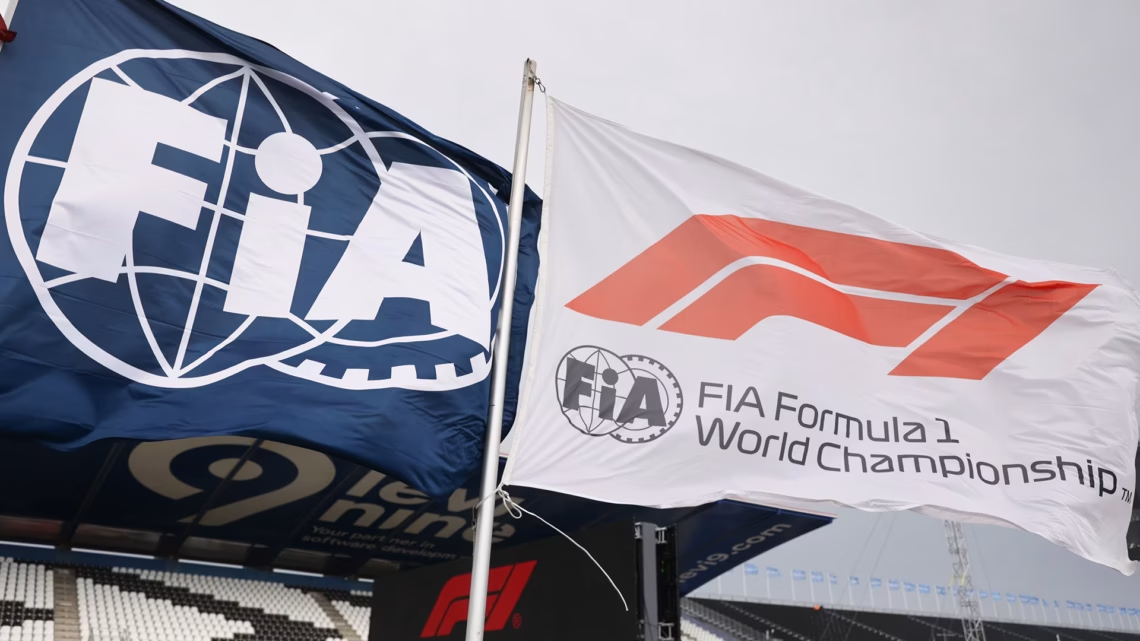
The 2026 financial regulations have made this investment landscape particularly important. The FIA has removed the separate capital expenditure allowance and brought the annual depreciation costs of qualifying assets into the main team cost cap. Formula 1 explained the change in April 2026, noting that the overall base cap had increased to $215 million to reflect changes in the costs counted within it. <Cite refs={[“turn442074search0″,”turn655436search8”]}/>
The implication is significant. A team building new infrastructure must consider not only the cost of acquiring an asset but also how its accounting treatment affects the financial room available in subsequent years.
So which teams have made identifiable capital investments in 2026?
The public record does not provide a complete, independently verified ledger of every team’s capital expenditure. However, several projects have been publicly documented. They offer a useful look at where Formula 1’s teams are strengthening their technical foundations, and where the evidence is not yet sufficient to quantify spending.
1. Audi: A new campus in Hinwil
<AsyncImage query=”Audi Revolut Formula 1 new Hinwil campus Zurichstrasse architectural rendering 2026″ aspectRatio=”16:9″ width=”100%”/><text color=”secondary” size=”sm”>Investment focus: factory infrastructure, engineering collaboration and manufacturing capacity.</text>
Audi has one of the clearest publicly announced infrastructure projects of the 2026 season.
On 1 October 2026, the team revealed plans for a new campus on Zurichstrasse, less than a kilometre from its existing base in Hinwil, Switzerland. Elements of the campus became operational during the summer, while completion of the wider development is scheduled for 2030. <Cite refs={[“turn442074search1″,”turn442074search4”]}/>
The project forms part of Audi’s long-term effort to establish itself as a fully integrated Formula 1 operation following its takeover of Sauber.
The existing Wildbachstrasse site is expected to remain operational and subsequently serve as a manufacturing centre and wind-tunnel facility. Power-unit development and manufacturing will continue at Neuburg in Germany, while the team retains its technical centre in Bicester, United Kingdom. <Cite refs={[“turn442074search1”]}/>
Team principal Mattia Binotto has framed the expansion around attracting and retaining specialist talent, improving collaboration and providing the foundations for Audi’s long-term ambitions.
That is an important distinction. The project is not simply about creating a more impressive corporate headquarters. In a sport where chassis development, simulation, production and engineering decisions must work together, the arrangement of facilities can influence how efficiently an organisation operates.
The full campus is a multiyear undertaking, so it would be inaccurate to classify its entire planned cost as 2026 expenditure. What is established is that elements were already operational in 2026 and that further development remains planned through 2030.
Capital investment assessment: A documented, ongoing infrastructure programme with elements operational in 2026. The total project cost and the amount recognised under the FIA’s 2026 financial regulations have not been established by the cited public announcements.
2. Haas: Bringing simulator capability to Banbury
<AsyncImage query=”MoneyGram Haas Formula 1 team Banbury factory simulator facility Toyota Gazoo Racing partnership” aspectRatio=”16:9″ width=”100%”/><text color=”secondary” size=”sm”>Investment focus: driver simulation and technical preparation.</text>
Haas has also been expanding its technical capabilities, with a new driver simulator at its Banbury headquarters among the most relevant developments entering the 2026 season.
Reporting published in December 2025 described the investment as part of the team’s growing relationship with Toyota, which became its title partner for 2026. The simulator was expected to become operational during 2026, with the reported target being around May or June. <Cite refs={[“turn442074news14”]}/>
For a team that had relied on Ferrari’s simulator at Maranello, bringing this capability closer to its own engineering base could improve logistical efficiency and make simulator sessions easier to integrate into the team’s development programme.
The 2026 regulations also made simulation particularly important. Teams were preparing for a substantially different generation of cars, with new power-unit and aerodynamic rules requiring engineers and drivers to develop their understanding of unfamiliar vehicle behaviour.
A simulator is not a substitute for track testing, nor does purchasing one guarantee better performance. Its value depends on the quality of the underlying vehicle model, correlation with real-world data, software and the team’s ability to use the system effectively.
Nevertheless, the acquisition of a dedicated simulator represents a materially different kind of investment from designing a new front wing. It creates a technical capability that can support the organisation across multiple seasons.
Capital investment assessment: A publicly reported simulator investment associated with Haas’s 2026 technical preparations. The precise acquisition cost, commissioning date and treatment under the FIA’s financial regulations have not been independently confirmed in the cited reporting.
3. Cadillac: Building an American Formula 1 operation
<AsyncImage query=”Cadillac Formula 1 team new factory Fishers Indiana construction facility 2026″ aspectRatio=”16:9″ width=”100%”/><text color=”secondary” size=”sm”>Investment focus: factory development, manufacturing infrastructure and future power-unit capability.</text>
Cadillac’s entry into Formula 1 has created a different kind of capital investment story: the construction of a new operation while the team is already competing.
In an August 2026 report, Motorsport.com described the team’s infrastructure as still developing. Cadillac was operating across several locations, including its principal Silverstone hub and General Motors facilities in North Carolina and Michigan, while using Toyota’s wind tunnel in Cologne. A new factory was under construction in Fishers, near Indianapolis, with a future power-unit operation planned in the Charlotte area. <Cite refs={[“turn442074search3″,”turn655436search1”]}/>
This distributed structure reflects Cadillac’s position as a new entrant. Rather than inheriting a fully established Formula 1 operation in its current form, the organisation has been building the systems, facilities and technical workforce needed to support its long-term ambitions.
The distinction between current operations and future investment is essential. Ferrari supplies Cadillac’s engine and gearbox for 2026, while General Motors develops the infrastructure intended to support a future works programme. The new factory and power-unit facilities should therefore be understood as part of a longer industrial strategy, not evidence that Cadillac already manufactures every component independently. <Cite refs={[“turn442074search9″,”turn442074search3”]}/>
The construction of a factory can represent a substantial capital commitment, but it also brings an operational question: how much of the investment can be converted into practical performance within the financial rules?
For Cadillac, that challenge is particularly relevant because it must establish essential technical capabilities while simultaneously running a race team.
Capital investment assessment: Factory construction and planned power-unit infrastructure are publicly documented. The total capital committed during calendar year 2026, the portion spent during that year and the amount recognised within the team cost cap remain unverified.
4. Alpine: New simulator technology at Enstone
<AsyncImage query=”BWT Alpine Formula One Team Enstone Dynisma motion simulator facility” aspectRatio=”16:9″ width=”100%”/><text color=”secondary” size=”sm”>Investment focus: driver-in-the-loop simulation and development tools.</text>
Alpine provides another example of how technical investment can be difficult to place neatly within a single calendar year.
Dynisma announced on 19 May 2026 that its driving-simulator technology had been installed at Alpine’s Enstone headquarters. The company stated that the installation was completed during 2025, as part of the team’s preparations for the new technical regulations, and that the system supports the current and future racing programmes. <Cite refs={[“turn655436search2”]}/>
The timing matters. The system was publicly documented in 2026, but its installation was completed in 2025. It should therefore not automatically be described as a capital purchase made during 2026.
The distinction is precisely the kind of issue that matters under the revised financial framework. An asset may become operational in one period after its acquisition, installation or construction has taken place in another. Its accounting treatment depends on the relevant facts and rules, not simply the date on which an announcement is published.
For Alpine, the simulator enhances the tools available for driver preparation and car development. It also illustrates how the technical value of capital investment can extend across several seasons.
Capital investment assessment: A confirmed technical asset, but not a verified 2026 acquisition. The public announcement dates the installation to 2025, and no financial figure has been established here.
5. Williams: The cost of building the foundations
Williams offers a different perspective: sometimes the most consequential investment is not a new performance tool but the systems needed to make an organisation function efficiently.
The team’s infrastructure needs have been discussed publicly for several years. In 2024, team principal James Vowles described a longer-term programme involving new facilities and simulators, with investments being ordered and introduced over a multiyear period. <Cite refs={[“turn655436search3”]}/>
More recently, Vowles has argued that the cost cap can leave less-established teams in a difficult position. In October 2026, Reuters reported his criticism that Williams needed to spend substantial sums on basic operational systems before that money could contribute to car upgrades. <Cite refs={[“turn655436news21”]}/>
His argument speaks directly to the capital expenditure debate. A team may need better production processes, inventory systems, digital infrastructure and manufacturing equipment simply to bring its operation up to the standard of its rivals.
Those investments may improve the team’s ability to work efficiently without immediately producing a measurable improvement in lap time.
However, the public statements cited here do not identify a particular Williams capital asset purchased in 2026, nor do they provide a verified breakdown of the team’s capital spending for the year. Vowles’s comments establish the existence of an infrastructure challenge, not the precise amount of CapEx booked during 2026.
Capital investment assessment: A documented long-term infrastructure programme and publicly stated operational needs, but no sufficiently detailed public ledger to quantify Williams’s 2026 capital expenditure.
What about Ferrari, Mercedes, McLaren, Red Bull, Aston Martin and Racing Bulls?
The remaining teams must be judged by the same standard.
Formula 1’s reporting confirms that teams continued to develop their cars throughout 2026. For example, the official update report for the Austrian Grand Prix documented aerodynamic and mechanical changes across the field, including a revised front-wing endplate for Ferrari and suspension and bodywork changes for Mercedes. <Cite refs={[“turn655436search10”]}/>
Those developments are evidence of engineering and performance expenditure, but they do not by themselves establish capital investment. A new aerodynamic component is generally part of the development programme, whereas a new manufacturing machine used to produce that component may qualify as a capital asset.
Similarly, the fact that a team has a modern factory, a sophisticated simulator or an advanced wind tunnel does not prove that it acquired or materially upgraded that asset during 2026. The timing of the original investment, the accounting treatment and any new capital commitments must be established separately.
Historical reporting has documented substantial infrastructure investment by organisations including McLaren and Aston Martin, as well as Ferrari’s wind-tunnel facilities. But those historical projects cannot automatically be presented as new 2026 investments. <Cite refs={[“turn655436search6″,”turn655436search7″,”turn442074search12”]}/>
For an article claiming to cover every team, that distinction is important. It would be misleading to fill the gaps with speculative dollar figures or to describe every new car part as capital expenditure.
The financial implications of the 2026 cost cap
The FIA’s revised framework changes how these investments interact with a team’s annual spending limit.
Under the earlier structure, qualifying capital expenditure was controlled through a separate allowance. From 2026, the separate allowance was removed and annual depreciation costs were brought into the main cap. Formula 1’s April 2026 explanation identified this as one of the reasons for increasing the base team cap to $215 million. <Cite refs={[“turn442074search0”]}/>
For an eligible asset, the initial purchase price and the annual amount recognised for accounting purposes are not necessarily the same figure. A facility or machine may cost millions to acquire, while its cost is recognised over a longer useful life, subject to the applicable rules.
This means that two teams undertaking investments of similar size could experience different financial consequences depending on their asset mix, depreciation schedules and other eligible expenditure.
It also explains why public announcements are insufficient to calculate a team’s remaining budget. Without the asset’s cost, timing, classification, useful life and treatment under the FIA regulations, it is impossible to calculate its exact impact on the cost cap.
The investment race is therefore about more than who builds the biggest factory. It is about which organisations can develop the necessary capabilities, integrate them efficiently and use them to improve performance without compromising their financial position.
Conclusion: Who is investing, and what can we prove?
The public evidence available for 2026 identifies several significant infrastructure and technology programmes, but it does not establish a complete financial ranking of all eleven teams.
Audi’s Hinwil campus is a clear multiyear expansion, with parts already operational. Haas has pursued a dedicated simulator capability at Banbury. Cadillac is building the infrastructure required to support its future American works operation. Alpine’s simulator illustrates how an important technical asset can be announced in 2026 despite having been installed the previous year. Williams’s public statements, meanwhile, highlight the difficulty of financing the operational foundations needed to compete.
These projects are not interchangeable, and their costs cannot be compared reliably without further disclosure.
The most defensible conclusion is that capital investment remains a strategic part of Formula 1’s competitive landscape, even under a unified cost cap. What has changed is the financial framework through which qualifying assets affect annual spending.
To establish exactly how much each team invested in 2026 would require team-level capital expenditure disclosures or sufficiently detailed financial statements. Without those records, a precise all-team ranking would imply a level of certainty that the public evidence does not support.
In Formula 1, the fastest car may command the attention, but the factories, simulators and manufacturing systems behind it help determine what a team can build next.




