There is a particular moment in yacht design when a designer stops simply drawing boats and starts shaping the direction of an entire shipyard.
For Giorgio Maria Cassetta, that moment came when a young Italian designer’s portfolio found its way onto the desk of the late Paolo Vitelli, founder of the Azimut-Benetti Group.
What followed was the beginning of one of the most productive designer-shipyard relationships in modern Italian yachting.
Today, Cassetta’s name is attached to some of Benetti’s most recognizable recent superyachts—from the 107.6-metre Luminosity to Spectre, Metis, Triumph, Calex, Artisan and the expanding B.Century family.
But there is another number that makes his career particularly interesting.
His studio has been involved in more than 60 completed creations, according to Benetti, while Cassetta has previously described his broader portfolio as exceeding 400 yacht designs and projects when concepts, development work and projects across different stages are included.
That is a very different story from saying he has built 400 yachts.
He hasn’t.
But the sheer volume of ideas that have passed through his studio tells us something about the designer.
Cassetta has become one of the industry’s prolific visual thinkers.
From Rome to the Sea
Giorgio Maria Cassetta studied Industrial Design, Transport and Product Design at Sapienza University in Rome.
That educational background is significant.
He wasn’t trained exclusively as a naval architect.
His foundation was broader industrial and transportation design, giving him an understanding of proportion, ergonomics, materials and the relationship between people and machines.
He subsequently worked with established yacht-design firms in Rome before eventually developing his own portfolio.
And he started thinking about boats remarkably young.
In an interview, Cassetta recalled building a model boat with his father when he was seven years old. He had already been drawing boats at three or four.
That childhood fascination eventually became a profession.
But Cassetta initially had a problem that many young designers encounter.
He was doing the work.
Other names were getting the recognition.
As projects moved through shipyards, the designer behind the original lines could disappear behind the name of the builder or the owner.
So Cassetta did something simple.
He put together a portfolio.
And on the cover was a 90-metre yacht concept.
The Portfolio That Reached Paolo Vitelli
Around 2012, Cassetta began showing that portfolio to people in the industry.
Eventually it reached Paolo Vitelli.
Vitelli recognized something in the young designer’s work and commissioned him to design a Benetti.
That first commission became the beginning of a relationship that would eventually span more than a decade.
There is a wonderful irony in the story.
Vitelli had spent decades building Azimut-Benetti into one of the world’s largest and most important yacht groups.
Cassetta was a relatively young designer trying to establish his own identity.
One had the shipyard.
The other had the drawings.
The meeting gave both something they needed.
Benetti gained a designer who could create a new visual language.
Cassetta gained the platform to prove that his ideas could survive the journey from sketch to ocean.
Benetti now describes its collaboration with Cassetta Yacht Designers as beginning in 2011 and calls it one of the yard’s longest-running designer partnerships.
The slightly different dates reported in interviews likely reflect the distinction between Cassetta’s early work and the formal evolution of his own studio, but the important point is clear:
The Benetti relationship began in the early 2010s and became the defining partnership of his career.
The First Benetti: Mediterraneo 116′
Cassetta’s breakthrough into Benetti’s production range came with the Mediterraneo 116′.
The first example was launched in 2016.
Rather than creating an intimidating superyacht, the Mediterraneo 116′ was designed to make a substantial yacht feel approachable.
The proportions were clean.
The windows were expansive.
The surfaces were uncluttered.
And there was a sense of openness that would become increasingly characteristic of Cassetta’s work.
It was an important lesson for Benetti:
A yacht didn’t have to look enormous to feel luxurious.
Then the Yachts Got Bigger
The fascinating part of Cassetta’s career is what happened next.
The designer who began with comparatively compact series-production yachts moved steadily into custom superyachts.
The Delfino.
The Diamond.
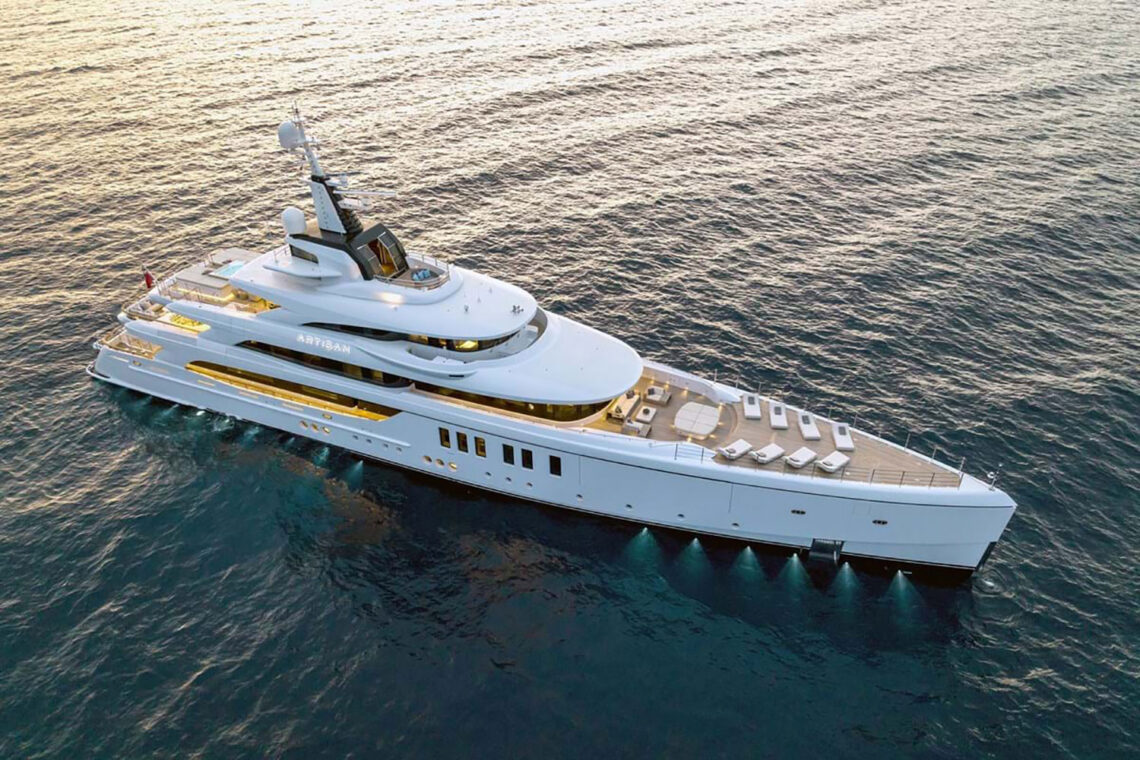
The Artisan.
The Metis.
The Spectre.
And eventually:
Luminosity.
The scale was changing.
But Cassetta’s fundamental design language remained recognizable.
Artisan: The Design That Became a Family
One yacht in particular changed the trajectory of Benetti’s larger-yacht portfolio.
Artisan.
Delivered in 2019, Artisan became the foundation for what would eventually evolve into the B.Century family.
Cassetta described Artisan as having a timeless quality: unmistakably Benetti, but deliberately uncluttered.
That simplicity proved commercially powerful.
Benetti ultimately used the platform and design language for a succession of yachts.
The result was remarkable.
One design became six yachts in the roughly 63-to-67-metre range, eventually forming the basis for the B.Century family.
This is where Cassetta’s importance to Benetti becomes clearer.
He wasn’t merely producing individual one-off yachts.
He was creating design DNA that could be adapted into a family.
The B.Century Family
Benetti’s B.Century family now encompasses yachts from approximately 55 to 75 metres.
The concept is straightforward:
Take the visual language developed through Cassetta’s custom work and adapt it to a repeatable Benetti platform.
The result is a family that feels related without every yacht looking identical.
That is difficult to accomplish.
Too much repetition and the yachts become generic.
Too much individuality and there is no family identity.
Cassetta’s designs occupy the middle ground.
The shapes are restrained.
The glass is generous.
The terraces are increasingly important.
And the yachts are designed to connect the interior with the sea rather than treating the exterior as a decorative shell.
Luminosity: When Cassetta Went Huge
Then came the yacht that put Cassetta’s name on an entirely different level.
M/Y Luminosity.
At 107.6 metres, Luminosity is an enormous custom Benetti and one of the studio’s defining achievements.
Benetti identifies Luminosity as one of the major products of its more than decade-long partnership with Cassetta.
And the yacht demonstrates what happens when Cassetta’s philosophy is applied without the restrictions of a production yacht.
The exterior is deliberately restrained.
The enormous glass surfaces dominate the appearance.
Instead of making the yacht look heavy, the design tries to dissolve the boundary between structure and landscape.
It is almost architectural.
And that is important because Cassetta’s work has increasingly moved toward the intersection of architecture, hospitality and transportation.
The yacht becomes a floating building.
But one that moves.
Spectre
The 69-metre Spectre is another of Cassetta’s signature Benetti designs.
The yacht was commissioned by an owner who wanted four things above all:
speed, silence, long range and fun for the family.
Those requirements could easily have produced a compromise.
Instead, Cassetta and Benetti turned them into the design brief.
Spectre combines the long-range capability expected of a serious superyacht with a much more relaxed approach to family life.
Benetti lists Spectre among Cassetta’s custom creations, alongside Triumph, Metis and Calex.
The yacht also became an award-winning design.
And once again, Cassetta’s strength was not making a yacht look complicated.
It was making complicated requirements appear simple.
Metis
Then there is Metis, a yacht of approximately 63 metres.
Metis is another example of Cassetta working within the Benetti custom-yacht environment while maintaining the same visual vocabulary.
The proportions are elegant rather than aggressive.
The superstructure is carefully controlled.
And the exterior spaces become increasingly important.
Cassetta’s yachts increasingly seem to be designed around the idea that the owner isn’t buying a floating building.
They’re buying access to the sea.
The yacht is simply the platform that makes that possible.
Triumph, Calex and the Expanding Portfolio
The Cassetta-Benetti relationship has continued to produce individual custom yachts.
Among the examples Benetti identifies are:
- FB270 M/Y Triumph
- FB276 M/Y Metis
- FB278 M/Y Calex
- FB269 M/Y Spectre
Benetti also identifies the B.Loft 65M and Class 44M among Cassetta’s work.
The Class 44M, for example, demonstrates how the designer’s language can work at a substantially smaller scale.
At 44 metres, the yacht uses large windows, flowing volumes and an emphasis on natural light to create the feeling of a much larger vessel.
And then there is the B.Loft.
B.Loft: Bringing Architecture to the Water
The B.Loft 65M may be one of the best examples of where Cassetta’s design thinking is heading.
The concept draws from architecture rather than traditional yacht styling.
Benetti describes the interiors as being inspired by the atmosphere of a Manhattan loft, while the exterior draws inspiration from South American seaside villas.
The result is less “traditional superyacht” and more luxury waterfront residence that happens to move.
That seems to be where Cassetta’s work is increasingly heading.
He isn’t trying to make a bigger boat.
He is trying to make a better environment.
So How Many Yachts Has He Actually Designed?
This requires some clarification.
If someone asks:
“How many yachts has Giorgio Maria Cassetta designed?”
The answer depends on what you mean by designed.
Cassetta’s studio says it has produced more than 60 impressive creations spanning approximately 20 to 108 metres.
But Cassetta has also been described as having more than 400 yacht designs to his name, covering concepts, studies, projects and vessels in various stages of development.
So the most accurate way to put it is:
Cassetta has created more than 400 yacht designs and projects, while more than 60 completed creations are attributed to his studio.
Those numbers are not contradictory.
They measure different things.
And that distinction matters when discussing yacht designers, because hundreds of concepts can exist without ever becoming physical boats.
Where Are His Original Yachts Now?
This is where the Cassetta story becomes more difficult—and more interesting.
Unlike classic car design, where original prototypes and production cars are frequently displayed at museums, yacht design doesn’t have an equivalent worldwide museum system.
Most of Cassetta’s original work isn’t sitting in a museum.
It is at sea.
The surviving and active examples are distributed among private owners, charter fleets, shipyards and brokerage markets.
The Benetti yachts are particularly difficult to treat as museum objects because many remain active, privately owned superyachts.
The original Mediterraneo 116′, for example, is a yacht rather than a static design artifact.
The same is true of Delfino 95, Diamond 44M, Artisan, Spectre, Metis, Luminosity and the other completed yachts.
Their “second life” is not necessarily preservation.
It is continued use.
Some appear on the brokerage market.
Others remain under private ownership.
Some are available for charter.
And many are deliberately kept out of the public eye.
That last point is especially important.
The superyacht world is fundamentally different from the automotive world.
A Ferrari prototype might eventually appear at Pebble Beach.
A 100-metre Benetti is more likely to remain behind a marina gate.
So when we ask where Cassetta’s original works are today, the honest answer is:
Many are still exactly where their designer intended them to be—on the water, privately owned and largely out of public view.
The Designer Who Didn’t Stay With Benetti
Cassetta’s success with Benetti didn’t mean he became exclusively a Benetti designer.
His studio has expanded into projects for Tankoa, Cantiere delle Marche, Alpha Yachts, Venture Yachts, Ocean Alexander, Cigarette Racing Team and others.
One of the most interesting recent projects is Tremenda, a 45-metre yacht built by Cantiere delle Marche and delivered in 2025.
Cassetta’s portfolio has therefore moved well beyond the shipyard that gave him his major breakthrough.
And that is probably the strongest indication that his career has matured.
He is no longer simply a Benetti designer.
He is now a designer whose work Benetti helped make famous.
And Who Else Is Designing Both Cars and Yachts?
This is where the modern story becomes particularly interesting.
The relationship between automotive design and yacht design has never disappeared.
In fact, it may be becoming stronger.
Pininfarina
The obvious heavyweight is Pininfarina.
The studio remains active in automotive design while simultaneously maintaining a dedicated nautical division.
Its yacht portfolio includes projects such as the Princess X95, Princess V55, Princess R35, Persico F70, Kairos, Elan E6 and Austin Parker Unica 58.
And this isn’t simply historical branding.
Pininfarina remains active in both sectors in 2026, with automotive projects and current nautical projects continuing side by side.
Fulvio De Simoni and Pininfarina
An even more interesting modern example is the partnership between Pininfarina and Fulvio De Simoni Yacht Design.
Here, the automotive design house and one of the world’s best-known yacht designers are deliberately combining their expertise.
The collaboration has already produced projects including X2 – Explorer X Experience and the CAT56 catamaran concept for Austin Parker.
It is almost the reverse of Cassetta’s story.
Cassetta came from transportation/product design and became a yacht-design specialist.
Pininfarina came from automobiles and expanded outward.
De Simoni came from yachts and collaborated with the automotive world.
The two disciplines are meeting in the middle.
Igor Lobanov
Another fascinating name is Igor Lobanov.
His background included mathematics, car design and transport design, and he worked in an automobile manufacturer’s exterior-design department before moving decisively into yacht design.
His chance meeting with a superyacht owner in 2003 eventually led him into the project that became the famous Motor Yacht A.
Lobanov subsequently established his own yacht-design studio.
He is a good example of the modern designer who can move between transportation disciplines rather than being confined to a single industry.
Alex Pirard
Alex Pirard is another direct example.
He studied product design and automotive design, worked for Volvo Strategic Design and BMW’s M & Individual department, while simultaneously beginning yacht work.
His first yacht project was the Difer 54, and he later established his own studio working across automotive and yacht design.
Michele Dragoni
Then there is Michele Dragoni, whose career took the opposite route.
He began with automotive ambitions and early automotive-industry experience before moving into yacht design.
Today he works across yacht projects, including production and custom vessels.
The New Generation
And there is an even newer generation emerging.
Łukasz Myszyński, for example, trained in car design at the Scuola Politecnica di Design in Milan and has worked on projects associated with Lamborghini, Audi and Ducati. His studio now explicitly operates across automotive and yacht design.
That is perhaps where the future is going.
The distinction between “car designer” and “yacht designer” is becoming less rigid.
Why Cars and Yachts Keep Finding Each Other
The reason is surprisingly simple.
Both industries sell emotion wrapped around engineering.
A car has to make you want to drive it.
A yacht has to make you want to live on it.
Both have to package enormous amounts of engineering beneath carefully controlled surfaces.
Both depend heavily on proportion.
Both use light, glass, materials and surface tension to communicate luxury.
And both have the same fundamental problem:
How do you make something enormous look effortless?
That is why the automotive world keeps appearing in yacht design.
Pininfarina doesn’t need to learn how to make a yacht beautiful from scratch.
It already understands how to make machines desirable.
Cassetta doesn’t need to design a Ferrari.
He understands how to make a 100-metre yacht feel light.
De Simoni doesn’t need to copy a Lamborghini.
He understands how to make a yacht look fast.
And perhaps that is the real legacy of Giorgio Maria Cassetta.
He didn’t simply design Benetti yachts.
He helped move Italian yacht design toward a place where architecture, automotive thinking, engineering and lifestyle could exist inside the same object.
From a seven-year-old drawing boats with his father to a 107.6-metre superyacht carrying his signature, the journey has been remarkable.
And the story isn’t finished.
Because somewhere in Rome, Cassetta’s studio is still drawing.
And somewhere in Viareggio, a new line is still waiting to become a yacht.
The next Cassetta design may already exist on paper.
The ocean just hasn’t seen it yet.