Formula 1’s driver market is moving quickly toward the next decade.
Max Verstappen has committed himself to Red Bull through 2030. Lando Norris has now signed with McLaren through at least 2030. Charles Leclerc has secured a new Ferrari agreement understood to run beyond 2028. The long-term pieces are beginning to fall into place.
And then there is Lewis Hamilton.
The seven-time world champion is already 41 years old, and while his Ferrari future has been repeatedly discussed, the situation is not as settled as some headlines suggest. Formula 1 currently describes Hamilton’s agreement simply as a multi-year deal, with reports generally pointing to 2027 as the current commitment. A new report ahead of the Italian Grand Prix suggests Hamilton could remain with Ferrari through 2028, but Ferrari has not formally confirmed that extension.
That leaves a much bigger question hanging over Maranello:
Does Ferrari have enough reason to keep Lewis Hamilton all the way to 2030?
And perhaps an even more important question:
Would Hamilton still want to be there?
2026 Has Changed the Conversation
When Hamilton joined Ferrari, the expectation was never simply that he would arrive and immediately dominate.
He was brought to Maranello to help Ferrari win the championship that has eluded the Scuderia since 2008—and, for Hamilton personally, to give him another opportunity to win an eighth Drivers’ World Championship.
His first Ferrari season did not deliver that.
In 2025, Hamilton finished 86 points behind Charles Leclerc and failed to score a Grand Prix podium, a difficult beginning to what was supposed to be the final major chapter of his career.
But 2026 has been a different story.
After the introduction of the new regulations, Hamilton has looked considerably more competitive. He has already won a Grand Prix for Ferrari and has added further podium finishes. Following the Dutch Grand Prix, he sits third in the Drivers’ Championship on 183 points—level with Mercedes’ George Russell and ahead of Ferrari teammate Charles Leclerc, who has 155.
That is not the performance of a driver who has simply arrived at the end of his career.
But it isn’t yet the performance Ferrari ultimately needs from a driver being considered for another four years.
One Victory Is Not Enough
Hamilton’s 2026 Spanish Grand Prix victory was significant.
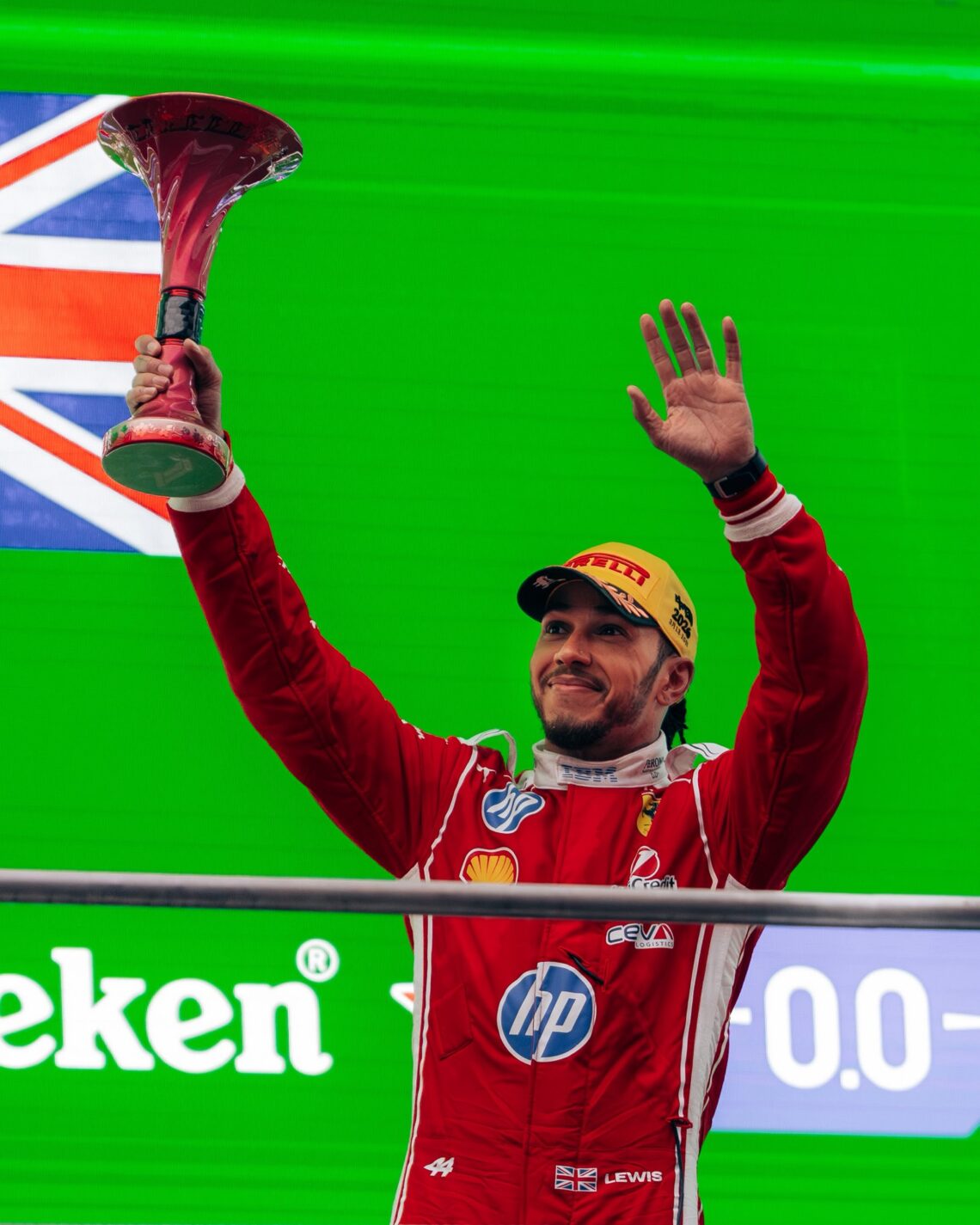
It ended a 686-day wait for a Grand Prix win and delivered his first Formula 1 victory in Ferrari red.
But Ferrari cannot make a 2030 decision based on the emotional significance of one victory.
The question has to be whether Hamilton can consistently perform at championship-winning level.
At the moment, the evidence is encouraging—but incomplete.
Hamilton is third in the championship, tied on points with George Russell, while Ferrari itself sits second in the Constructors’ Championship with 338 points, behind Mercedes’ 425 after the Dutch Grand Prix.
Ferrari therefore has a competitive car.
Hamilton has demonstrated that he can still win.
But Ferrari is still not the dominant force it needs to be.
And that distinction matters.
The Leclerc Problem
There is another factor Ferrari must consider.
Charles Leclerc.
Ferrari has now committed to Leclerc on a multi-year agreement understood to extend beyond 2028. That means the team already has a long-term driver around whom it can build.
Ferrari therefore doesn’t need Hamilton simply because it needs a world-class driver.
It needs Hamilton if it believes that his experience, technical feedback, leadership and ability to win under pressure provide something Leclerc alone cannot.
That is a very different calculation.
Hamilton’s value to Ferrari isn’t simply measured by lap time.
He brings seven world championships, decades of experience, enormous commercial value and an understanding of how championship-winning organisations operate.
Ferrari has plenty of young talent waiting behind him as well.
Oliver Bearman remains part of the Ferrari family and is already gaining experience with Haas. Formula 1 lists Bearman on a multi-year Haas agreement.
Eventually Ferrari must decide whether it wants experience beside Leclerc—or whether it wants to develop the next generation.
And What Does Fred Vasseur Think?
This may be the most revealing part of the story.
Ferrari team principal Fred Vasseur was asked directly about Hamilton’s future during 2026.
His response was not an announcement of negotiations.
It was essentially the opposite.
When asked about extending Hamilton, Vasseur replied:
“Who spoke about the extension?”
He then made it clear that Hamilton was still under contract and that it was not yet time to discuss an extension.
That statement matters.
It doesn’t mean Ferrari doesn’t want Hamilton.
It means Ferrari does not appear to be rushing into a long-term commitment.
And that makes perfect sense.
Why commit a 41-year-old driver through 2030 before knowing what the next few seasons will look like?
The 2030 Question Is Actually About 2027 and 2028
There is a tendency to jump directly from Hamilton’s current Ferrari deal to 2030.
Ferrari probably won’t.
The real decision tree is much simpler:
2026: Is Hamilton still competitive?
2027: Can Hamilton consistently challenge for wins and a championship?
2028: Is Ferrari fighting for the title—and is Hamilton still capable of being the driver to deliver it?
Only then does 2030 become a realistic conversation.
And there is another reason.
By the time the 2030 season arrives, Hamilton would be 45 years old.
Fernando Alonso has already demonstrated that extraordinary longevity is possible—he is 45 in 2026 and remains on the grid—but Ferrari cannot assume Hamilton will have the same appetite or competitive capacity at that age.
Ferrari Doesn’t Need to Renew Him Because He’s Lewis Hamilton
This is perhaps the harshest truth.
Ferrari doesn’t owe Hamilton a seat because he is a seven-time world champion.
Nor should Hamilton expect one because of his historical achievements.
Ferrari is a championship organisation.
If Hamilton is still producing championship-level performances, Ferrari has every reason to keep him.
If he isn’t, the badge on the side of his helmet won’t matter.
The Scuderia will have to ask a simple question:
Who gives us the best chance of winning the World Championship?
If the answer is Hamilton, he stays.
If the answer is Leclerc plus a younger driver, Ferrari moves on.
So, Are There Talks About Renewing Him?
There are certainly reports and questions surrounding Hamilton’s future.
But as of August 30, 2026, there is no confirmed Ferrari announcement of a contract extension through 2030.
There is also no official confirmation that Hamilton has signed a new four-year deal.
In fact, the latest reporting is contradictory.
Ferrari has not confirmed a 2028 seat, while GPBlog reports that Hamilton could remain with Ferrari through 2028. Meanwhile, Formula 1’s official contract overview continues to describe Hamilton’s agreement only as a “multi-year” deal and notes suggestions that it runs through 2027.
That means the responsible conclusion is:
Talk of Hamilton’s Ferrari future is real. A 2030 contract is not.
What Happens If Ferrari Doesn’t Renew?
This is where the story becomes particularly interesting.
Hamilton would not necessarily have to retire immediately.
There are several possibilities.
1. Hamilton retires
This is the simplest outcome.
If Ferrari decides not to continue beyond the end of his contract, Hamilton could decide that there is nowhere else worth going.
After spending his final years chasing an eighth championship, retirement would allow him to leave Formula 1 on his own terms.
2. Hamilton finds another seat
This is much more difficult.
By 2028, Hamilton would be 43.
Most of the premium seats could already be occupied.
Norris is now committed to McLaren through at least 2030. Verstappen is committed to Red Bull through 2030. Leclerc is tied to Ferrari beyond 2028. Mercedes has George Russell and Kimi Antonelli under multi-year arrangements.
The traditional route back to Mercedes therefore becomes complicated.
Hamilton’s former team has already built its next generation around Russell and Antonelli.
3. Hamilton becomes a free agent
This is the fascinating possibility.
If Ferrari chooses not to continue, Hamilton’s name would immediately become the biggest free agent in Formula 1.
But being the biggest name doesn’t necessarily mean having a seat.
A team would need to believe that Hamilton at 43 or 44 still represents a better championship proposition than a younger driver.
That would be a sporting decision—not a marketing decision.
4. Hamilton moves into another role
There is also a growing possibility that Hamilton’s future in motorsport extends beyond the Ferrari cockpit.
His involvement in film, fashion, business and racing projects has already expanded significantly.
His father, Anthony Hamilton, is also working on plans for a new HybridV10 racing series intended to begin around 2028/29, meaning the Hamilton family could have an entirely different motorsport platform developing outside Formula 1.
Lewis therefore has options that most drivers never possess.
But Ferrari Has a Reason to Keep Him
There is one argument that could keep Hamilton in red longer than his statistics alone would suggest.
Ferrari needs to win.
The team hasn’t won a Drivers’ Championship since 2007 and hasn’t won a Constructors’ Championship since 2008.
Hamilton knows how to win championships.
He knows how to manage a title campaign.
He knows how to work with engineers.
He knows how to handle the political pressure surrounding Ferrari.
And, perhaps most importantly, he understands what a championship-winning organisation looks like.
That experience becomes extremely valuable if Ferrari finally produces a car capable of winning the title.
The Real Test Is Coming
The 2026 season has already given Ferrari a reason to reconsider Hamilton.
He has gone from a difficult first Ferrari season to a driver sitting third in the championship.
He has won.
He has stood on the podium.
He is currently ahead of his Ferrari teammate in the Drivers’ Championship.
But Ferrari is still 87 points behind Mercedes in the Constructors’ Championship after Zandvoort.
And Hamilton himself has just demonstrated the other side of the equation.
At the Dutch Grand Prix, he finished fourth after Ferrari’s strategy prevented him from capitalising on a faster race pace relative to Leclerc. Hamilton was frustrated enough to criticise the team’s decision-making, although he later accepted responsibility for his comments.
That tells us something important.
Hamilton still cares.
He still believes he should be fighting for podiums.
He still believes Ferrari should be maximising every point.
That is not the behaviour of a driver who has mentally checked out.
So Should Ferrari Keep Him Until 2030?
If Ferrari wins a championship with Hamilton between now and 2028, the answer becomes much easier.
Yes.
If Hamilton is still regularly winning races and fighting for the championship at 43, Ferrari would have very little reason to replace him simply because of his age.
But if Ferrari remains a second-place team and Hamilton is consistently being beaten by Leclerc, the argument changes dramatically.
Ferrari would then have to ask whether keeping Hamilton until 2030 is about winning championships—or simply extending the career of one of Formula 1’s greatest names.
Those are not the same thing.
And Ferrari cannot afford to confuse them.
The Verdict
Right now, I would not be talking about a Hamilton-Ferrari contract through 2030.
I would be talking about Hamilton’s audition for the rest of the decade.
The seven-time champion has given Ferrari something it desperately needed in 2026: evidence that the Ferrari-Hamilton combination can work.
But he hasn’t yet given them enough evidence to justify a commitment through 2030.
That will come down to three things:
Wins.
Championship contention.
Consistency.
If those three arrive, age becomes almost irrelevant.
If they don’t, Ferrari already has Charles Leclerc committed for the long term and a younger generation—including Oliver Bearman—waiting for its opportunity.
For Hamilton, the stakes are equally high.
He came to Ferrari to win an eighth championship.
If he achieves it, he may decide that there is nothing left to prove.
If he doesn’t, and Ferrari refuses to renew him, the seven-time champion could face the most unusual ending imaginable: not retirement because he is finished, but retirement because the grid has simply run out of room for a legend who refuses to slow down.
And perhaps that is the real question surrounding Lewis Hamilton in 2026:
Can he convince Ferrari that the future still needs him before Ferrari decides it needs to build its future without him?