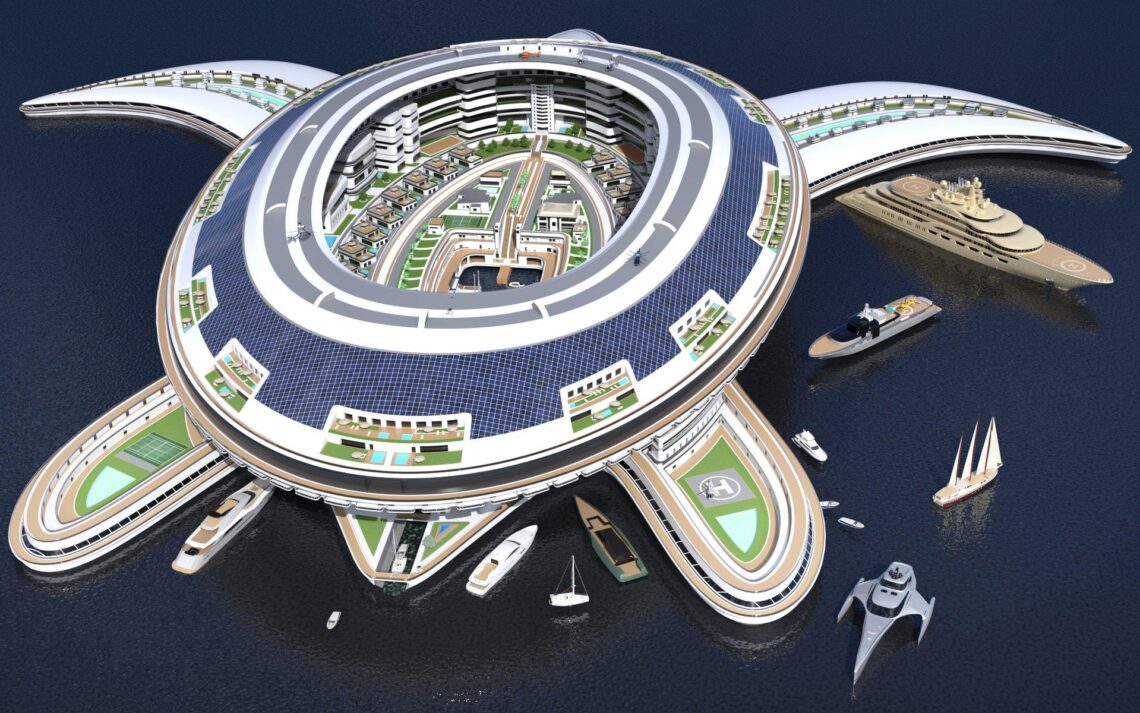
There are few yacht concepts that have generated as much fascination as Pangeos, the enormous turtle-shaped “terayacht” conceived by Italian designer Pierpaolo Lazzarini and his Rome-based Lazzarini Design Studio.
It is not really a yacht in the conventional sense.
At approximately 550 metres long and 610 metres wide, Pangeos was conceived as a floating city capable of accommodating as many as 60,000 people. The proposed structure includes hotels, residences, shopping areas, parks, entertainment spaces, a marina and facilities for aircraft.
And that distinction—concept versus construction project—is extremely important when looking at where Pangeos stands today.
2009: THE IDEA BEGINS
The Pangeos story actually starts well before the spectacular renderings appeared online.
Around 2009, according to accounts of the project, Lazzarini began contemplating something much larger: rather than simply designing a yacht, why not create a floating city capable of moving around the world?
That eventually became Pangeos.
The name is a reference to Pangaea, the prehistoric supercontinent.
2022: PANGEOS IS REVEALED
The project really entered the public consciousness in November 2022, when Lazzarini Design Studio released its detailed concept.
The numbers were extraordinary:
- 550 metres length
- 610 metres maximum beam
- Approximately 30 metres draft
- Up to 60,000 occupants
- Approximately 30,000 floating cells making up the hull
- Nine proposed electric propulsion units
- Approximately 16,800 hp per engine
- Target cruising speed around 5 knots
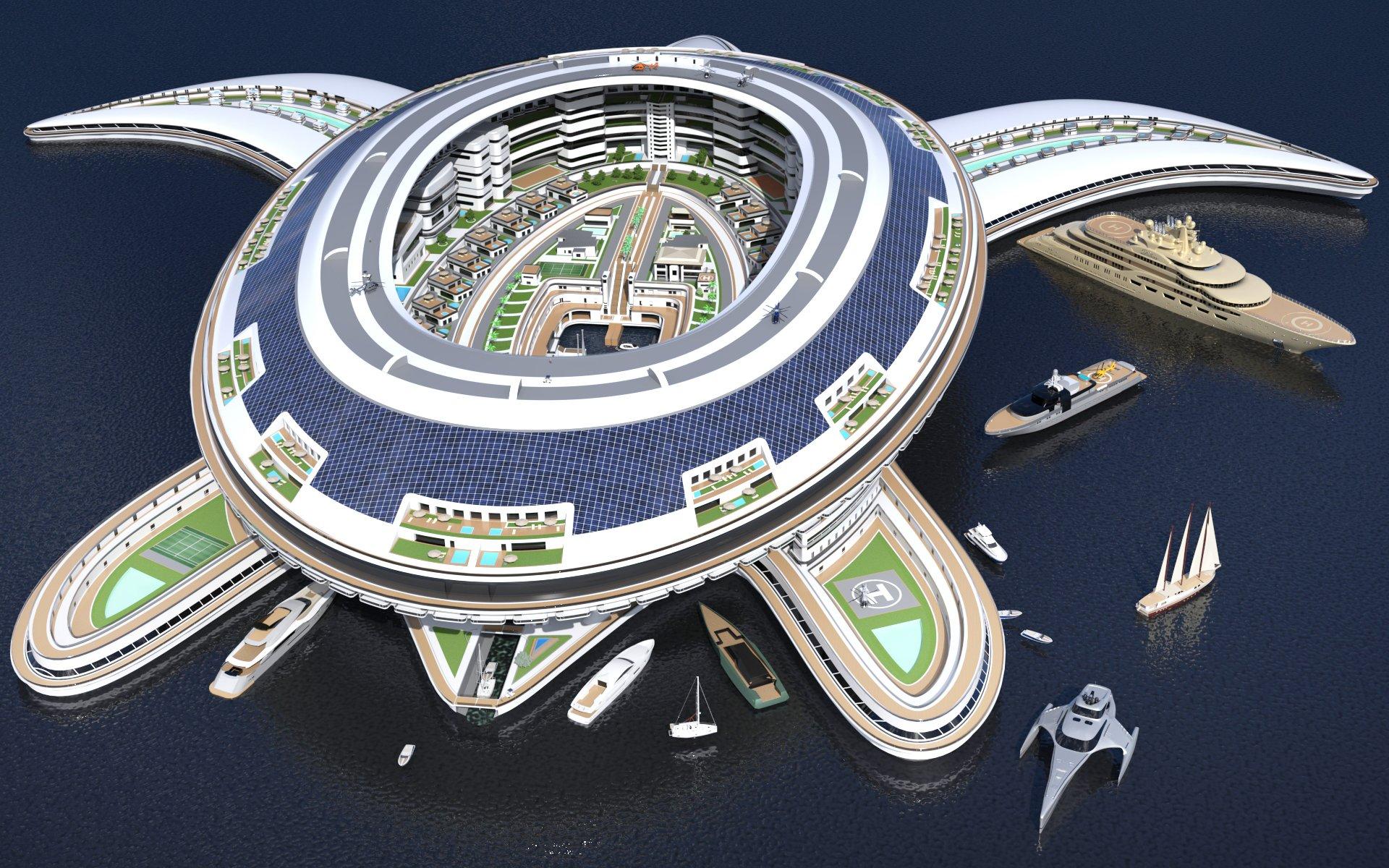
The design essentially takes the shape of a giant sea turtle.
The central body becomes the “shell”, while enormous lateral structures form the equivalent of the turtle’s flippers.
WHY IS IT SO LARGE?
The intention wasn’t simply to build the world’s biggest yacht.
Pangeos was designed as a destination that happens to move.
The concept includes:
- luxury hotels
- private residences
- villas
- restaurants
- shopping
- entertainment
- parks
- swimming areas
- beach-club-style spaces
- internal maritime facilities
- aircraft access
- public areas
The enormous scale allows the designers to treat the vessel almost like an urban development rather than a conventional ship.
That is also why calling it a “terayacht” is more appropriate than calling it a superyacht.
THE ENGINEERING IDEA
The propulsion concept is particularly interesting.
Lazzarini proposed nine electric HTS propulsion systems, each rated at approximately 16,800 horsepower.
The vessel would theoretically use a combination of:
solar energy + wave energy + electric propulsion.
The enormous “flippers” are intended to interact with the movement of the sea, while solar panels would cover portions of the upper structure.
The objective is not speed.
The philosophy is essentially:
Pangeos doesn’t need to rush anywhere because Pangeos itself is the destination.
THEN CAME THE $8 BILLION PROBLEM
The project has always had one enormous obstacle:
money.
Lazzarini has estimated the cost at approximately $8 billion.
And this isn’t a normal yacht financing problem.
A conventional superyacht can be built inside an existing shipyard.
Pangeos cannot.
There isn’t currently a shipyard capable of simply putting Pangeos into a construction dock.
According to the project’s specifications, a dedicated construction facility would be required measuring approximately 600 × 650 metres.
Approximately one square kilometre of sea would have to be dredged, with a huge temporary circular dam constructed around the building area.
Pangeos would effectively be constructed inside a man-made marine basin.
Once completed, the basin would then be flooded and the structure floated out.
That means the project doesn’t merely require:
$8 billion for a ship.
It potentially requires the creation of an entirely new shipbuilding infrastructure capable of building the ship.
That’s a much bigger proposition.
WHY SAUDI ARABIA?
This is where the story becomes particularly interesting.
Lazzarini identified Saudi Arabia as a potential location for the project.
More specifically, the area around King Abdullah Port, north of Jeddah, has repeatedly been identified as a possible location for the enormous construction facility.
Saudi Arabia made obvious sense from the designers’ perspective.
The country has:
- enormous coastline
- significant financial resources
- ambitions in tourism
- massive infrastructure projects
- Vision 2030
- experience developing projects on a scale rarely attempted elsewhere
And perhaps most importantly:
Saudi Arabia has the physical space.
But there is an enormous difference between saying that Saudi Arabia is a suitable location and saying that Saudi Arabia has agreed to build Pangeos.
I found no credible evidence that the Saudi government or the Public Investment Fund has officially adopted Pangeos as a funded Saudi megaproject.
That distinction gets lost in a lot of online coverage.
THE ORIGINAL CONSTRUCTION TIMELINE
Here’s where some of the confusion comes from.
Early reports suggested that construction could begin around 2025.
But later reporting continued to describe the project as being in the conceptual/development stage.
Some reports subsequently referenced 2033 as the intended construction start.
That is an important evolution.
The original “construction could begin in 2025” messaging should therefore not be interpreted as meaning that a construction programme began in 2025.
It didn’t.
WHAT ABOUT THE FINANCING?
This is perhaps the most interesting part of your question.
There has been a financing mechanism.
But there is a huge difference between fundraising and project financing.
Pangeos has promoted a crowdfunding concept involving what was called “Unreal Estate.”
People could purchase virtual spaces associated with the future Pangeos environment, including virtual tickets, rooms and residences.
The idea was that the virtual ecosystem could create interest and potentially help raise money for the real project.
In other words:
the public could participate in the project before the physical project existed.
The concept was tied to NFTs and a metaverse representation of Pangeos.
But there is no evidence that NFT sales came remotely close to financing an $8 billion construction programme.
And this is where I would be extremely cautious about articles claiming that Pangeos is “being funded.”
It is more accurate to say:
Pangeos has explored crowdfunding and virtual-property sales as part of its funding strategy.
That is not the same thing as:
Pangeos has secured $8 billion in institutional financing.
I found no evidence of the latter.
SO IS THE CROWDFUNDING STILL ACTIVE IN 2026?
This is where things become murky.
However, I could not find a 2026 announcement showing:
- an $8 billion financing close
- a sovereign investment
- a Saudi PIF commitment
- a commercial-bank financing package
- a shipyard contract
- an EPC contract
- a construction contract
- a financial close
- or a formal construction start.
That’s a critical finding.
AND HAS ANYONE ACTUALLY STARTED BUILDING IT?
No—at least not the Pangeos vessel itself.
This is the clearest conclusion I can reach from the evidence available as of August 2026.
The most recent credible reporting I found still says essentially the same thing:
the shipyard required to build Pangeos does not yet exist.
Le Figaro Nautisme, in its March 2026 report, specifically described the required shipyard as something that still needs to be created and continued to identify Saudi Arabia as the prospective location.
That means there is no evidence of:
keel laid → hull construction → modules fabricated → dry-dock assembly → launch basin → completed vessel.
None of that has happened.
WHAT HAS ACTUALLY BEEN BUILT?
This is another important distinction.
There is a substantial amount of digital development surrounding Pangeos:
- 3D modelling
- architectural concepts
- exterior renderings
- interior renderings
- engineering concepts
- propulsion concepts
- virtual real-estate concepts
- metaverse representation
But those aren’t equivalent to physical construction.
The project has become increasingly sophisticated as a design proposal, but there is no evidence that the physical vessel has progressed into a conventional shipbuilding programme.
WHO IS ACTUALLY WORKING ON PANGEOS?
The central figure is:
Pierpaolo Lazzarini
He is the founder and principal figure behind Lazzarini Design Studio.
The studio is responsible for the original concept and design.
But—and this is important—Pangeos doesn’t currently appear to have the sort of enormous industrial consortium that you would normally expect behind an $8 billion shipbuilding programme.
I have not found evidence of a confirmed team consisting of:
- named shipyard
- main contractor
- naval construction consortium
- classification society
- propulsion manufacturer under contract
- financing consortium
- Saudi developer
- sovereign investor
- confirmed operator
That doesn’t mean conversations aren’t happening privately.
It means there is no publicly confirmed industrial team that has taken Pangeos into construction.
WHAT HAS Lazzarini SAID RECENTLY?
This is one of the more revealing aspects of the investigation.
There is plenty of recent media coverage, but surprisingly little evidence of a major new announcement from Lazzarini himself saying:
“We’ve secured the money.”
The March 2026 Le Figaro article still describes the project in terms of the proposed concept, the nonexistent construction facility, the $8 billion estimate and the virtual financing mechanism.
That suggests that the fundamental status had not materially changed by 2026.
THERE’S ANOTHER IMPORTANT RED FLAG
I found an interesting piece of evidence concerning the project’s web presence.
The Pangeos website itself is accessible, but its current web footprint is not particularly strong, and a domain-auction record indicates that pangeosyacht.com was listed in a domain auction in November 2025, reportedly selling for $5,900.
I would not automatically conclude from that that the Pangeos project is dead.
Domains can change ownership, management or hosting arrangements for all kinds of reasons.
But it is certainly something worth flagging because the project supposedly remains active.
It also makes me considerably more cautious about claims that the NFT crowdfunding operation is still functioning normally in 2026.
AND THEN THERE IS THE NFT QUESTION
There is another reason to be careful.
German yacht publication YACHT previously investigated the Pangeos NFT concept and raised concerns surrounding the project’s virtual-property sales and the possibility that buyers could end up with digital assets without the physical project ever materialising.
That doesn’t establish wrongdoing.
But it highlights the fundamental financial problem:
An NFT campaign cannot substitute for the institutional financing required to build a $8 billion marine megastructure.
At some point Pangeos would need serious capital.
Probably:
sovereign wealth / institutional investors + project finance + strategic development partners + potentially presold residences/hospitality + enormous government infrastructure investment.
WHAT ABOUT SAUDI ARABIA’S FINANCIAL SITUATION?
This is where the timing becomes fascinating.
Saudi Arabia remains one of the few places on Earth where a project of Pangeos’ scale is at least imaginable.
But 2025–2026 has also demonstrated that Saudi Arabia is becoming more selective about its megaproject spending.
Reuters reported in January 2026 that Saudi Arabia had suspended construction beyond excavation and piling on the massive Mukaab project while financing and feasibility were reassessed.
Reuters had previously reported in October 2025 that Saudi Arabia’s Public Investment Fund was reconsidering its strategy following delays and concerns surrounding several massive Vision 2030 projects.
That doesn’t mean Saudi Arabia couldn’t finance Pangeos.
But it makes the absence of a formal Saudi commitment even more significant.
If Pangeos were going to become an $8 billion flagship Saudi project, we would expect to see some combination of:
PIF announcement → Saudi developer → land/sea allocation → engineering consortium → shipyard announcement → financing → construction contract.
None of that has publicly materialised.
MY 2026 STATUS REPORT
If I were writing an investment or industry briefing today, I would classify Pangeos as:
PROJECT STATUS: CONCEPT / DEVELOPMENT
Not:
Under construction
Not:
Financed
Not:
Approved Saudi megaproject
Not:
Shipyard construction
Not:
Financial close
And certainly not:
Guaranteed to be built.
The timeline
Year | What happened |
|---|---|
2009 | Lazzarini begins developing the idea of a giant floating-city concept |
2022 | Pangeos publicly unveiled as a 550 × 610 m terayacht |
2022–23 | Saudi Arabia identified as potential construction location |
2023 | NFT/virtual-property crowdfunding strategy promoted |
2024 | Project remains conceptual |
2025 | Major renewed media attention; still no physical construction |
2025 | Reports continue to describe Saudi Arabia/King Abdullah Port as a potential site |
2026 | Le Figaro still describes the necessary shipyard as nonexistent and Pangeos as a proposed project |
August 2026 | No verified construction start, no disclosed $8bn financial close, no confirmed shipyard consortium or Saudi government funding commitment found |
SO, IS PANGEOS DEAD?
I wouldn’t call it dead.
But I also wouldn’t call it an active construction project.
There is a more accurate description:
Pangeos is a live design concept searching for the industrial and financial conditions necessary to become a real project.
That’s quite different from the impression created by some of the viral headlines.
The design itself remains alive.
The concept continues to circulate.
Lazzarini continues to work on futuristic maritime projects.
And media coverage of Pangeos continues into 2026.
But the bridge between rendering and reality has not yet been crossed.
THE BIG QUESTION: COULD IT ACTUALLY BE BUILT?
Technically?
Possibly.
Financially?
Extremely difficult.
Commercially?
That’s the bigger question.
The engineering challenge isn’t merely making a 550-metre object float.
The challenge is creating a structure 610 metres wide, capable of carrying tens of thousands of people, surviving ocean conditions, providing hotel/residential infrastructure, maintaining stability, operating propulsion and power systems, satisfying classification and maritime regulations, and doing all of that economically.
Then there’s the extraordinary question of emergency evacuation.
Imagine evacuating 60,000 people from a floating structure in the middle of the ocean.
Then imagine:
- fire
- severe weather
- collision
- propulsion failure
- flooding
- medical emergencies
- aviation operations
- waste management
- freshwater production
- food supply
- fuel/electricity storage
- insurance
- maritime jurisdiction
- passenger regulations.
At that point you’re no longer just building a yacht.
You’re building a floating city with its own infrastructure ecosystem.
MY BIGGEST TAKEAWAY
The most interesting thing about Pangeos in 2026 isn’t actually the turtle.
It’s the gap between the publicity and the project-development reality.
The renderings make Pangeos look almost inevitable.
The reality is much different.
The project has no confirmed construction site, no publicly disclosed construction consortium, no confirmed $8 billion financial close, no confirmed Saudi government/PIF investment, and no evidence of physical construction of the vessel.
The fact that recent 2026 reporting continues to describe the required shipyard as something that still needs to be created is probably the single most important status indicator.
And if someone tells you in 2026 that “Pangeos is being built in Saudi Arabia,” I’d ask them one simple question:
“Show me the construction contract.”
Because at the moment, the evidence doesn’t show one.
One final clarification
There is also a completely unrelated European scientific initiative called PANGEOS COST Action, which appears prominently in search results and has active 2026 meetings and funding. That organization has nothing to do with Lazzarini’s Pangeos terayacht.
So you will see “PANGEOS funding” and “PANGEOS 2026” search results that have nothing whatsoever to do with the yacht.