In the relentless pressure-cooker of Formula 1’s 2026 technical landscape, public apologies and grid penalties are merely static noise. For Fred Vasseur and the engineers at Maranello, the true narrative is defined by one relentless variable: raw, uncompromising performance on the asphalt.
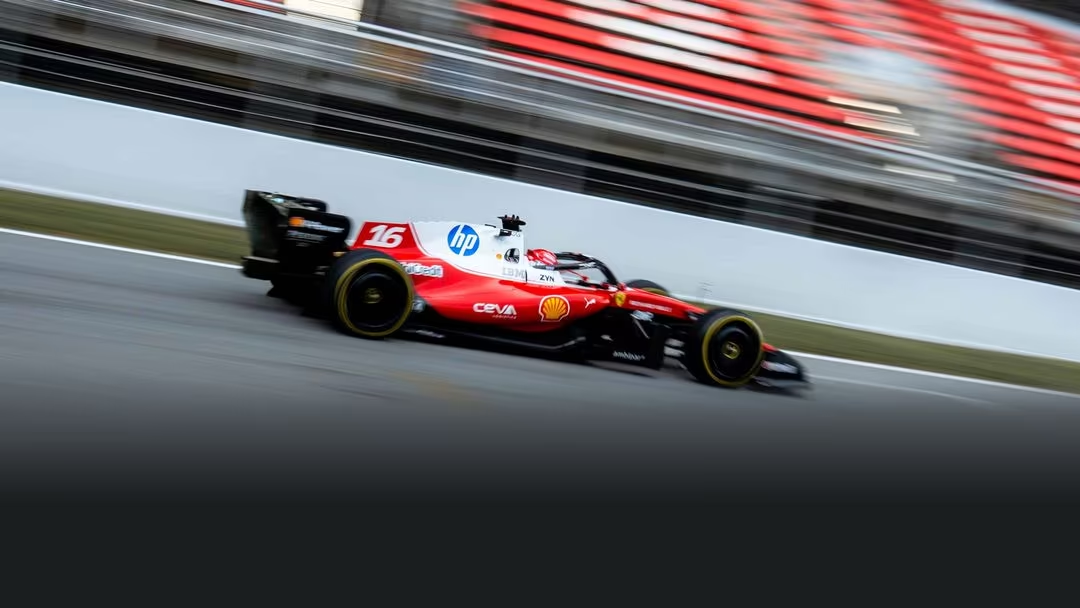
As the paddock prepares for the historic, ultra-high-speed sweeps of the Autodromo Nazionale Monza, all eyes are fixed firmly on the Scuderia Ferrari HP garage. The SF-26 has already proven itself to be an absolute mechanical weapon through complex, high-downforce cornering sectors—yet its high-speed deficit on long straights has remained a persistent Achilles’ heel.
Monza is not just another race on the calendar; it is the ultimate low-drag crucible. To conquer their home turf, Maranello is unleashing a massive, two-stage technical package engineered to solve the SF-26’s straight-line bottlenecks.
The Mechanical Vanguard: “ADUO 2” Power Unit Upgrade
The crown jewel of Ferrari’s Monza strategy lies beneath the engine cover. Utilizing the FIA’s 2026 Additional Development and Upgrade Opportunity (ADUO) framework—a regulatory mechanism designed to allow engine manufacturers to close performance gaps—Ferrari is debuting their highly anticipated ADUO 2 power unit specification.
While the earlier ADUO 1 iteration introduced in Austria delivered a modest baseline bump, ADUO 2 represents a fundamental architectural refinement:
- Redesigned Turbocharger Assembly: Early in the 2026 cycle, Ferrari opted for a compact turbocharger layout optimized for instant throttle response. However, following procedural start tweaks and real-world deployment data, that smaller turbine created a power ceiling at peak RPMs. The Monza package introduces revised blade geometry and advanced heat-tolerant alloys to sustain maximum boost longer down Monza’s legendary straights.
- Shell High-Density Fuel Formulation: In tandem with the hardware tweaks, technical partner Shell has introduced an updated synthetic fuel blend targeting an estimated 8 to 9 additional horsepower, bringing the total targeted engine recovery program close to a crucial 30-hp threshold.
- Thermal Management: Extreme combustion temperatures demand elevated thermal efficiency. The updated ICE layout balances higher top-end output without compromising the baseline reliability required for the second half of the season.
Aerodynamic Architecture: Floor Expansion & The Low-Drag Wing
An upgraded engine is useless if the chassis creates excessive drag. To complement the ADUO 2 deployment, Ferrari’s aerodynamic department has tailored a bespoke, ultra-low-drag floor and wing configuration specifically for Monza’s high-speed profile.
[ SF-26 Monza Aerodynamic Ecosystem ]
Low-Profile Front Wing —> Underbody Diffuser —> Rotating Rear Wing
(Minimizes Wake Drag) (Extends Low-Pressure) (Flattens for Speed)
1. Underbody Diffuser & “Mouse Hole” Optimization
The SF-26’s floor architecture relies on aggressive, rearward-mounted differential packaging that allows lower bodywork to extend beyond standard limits. At Monza, Ferrari is introducing refined lateral “mouse hole” slots near the diffuser walls. These cutouts energize the underbody airflow, maintaining underfloor suction and cornering stability while drastically reducing the drag penalty associated with traditional high-downforce floor edges.
2. Evolution of the Active Rear Wing
Ferrari’s radical rotating rear wing design—which active aero regulations allow to flatten out along straightaways—receives a bespoke low-downforce mainplane for the Temple of Speed. By reducing the chord length of the upper flap and reprofiling the wing endplate actuators, the wing transitions into its low-drag configuration with greater fluid continuity, effectively eliminating drag wakes behind the rear tires.
The Head-to-Head Technical Landscape
Heading into the Italian Grand Prix, the grid finds itself divided between distinct design philosophies:
Technical Vector | Scuderia Ferrari HP (SF-26) | Mercedes-AMG F1 | McLaren F1 Team |
|---|---|---|---|
Cornering Balance | Exceptional low-to-mid speed traction | Strong mid-speed stability | High aerodynamic consistency |
Monza Aero Strategy | Extended diffuser ramp + ultra-low-profile active wing | Beam-wing deletion focus | Low-drag trim with aggressive wing slots |
Power Unit Status | ADUO 2 Spec (Focus on top-end turbo recovery) | Baseline benchmark output | Customer Mercedes PU |
The Bottom Line
For Charles Leclerc and Lewis Hamilton, Monza is far more than an emotional homecoming—it is a technical referendum. If the ADUO 2 power unit step operates as simulated, bridging the straight-line top-speed gap while preserving the SF-26’s lethal cornering balance, Ferrari won’t just be competing for a podium at home. They will be actively redefining the championship fight for the remainder of the 2026 season.