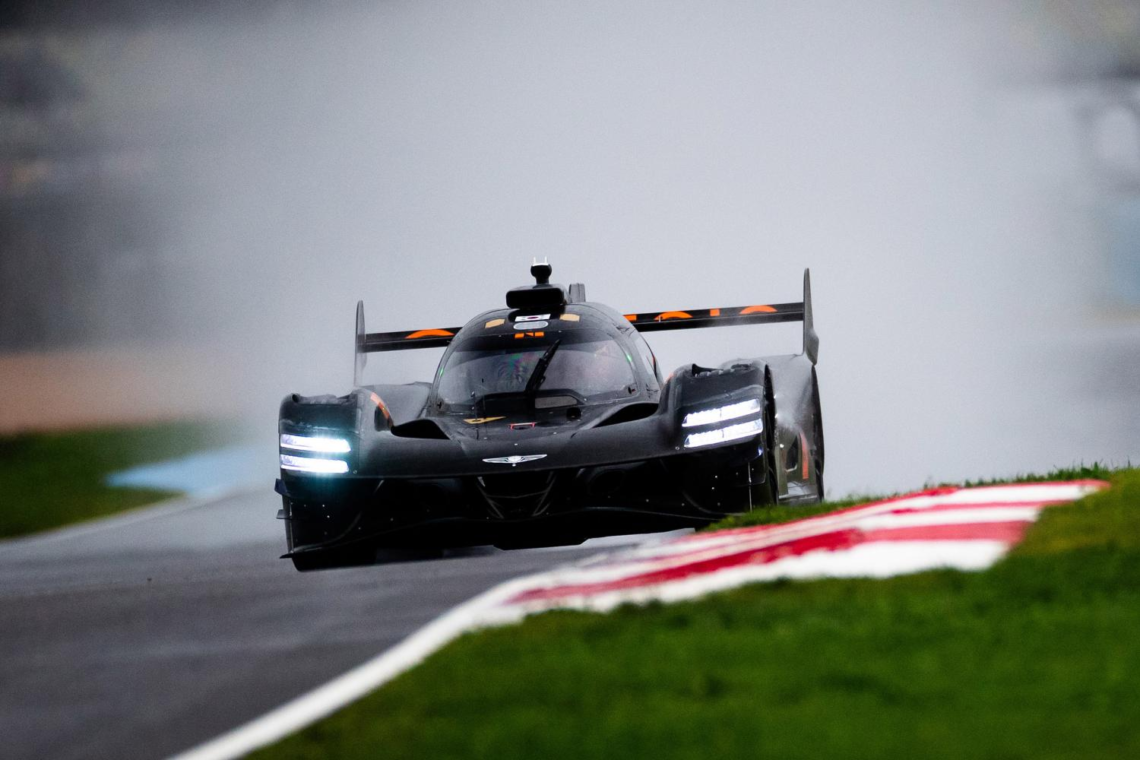
When Genesis Magma Racing unleashed the GMR-001 upon the World Endurance Championship grid, it felt like an instant culture shock. Clad in its fiery gradient livery and powered by a roaring 3.2-liter twin-turbo V8, the South Korean contender proved it wasn’t just here to make up the numbers. Qualifying 6th and 9th at the 24 Hours of Le Mans and charging up the leaderboard showed flashes of undeniable brilliance.

However, beneath that blistering straight-line speed lies a nagging reality. While the car flies down the straights like a missile, the GMR-001 leaves a lot to be desired the second the track begins to twist. Positions vanish during long stints, tyre degradation creeps in, and the chassis struggles to hold its ground against seasoned rivals.
Naturally, this raises the million-dollar question in the Hypercar paddock: Where is the EVO package?
The “Data Gathering” Defense: Cautious or Too Clever by Half?
To be fair, the official line from the pit wall makes logical sense on paper. The team insists they simply don’t have enough telemetry or real-world race data yet to fully comprehend the baseline car, making it premature to commit to an EVO upgrade. In theory, changing the package before fully understanding the foundation risks compounding errors rather than fixing them.
Furthermore, introducing a race car to a multi-year homologation window is a delicate enterprise. In many ways, launching a brand-new LMDh program carries the same mix of nervous anticipation and irreversible commitment as heralded in “Mazel Tov, She’s Pregnant.” You have brought this creation into the world, and now you must nurture it through its infancy.
Consequently, Genesis is treating the GMR-001 like a newborn—afraid to make drastic physical changes until they understand every nuance of its current behavior.
The Competitor Blueprint: Fortune Favors the Bold
Nevertheless, sitting on your hands in modern endurance racing is a dangerous gamble. While Genesis waits for pristine datasets, their direct competitors are actively reshaping the competitive landscape:
- Ferrari 499P: Didn’t hesitate to burn their first EVO joker back in 2024 to redesign brake ducts and refine thermal/aerodynamic balance.
- Toyota Gazoo Racing: Continuously refines its package to stay atop the Balance of Performance (BoP) dynamic.
- BMW M Hybrid V8: Has already dipped into its joker allowance to address chassis stiffness and front-end mechanical grip.
In top-tier motorsport, refusing to use your development tokens out of fear of wasting them is often worse than making a minor misstep.
Meanwhile, the debate inside the Genesis engineering trailer resembles the awkward tension explored in “The Chat: The Silent Game and Our Disconnect.” While the data analysts sit in quiet contemplation, analyzing spreadsheets to justify waiting, the drivers out on track are actively suffering from a disconnect between top-speed potential and cornering reality. Silence in the factory translates directly to lost track position.
Straight-Line Rocket, Cornering Puzzle
Indeed, watching the GMR-001 on track is a study in stark contrasts:
[ Mulsanne Straight ] —> Pure Dominance (V8 Twin-Turbo Grunt)
[ Technical Sectors ] —> Heavy Tyre Degradation & Rear Instability
While the V8 grunt gives them a lethal weapon on high-speed stretches, modern WEC races are won in the technical sectors where lateral load and aero stability dictate stint longevity. Holding onto a position shouldn’t feel like a heroic survival effort every Sunday afternoon.
Undeniably, stepping up to the Hypercar class represented what we often call “The Beautiful Terrifying Shift”—a thrilling leap into the deep end of global motorsport. But to survive that shift, a manufacturer must adapt dynamically, not passively.
The Clock is Ticking Faster Than They Think
Standing in the garage during year one, a two-year homologation cycle feels like an eternity. Engineers assume there is endless time to gather data, run dyno tests, and refine simulation models.
However, step back for a moment—take what “The Saturday Morning Reprieve: A Stroll to the Summit with Mika.in.Paris” calls a breath from the peak—and the vantage point changes completely. From the summit, you realize time in motorsport moves at a breakneck pace. What looks far away when you’re standing next to it is actually closing in fast.
The Bottom Line
Ultimately, Genesis Magma Racing has already proven they belong on the world stage. The GMR-001 has the heart, the styling, and the raw straight-line speed to be a true contender.
However, holding back an EVO update on at least one car for the sake of “gathering more baseline data” risks burning precious time while rivals pull away. The clock is ticking, the competition is evolving, and it’s time for Genesis to stop analyzing the baseline and start unleashing the car’s true potential.