Asphalt - Cars - The Lifestyle

The Mad Genius of Clapham: Sydney Allard’s Transatlantic Formula

Long before Carroll Shelby’s name became synonymous with the Anglo-American hybrid, a eccentric British racer and shop owner named Sydney Allard was working out of a small garage in Clapham, South London.

In the late 1940s, while the European motorsport elite Ferrari, Jaguar, and Aston Martin—were building sophisticated, high-revving, small-displacement sports cars, Allard had a brutally simple idea. He took a lightweight, minimalist British chassis, stuffed a massive American V8 under the hood, and sent it out to conquer the racing world.

His creation was the Allard J2.

When American sports car drivers like Zora Arkus-Duntov (the man who would later engineer the Chevrolet Corvette) and Carroll Shelby drove the J2 in the early 1950s, it was an awakening. The car was wild, tail-happy, and brutally fast. At the 1950 24 Hours of Le Mans, Sydney Allard personally co-drove a Cadillac-powered J2 to a shocking 3rd place overall—despite driving the final hours stuck in third gear.

Allard had inadvertently written the blueprint for the modern transatlantic performance car. But while Sydney Allard would later pivot to become the “Father of British Drag Racing,” building Europe’s very first Chrysler Hemi-powered dragster in 1961, his Anglo-American formula was about to be perfected by another boutique British maker down the road.

Thames Ditton, John Tojeiro, and the Birth of an Icon

Just miles away from Allard’s workshop sat AC Cars in Thames Ditton, Surrey—one of the oldest independent British car manufacturers in existence.

In the early 1950s, AC was looking for a modern design to capture post-war buyers. They turned to a brilliant freelance engineer named John Tojeiro, who had hand-built a lightweight aluminum Barchetta race car inspired by the Ferrari 166 MM.

AC bought the rights to Tojeiro’s design and launched it as the AC Ace in 1953.

The Ace was a masterclass in balance:


  • It featured a rigid, twin-tube ladder frame chassis.

  • It utilized an independent transverse leaf-spring suspension.

  • It was clothed in a breathtaking, hand-beaten aluminum body that weighed virtually nothing.

For years, the Ace competed on European circuits powered by modest inline-six engines. It was universally praised for its razor-sharp agility, exceptional steering feedback, and poise. But by the turn of the decade, AC was facing a major crisis: their engine supplier, Bristol, was shutting down production. AC had a world-class, beautifully balanced chassis, but no engine to put inside it.

The Handshake That Changed Motorsport History

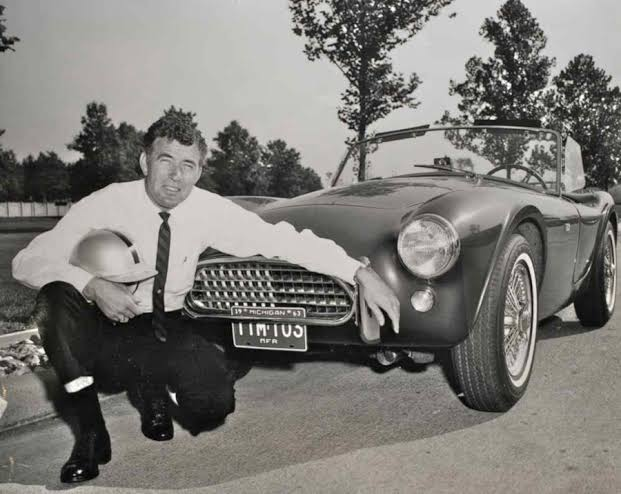
In late 1961, a tall Texan in a black cowboy hat walked into the Thames Ditton factory. It was Carroll Shelby.

Shelby hadn’t forgotten the lessons he learned years earlier while driving Sydney Allard’s V8-powered race cars. He knew that if you took a agile, lightweight British chassis—like the AC Ace—and dropped a lightweight American V8 into it, you would have a Ferrari-killer.

Shelby convinced AC Cars to modify the Ace’s engine bay and chassis to accept Ford’s new 260-cubic-inch V8.

In early 1962, the prototype was shipped across the Atlantic to Venice, California. Shelby and his small team squeezed the Ford V8 into the AC chassis, painted it bright yellow, and took it out on the streets to terrorize local racers.

The AC Cobra was born.

The Legacy of the Anglo-American Hybrid

The lineage running from Sydney Allard’s Clapham workshop through John Tojeiro’s sleek AC Ace chassis directly created the most fiercely celebrated roadster in automotive history.

At the 1964 24 Hours of Le Mans, the aerodynamically optimized AC Cobra Daytona Coupes dominated the GT class, breaking Ferrari’s long-standing stranglehold on world GT racing.

The story of AC and Allard is a core pillar of car culture: proof that true automotive breakthroughs rarely come from giant corporate boardrooms. Instead, they come from small, passionate workshops where engineers are brave enough to mix European handling grace with raw American horsepower.

Leave a Reply

Your email address will not be published. Required fields are marked *