Before the name McLaren became synonymous with Formula 1 world championships and record-breaking hypercars, it belonged to a quiet, tenacious engineer and racing driver from New Zealand. Bruce McLaren was not merely a champion behind the wheel; he was a visionary constructor whose passion reshaped motorsport history.
1. Before the Empire: The Early Years
Born in Auckland, New Zealand, in 1937, Bruce Leslie McLaren was immersed in the world of automobiles from the start. His father, Les McLaren, was a service station owner and motorcycle racer. Bruce grew up in an apartment above the family garage, learning the inner workings of engines before he was even old enough to hold a driver’s license.
His path, however, was nearly cut short at age nine when he contracted Legg-Calvé-Perthes disease, a painful hip disorder. Bruce spent nearly three years in traction and wheelchairs, leaving him with a permanent limp and one leg shorter than the other.
Far from dampening his spirit, the ordeal forged an extraordinary resilience. Deprived of contact sports, he channeled his energy into engineering and mechanics.
- First Race (Age 15): Bruce competed in his first local hill-climb behind the wheel of a restored Austin 7 Ulster.
- The European Breakout: Studying engineering at the University of Auckland, his exceptional driving talents earned him the inaugural “Driver to Europe” scholarship in 1958.
- History in the Making: Joining the Cooper Formula 1 team alongside Jack Brabham, Bruce won the 1959 United States Grand Prix at just 22 years old—becoming the youngest Grand Prix winner in history at the time, a record that stood for over four decades.
2. The Spark: What Inspired Bruce to Start His Own Company?
By the early 1960s, Bruce was one of the finest drivers on the F1 grid, but his talents extended far beyond driving technique. He possessed an intuitive understanding of vehicle dynamics, aerodynamics, and structural engineering.
As Cooper’s performance began to stall relative to its rivals, Bruce grew frustrated with the constraints of driving for a factory team whose engineering decisions he could not fully control. He recognized a simple truth: to build cars capable of winning on his own terms, he needed to control every aspect of the design and build process.
“To do something well is so worthwhile that to die trying to do it better cannot be foolhardy. It would be a waste of life to do nothing with one’s ability, for I feel that life is measured in achievement, not in years alone.”
— Bruce McLaren
In 1963, at just 26 years old, he founded Bruce McLaren Motor Racing Limited. Starting in a modest workshop near London, Bruce brought together a tight-knit group of talented mechanics and designers. His hands-on leadership style was legendary—he was as comfortable sweeping the factory floor or wielding a wrench as he was taking pole position.
The team quickly dominated the North American Can-Am (Canadian-American Challenge Cup) series in the late 1960s, earning the nickname the “Bruce and Denny Show” alongside teammate Denny Hulme.
3. The McLaren M6GT: Why It Was Special to the Man
While Bruce’s race cars were winning championships across the globe, his grandest ambition was taking shape off the track: building the ultimate road-legal supercar.
A Track Legend Made for the Street
In 1969, Bruce conceived the McLaren M6GT. Based on the championship-winning M6A Can-Am race chassis, the M6GT was designed to be the fastest, best-handling, and lightest road car in the world.
- Weight & Power: Weighing just 800 kg (1,764 lbs) with an ultra-lightweight fiberglass and aluminum monocoque, it was powered by a Bartz-tuned 5.7-liter Chevrolet V8 producing around 370 horsepower.
- Staggering Performance: It sprinted from 0 to 100 mph (161 km/h) in just 8 seconds with a top speed of 165 mph (265 km/h)—eclipsing contemporary offerings from Ferrari, Lamborghini, and Porsche.
- Pioneering Aerodynamics: The M6GT featured iconic butterfly doors and a sleek, low-slung aerodynamic silhouette.
Bruce’s Personal Transport
The M6GT was not just a commercial prototype; it was Bruce’s personal passion project. Registered as OBH 500H, the prototype became his daily commuter car. He drove it to business meetings, race tracks, and social events, continuously tweaking and refining the design based on real-world driving.
Bruce intended to homologate the car for GT racing by producing 250 road-going units in partnership with Trojan. It represented the transition of McLaren from a pure racing outfit into a premier road car manufacturer.
An Unfinished Legacy
Tragically, on June 2, 1970, Bruce McLaren lost his life at the age of 32 during a high-speed testing accident at the Goodwood Circuit in England. Following his death, the ambitious production run for the M6GT was suspended, leaving only three original prototypes in existence.
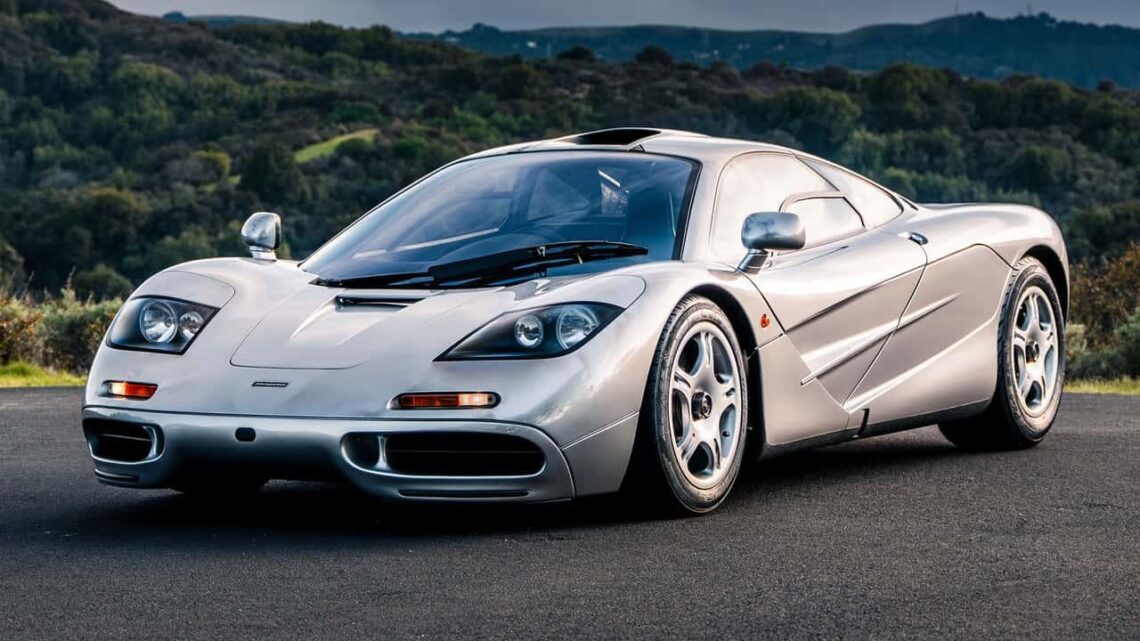
Though his life was cut short, the M6GT set the design philosophy, engineering mindset, and pursuit of lightweight performance that later birthed the legendary McLaren F1 in 1992 and modern McLaren Automotive today. The M6GT remains the emotional genesis of every McLaren road car ever built.