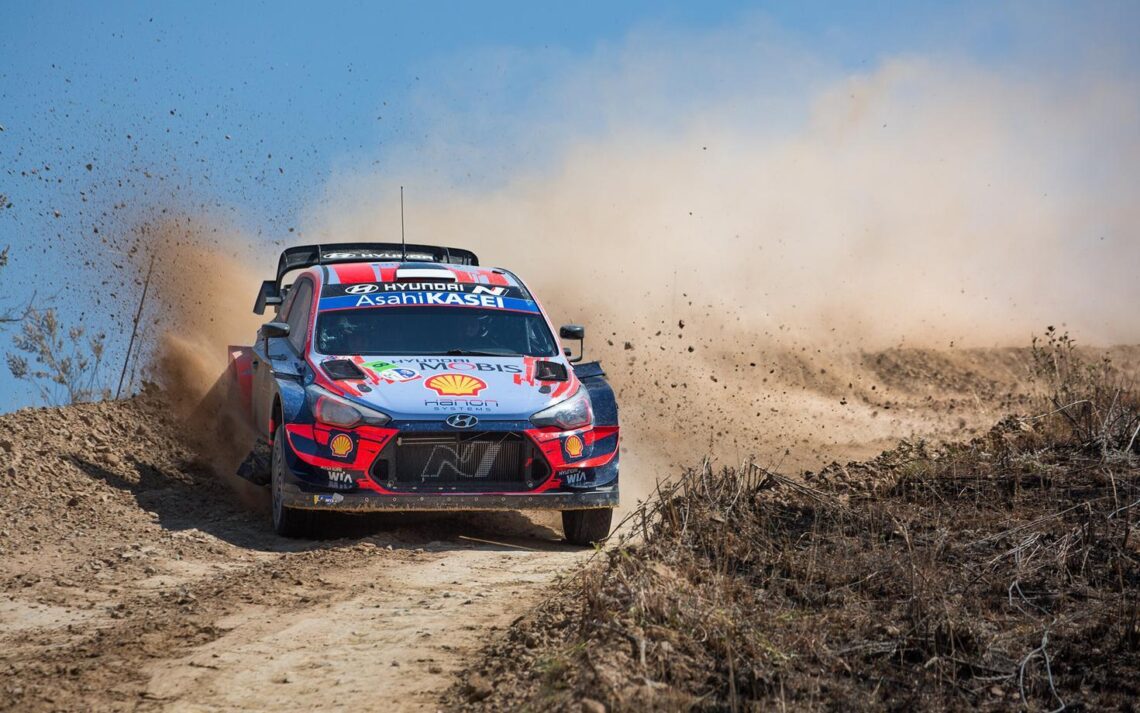
There is an old rallying adage that the EKO Acropolis Rally Greece isn’t a race against the stopwatch; it’s a race against the bedrock. On Day 2 of this legendary fixture, the gods of speed demanded their usual toll in broken machinery, shredded rubber, and shattered nerves.

As the dust settled on the longest and most punishing leg of the event, Hyundai’s Thierry Neuville emerged from the chaos clinging to a razor-thin lead over the relentless, eight-time world champion Sébastien Ogier.
The Crucible: Why Greece Breaks Cars and Drivers
To understand the difficulty of Day 2, you have to look at the geology of the Loutraki region. The stages north of the Gulf of Corinth aren’t just gravel—they are a shifting graveyard of jagged limestone and unforgiving bedrock. This year, organizers added massive amounts of loose stones and rocks to resurface several sections, inadvertently turning the stages into an absolute tire-shredding lottery.

On Day 2, drivers faced a brutal cocktail of mechanical nightmares:
- The Sweeping Disadvantage: As the early cars on the road, championship front-runners like Elfyn Evans and Sébastien Ogier acted as literal brooms. They were forced to sweep away inches of loose, power-sapping gravel, sacrificing massive amounts of traction and time to the cars starting further down the order.
- Aerodynamic Sabotage: The rocks don’t just puncture tires; they smash bodywork. Thierry Neuville lost his front splitter early on, completely unbalancing his car’s high-speed aerodynamics. On the fast, sweeping sections of the Stiri stage, a missing splitter means the car fights its own downforce, turning a 500-horsepower hybrid rocket into a handful to steer.
- The Tyranny of Tyres: The line between a stage win and a three-minute disaster is millimeters wide. Drivers were forced into a delicate, frustrating dance of risk management. Push 5% harder for a stage win, and a sharp step in the bedrock will pinch-puncture a tire instantly.
Few escaped unscathed. M-Sport Ford’s rising star Jon Armstrong secured a historic debut stage win on Elikon Mt, only to have his rally unravel moments later with a front-right puncture and subsequent power loss. Toyota’s Kalle Rovanperä and Takamoto Katsuta both fell victim to the Greek rock, losing roughly two minutes each to mid-stage wheel changes.
The Standings After Day 2
Through a masterful blend of calculated aggression and pure mechanical sympathy, Thierry Neuville holds the top spot, but Sébastien Ogier is breathing heavily down his neck. The gap stands at less than ten seconds, setting up a phenomenal weekend shootout.
| Position | Driver | Team / Vehicle | Gap to Leader |
| 1 | Thierry Neuville | Hyundai Shell Mobis WRT | — |
| 2 | Sébastien Ogier | Toyota Gazoo Racing WRT | +6.3s |
| 3 | Adrien Fourmaux | M-Sport Ford World Rally Team | +50.6s |
| 4 | Josh McErlean | M-Sport Ford (WRC2) | +1m 10.1s |
| 5 | Mārtiņš Sesks | M-Sport Ford World Rally Team | +1m 16.9s |
| 6 | Elfyn Evans | Toyota Gazoo Racing WRT | +2m 08.4s |
“We are taking care of the tires and the car,” Neuville muttered at the end of the grueling loop, his face masked in white dust. “Ten seconds in front or behind doesn’t change anything on a rally like this. There is a massive amount of work left.”
Ogier, ever the tactician, mirrored the sentiment. The Frenchman refused to over-drive the car, treating the brutal stages like an endurance marathon rather than a sprint. “We could push more, but the risk of puncture here is too high. We follow the plan.”
Behind the leading trio, M-Sport’s Josh McErlean is putting together a career-defining performance in fourth, fending off a charging Elfyn Evans, who clawed his way back up the leaderboard after a miserable morning loop of cleaning the roads.
The Acropolis has done its job. It has stripped away the fluff, broken the fragile, and left only the toughest engineering and smartest minds at the front. With the rally transitioning south into the tree-lined mountains of Lamia, the game changes—but the pressure remains absolute.