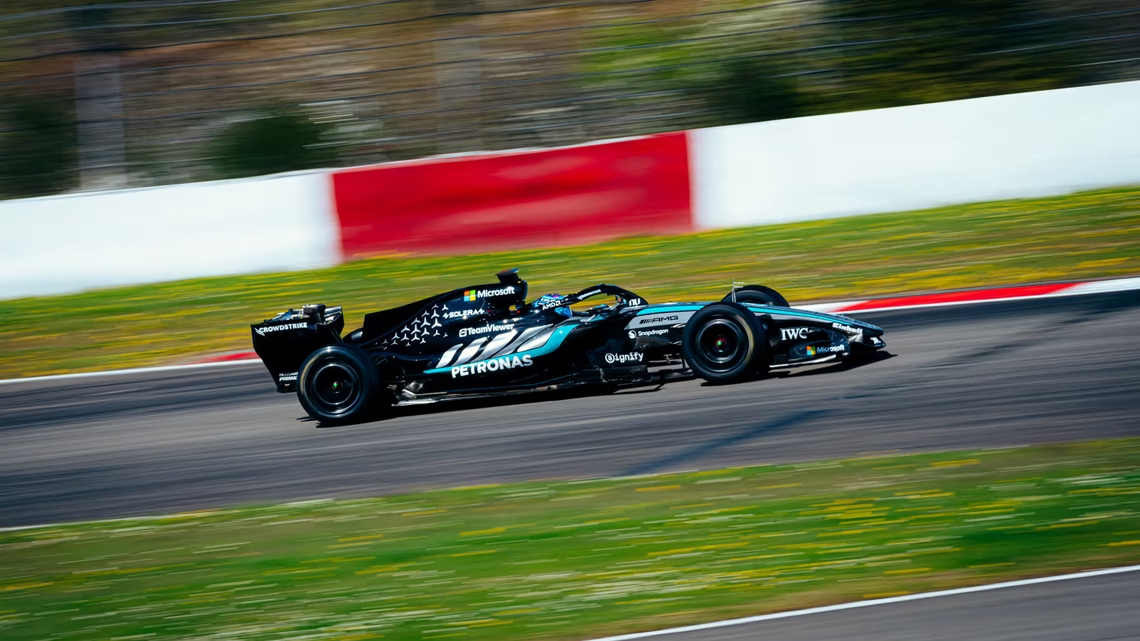
The high-altitude crucible of the Red Bull Ring has always been a graveyard for cooling architectures. But as the paddock unloads into an Austrian Grand Prix weekend plagued by punishing 38°C ambient heat and track temperatures bubbling past 50°C, the technical team at Mercedes AMG Petronas finds itself fighting a localized crisis.

Following a string of catastrophic, heat-induced battery failures that triggered double-DNFs for George Russell and Kimi Antonelli, Technical Director James Allison has been forced to orchestrate a severe, short-term compromise across the W17’s electrical and aerodynamic frameworks to survive the weekend.
[ Thin Alpine Air + 50°C Track Temps ]
│
▼
[ Mercedes W17 Battery Overheating ]
│
┌─────────────────┴─────────────────┐
▼ ▼
[ Aerodynamic Penalty ] [ Strategic Power Penalty ]
Open cooling louvres; Conservative energy maps;
Increased straight-line drag. No prolonged dirty air running.
1. Dialing Back the Core: The Half-Step Backward
The root cause of Mercedes’ recent reliability issues has been traced to the internal thermal limits of their energy store modules. Under aggressive electrical harvesting and deployment cycles, the battery core temperatures have been spiking past critical thresholds, causing localized thermal runaway.
To prevent another weekend of terminal component failures, Allison’s engineering team has implemented a tactical “half-step backward.” Mercedes has explicitly re-mapped their power unit software to run far more conservative energy deployment strategies. By capping the peak harvesting rates of the MGU-K and lowering the maximum discharge velocity, engineers are artificially injecting an extra margin of thermal resilience—sacrificing raw lap time to keep the battery core from cooking itself in the thin mountain air.
2. The Clean Air Mandate
Austria’s rapid-cycling layout features three consecutive DRS zones up steep inclines, demanding maximum deployment from the hybrid system. However, the W17’s internal cooling ducting relies heavily on a clean, high-velocity laminar airflow over the sidepods to pull heat away from the battery housing.
Because wake turbulence significantly reduces cooling efficiency, Mercedes has issued strict operational mandates to both drivers: minimize prolonged stints in dirty air. Trailing closely behind a rival car in the Austrian heat starves the radiator packaging of clean oxygen, a scenario that Mercedes’ simulations show will catastrophically accelerate battery thermal degradation within less than two laps.

3. Phasing in the Module Patch
While a complete structural overhaul of the power unit layout is impossible under current cost-cap regulations mid-season, Mercedes has begun a frantic component-swapping program.
[ W17 Original Energy Store ] [ Emergency Austrian Spec ]
• High-density, tight packing • Redesigned internal modules
• Low thermal tolerance ceiling • Higher structural tolerance
• Prone to wake-induced spikes • Phased into existing pool
The team is actively phasing newly manufactured and structurally optimized battery modules into their active pool. These updated internals feature tighter manufacturing tolerances and improved internal heat dissipation properties, designed specifically to cope with the relentless load of the Spielberg circuit’s uphill acceleration zones.
4. The Aerodynamic Tax
Cooling a highly sensitive hybrid battery in extreme heat requires a physical opening of the car’s bodywork. To keep air flowing through the core, Mercedes has been forced to open up the W17’s rear engine packaging and cooling louvres to their maximum legal parameters.
While this allows the critical MGU and battery components to shed vital BTUs, it comes at a punishing performance cost. The heavily vented bodywork severely disrupts the aerodynamic efficiency of the engine cover, introducing massive amounts of drag down the main straights.
With both Russell and Antonelli already sitting precariously on their second battery allocations out of a maximum of three for the entire season, Mercedes is playing a dangerous game of mitigation: taking a definitive hit to their aerodynamic and hybrid performance to avoid a catastrophic 10-place grid penalty later in the summer.