In the early 1920s, W.O. Bentley had a marketing problem. He was an engineering purist who built cars with immaculate mechanical bones heavy, durable, and highly advanced machines featuring overhead camshafts and four valves per cylinder. But to the British aristocracy, his 3 Litre model was seen merely as a reliable, fast tourer. W.O. himself famously detested motorsport, dismissively calling the newly minted 24 Hours of Le Mans “crazy” and arguing that “cars are not designed to stand that sort of strain for 24 hours.”
He was wrong. And it took a visionary privateer, a band of wealthy hedonists, and a historic triumph in France to alter the course of automotive history, forcing the creation of Bentley’s most hardcore vintage machine: the 1925 3 Litre Super Sports.
The Catalyst: John Duff’s Historic 1924 Triumph
John Duff was not a factory driver; he was an energetic dealer, a veteran of the Great War, and a rogue racer who saw the untapped performance potential hiding within the Bentley 3 Litre chassis. In 1923, entirely on his own dime, Duff entered his personal 3 Litre into the inaugural Le Mans race, dragging a skeptical W.O. Bentley along to watch. Duff finished an impressive fourth despite running out of fuel and having to hike to the pits.

By June 1924, Duff was back at the Sarthe circuit, alongside co-driver Frank Clement, piloting a British Racing Green 3 Litre Sport.
The privateer entry that changed everything: John Duff’s 1924 Le Mans winner. Source: CK-Modelcars
The race was grueling. Facing heavily favored, lighter French entries from Lorraine-Dietrich and Chenard-Walcker, the stone-reliable Bentley hammered its way through 120-degree track heat and night-time downpours. When the checkered flag dropped, Duff and Clement hadn’t just survived; they had won the entire race, covering 1,357 miles and securing Bentley’s first historic international victory.

The win sent shockwaves through London’s elite enclaves. It proved that W.O.’s engineering didn’t just endure it dominated.
Enter the “Bentley Boys” and the Color of Speed
Duff’s victory crystallized a cultural phenomenon. A loose collective of ultra-wealthy British playboys, aviators, and industrialists—dubbed the “Bentley Boys” by the press—adopted the brand as their official uniform. Led by figures like Woolf Barnato (the diamond mining heir who would later buy the company to keep it afloat), Sir Henry “Tim” Birkin, and Glen Kidston, they lived by a simple code: race hard on the weekends, party harder at the Savoy during the week, and drive nothing but British Racing Green.
These men didn’t just want luxury; they demanded raw, unpretentious, technically superior velocity. They wanted road-going versions of Duff’s Le Mans machine, capable of chasing the ultimate automotive milestone of the era: the 100 mph barrier.
W.O. Bentley, now fully aware that racing sold cars, listened. To satisfy this elite, speed-obsessed clientele, he set out to build a highly focused variant of the 3 Litre that stripped away all excess weight and maximized the engine’s architectural potential.
Decoding the Labels: The Genesis of the “Green Label”
To distinguish his different performance states of tune, W.O. utilized a brilliant, color-coded enamel system for the iconic “Winged B” radiator badges:
- Blue Label: The standard, long-wheelbase chassis designed for heavy, bespoke coachwork and refined touring.
- Red Label: The 9-foot, 9-inch short chassis with a high-compression engine the standard “Sport” model.
- Green Label: The ultimate, uncompromising specification. Reserved exclusively for the Super Sports.
The 1925 Super Sports: The First 100-MPH Hot Rod
Unveiled in July 1925 directly as a response to the post-Le Mans demand, the Bentley 3 Litre Super Sports was a mechanical masterpiece of truncation and compression.
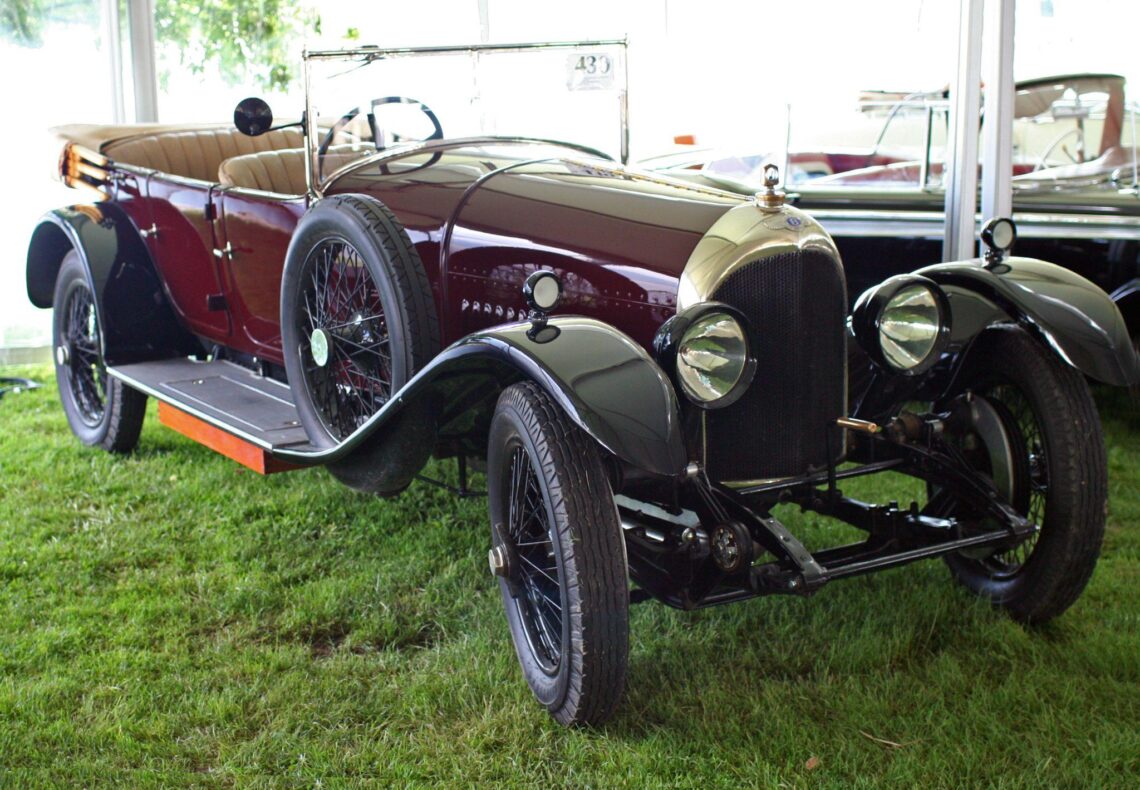
W.O. took the chassis and cut it down to a tiny, ultra-short 9-foot wheelbase to sharpen the handling and shed pounds. Under the hood, the 3-liter four-cylinder engine was pushed to its absolute ragged edge. It was given an extreme high-compression ratio (5.6:1) and fitted with twin SU “sloper” carburetors.
The 1925 Bentley 3 Litre Super Sports: Raw mechanical bones engineered for pure velocity. Source: Bonhams Cars
The car was a sensory assault. It was loud, fiercely quick, and delivered a level of geometric tension in its handling that normal tourers couldn’t hope to match.
The Green Label on the radiator was a formal, binding contract between the factory and the buyer: Bentley mathematically guaranteed that every single Super Sports leaving the factory gates could exceed 100 mph on the banked circuit at Brooklands.
It was so highly strung and tuned so dangerously close to its mechanical limits that Bentley, terrified of the mechanical sympathy (or lack thereof) of the Bentley Boys, slashed their famous five-year vehicle warranty down to just 12 months for Super Sports buyers.
Only 18 units of the original Green Label Super Sports were ever built before production wrapped in 1927. It remains the absolute genesis of the “Supersports” lineage—a direct bridge connecting Privateer John Duff’s muddy, triumphant weekend in France to the high-performance DNA that still defines the brand today.