When BMW M launched the original F87-generation M2 a decade ago, it felt like a spiritual rescue mission. The M3 and M4 had ballooned into grand tourers, leaving a vacuum for the raw, compact, tail-happy magic that defined the legendary E30 and 1M Coupe. The original M2 was a simple recipe: a short wheelbase, straight-six muscle, and 100% of the fury sent exclusively to the rear wheels.

But progress catches up to everything. The second-generation (G87) model arrived with a radical new design language and a massive step up in performance. Now, BMW has done the previously unthinkable: they dropped an all-wheel-drive xDrive system into the M2.
For a car built on the very ethos of rear-wheel-drive delinquency, this is a massive philosophical pivot. Yet, the engineering tells a deeper story. It’s a tale of two halves: a front end that has completely broken from tradition, and a rear end that fiercely guards the car’s founding soul.
The xDrive Function: Weaponized Grip vs. Pure Hooliganism
Purists might initially see the inclusion of M xDrive as sacrilege, but the numbers speak for themselves. The twin-turbocharged 3.0-liter S58 inline-six pumps out 473 horsepower. In the rear-wheel-drive variant, managing that power off the line is an exercise in managing tire smoke.

The xDrive system solves the physics problem. Paired exclusively with the lightning-fast 8-speed automatic, it drops the 0–60 mph sprint down to a blistering 3.3 seconds (with a standard one-foot rollout)—shaving three-tenths off its rear-drive sibling and putting it dead in the crosshairs of supercar territory from just a few years ago.
But this isn’t a clinical, front-heavy commuter system. BMW tuned this setup with a severe rear bias.
- The Intelligent Brain: An electronically controlled multi-plate clutch in the transfer case features integrated wheel-slip limitation. It shuffles torque between the front and rear axles dynamically, adjusting for slip within milliseconds before the central stability control even needs to pull power.
- The Party Trick (2WD Mode): If you’re worried the M2 has lost its edge, you can dive into the M Setup menu and completely decouple the front axle. Turn off the Dynamic Stability Control (DSC), engage 2WD mode, and the car transforms back into a pure, unadulterated rear-wheel-drive drift machine.
Essentially, xDrive turns the M2 into an all-weather, four-season weapon when you need it, and a tire-shredding hooligan when you want it.
The Front End: A Total Departure from the Past
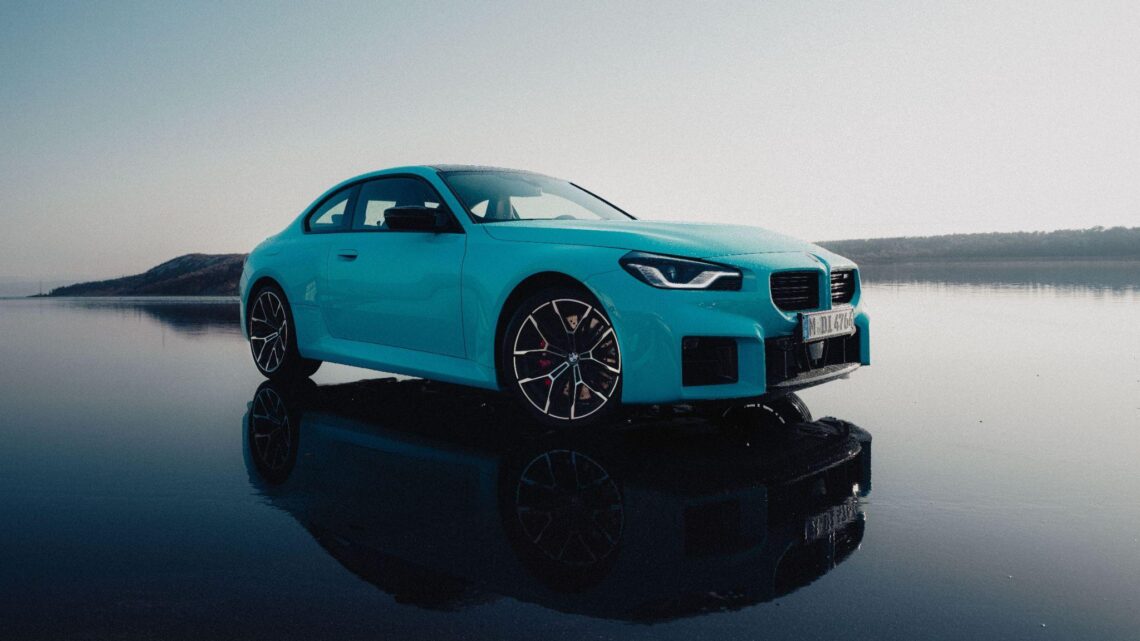
If you park a current G87 M2 next to the original F87, the styling evolution at the front is jarring. The first-generation M2 was defined by organic curves, sweeping lines, and classic BMW proportions. It featured the traditional, rounded kidney grilles and massive, sculpted lower air intakes that felt fluid and aggressive.
The current car completely tears up that script in favor of functional minimalism.
[F87 “OG” Front] ───► Organic curves, sweeping lines, traditional kidney grilles
[G87 Current Front] ──► Blocky geometries, frameless horizontal grilles, absolute function
The front fascia is heavily squared-off, dominated by frameless, horizontal kidney grilles that look almost industrial. Instead of swooping, stylized intakes, the front bumper features blocky, rectangular openings designed with one goal in mind: maximum cooling efficiency for the radiator and brakes. The headlight clusters shranked down to single-LED units, pushed far to the outer edges to emphasize the car’s widened track. It’s a polarizing, tech-forward aesthetic that traded classic elegance for a brutalist, wide-body stance.

The Rear End: Holding True to the Legacy
While the front end looks to the future, the view from the back is a love letter to the original M2’s DNA.
The rear of the M2 has always been its signature angle, defined by hips so wide they look like they belong on a dedicated race car. Thankfully, BMW’s design team didn’t mess with the formula here. The current car retains the aggressively flared rear wheel arches that made the original look so muscular.
Original F87 Rear Current G87 Rear
┌───────────────────────┐ ┌───────────────────────┐
│ • Muscle-bound hips │ ====> │ • Staggered wide tires│
│ • Quad exhaust tips │ TRADITION │ • Center-focused pipes│
│ • True M-car stance │ RETAINED │ • Brutal diffuser │
└───────────────────────┘ └───────────────────────┘
The rear is anchored by a massive diffuser housing the iconic quad exhaust tips two on each side pushed toward the center just like the original M cars of old. The taillights remain compact, keeping the visual weight low and emphasizing the sheer width of the staggered rear rubber (20-inch wheels in the back, 19s in the front). It is blockier and sharper than the original, yes, but the architecture tells the exact same story: this is a wide, stubby, muscular sports car that looks like it’s crouching, ready to pounce.
The Verdict
By pairing the brutalist new front-end design with the classic, muscle-bound rear proportions, BMW has visually mirrored the mechanical transformation underneath. The M2 xDrive is a car that embraces modern engineering to go faster, grip harder, and survive all four seasons yet refuses to forget the sideways, smoke-filled heritage that made it a legend in the first place.