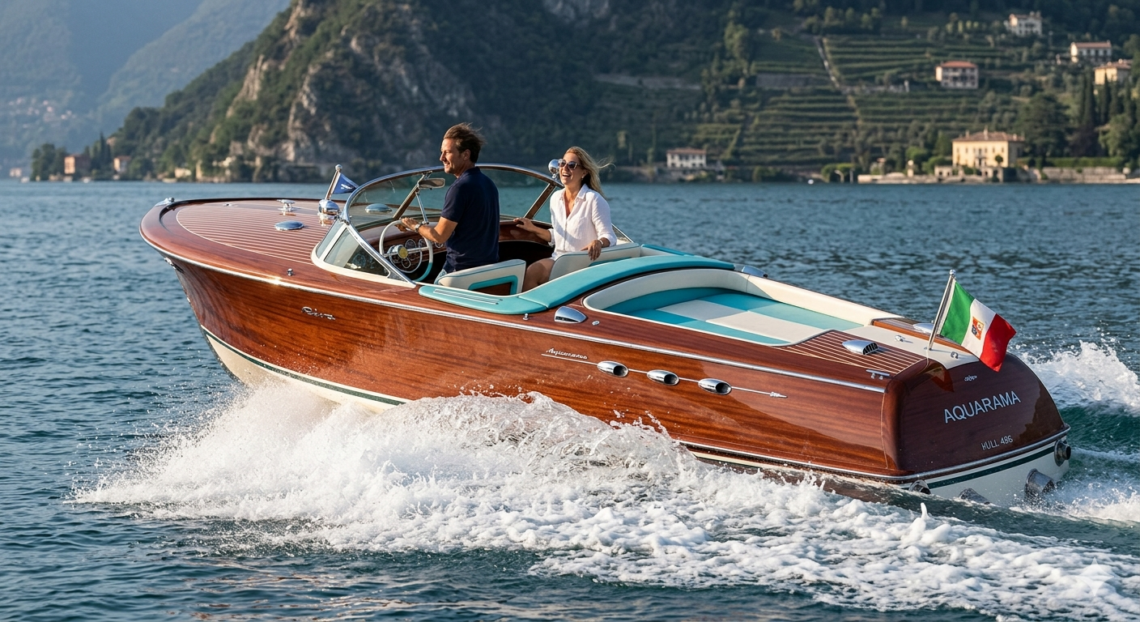
In our initial investigation over at DLifestyleMagazine.com, we laid out the groundwork for the “Phantom Seven” the legendary, ultra-rare run of the Riva Aquarama Lungo series (#496–#502) built in 1972. We established how the 8.72-meter hull served as a massive mechanical bridge between standard marine design and Italian supercar royalty. But a boat does not become a phantom simply because its registry is hidden in an elite vault on Lake Iseo. It begins with the heavy atmosphere of the workshop floor, the select hands allowed inside the room, and a fanatical obsession with organic materials. To understand the true genesis of the series, we have to look directly at the closed doors surrounding Hull #496 during its construction in Sarnico, Italy, and the extreme woodcraft required to preserve its legendary skin.
The Inner Circle: Who Was in the Room?
In 1972, the Riva boatyard was at a historical crossroads. Carlo Riva had sold the company to modern corporate interests a few years prior, but his spirit, his standards, and his inner circle of veteran craftsmen still completely controlled the experimental shop floor. When the blueprint for Hull #496 was pulled down to create a testbed for the extended Lungo hull, it was treated with absolute secrecy.

[The Sarnico Mastermind] âž” Carlo Riva (Design Oversight)
└── Giorgio Barilani (Chief Architect)
└── The "Maestri d'Ascia" (Master Shipwrights)
- Carlo Riva & Giorgio Barilani: While Carlo stepped back from daily administrative duties, he remained a regular shadow on the floor. Alongside him was Giorgio Barilani, Riva’s legendary chief designer since 1957. Barilani was the visual architect responsible for managing the delicate proportions of the extra length, ensuring the boat didn’t lose its signature tumblehome stern.


- The Maestri d’Ascia (Master Shipwrights): The actual construction of #496 was trusted to a tiny handful of elite maestri d’ascia master axe-and-chisel shipwrights who had worked with the Riva family for decades. These men didn’t rely solely on tape measures; they selected and shaped wood based on the distinct tactile feedback of the grain, understanding exactly how the hull would flex when subjected to the violent torque of twin V8 engines at 50 knots.
Material Selection: The Hunt for Perfect Mahogany
The skin of Hull #496 is not a standard marine laminate; it is an organic mosaic. To build a boat worthy of Enzo Ferrari’s personal circle, the timber sourcing was ruthless.

The yard used premium Honduras Mahogany (Swietenia macrophylla), but only a microscopic percentage of imported logs cleared inspection. Carlo Riva demanded logs that were completely free of knots, straight-grained, and possessed a high natural oil density to repel moisture.

More importantly, the planks used for the outer hull wrap had to be cut from the exact same log trunk. This ensured that the wood fibers possessed identical coloring, density, and grain patterns across the entire 8.72-meter length of the boat, creating the illusion that the hull was carved from a single, massive piece of living timber.
Curing and Seasoning: Seducing the Grain
Before a single piece of wood was fastened to the oak frames of #496, the timber underwent a rigorous, multi-year seasoning process that separated Riva from every other builder on earth.
[Raw Honduras Mahogany] âž” 3-Year Air Seasoning âž” Sub-12% Core Moisture âž” 24-Layer Varnish
- Natural Air Seasoning: Planks were stacked in temperature-controlled, well-ventilated drying sheds along the Oglio River for a minimum of three years. Carlo Riva completely rejected modern kiln-drying, arguing that forced heat cooked the natural resins out of the mahogany, making it brittle and dull under varnish.
- The Equilibrium Standard: The wood was seasoned until its internal moisture content sat between 10% and 12%. This exact window prevented the planks from shrinking or expanding when transitioning from the humid air of the Sarnico workshop to the cold waters of the Mediterranean.
The 24-Layer Glass Armour
The mirror-like reflection that defines the Aquarama Lungo isn’t a modern chemical coat it is a monument to human patience. To preserve the mahogany of Hull #496 against UV damage and saltwater corrosion, the yard applied a staggering 24 layers of specialized Stoppani varnish.

The process was brutal:
- The first layers were applied heavily diluted, allowing the varnish to penetrate deep into the raw pores of the mahogany, essentially petrifying the top layers of the wood.
- Subsequent coats were hand-brushed, left to cure, and then completely hand-sanded with progressively finer grits.
- The final coats were applied in an absolute cleanroom environment to prevent dust specs from marring the surface.
This multi-layered process didn’t just protect the wood; it created a thick optical lens over the mahogany, catching the sunlight and giving the grain an incredible three-dimensional depth. It turned Hull #496 into a living sculpture and set the golden standard for the final, legendary chapter of the wooden runabout era.