Imagine if, when Noah sent the dove out from the ark to scan the horizon for signs of life, the bird had returned not with a simple twig, but with Bulgari’s Secret Garden high jewelry necklace clamped in its beak. Talk about an upgrade to the covenant.

But all biblical imagery aside, there is a grounded, deeply unpretentious reality to what that image represents. For the Roman tradition, the olive branch is not some abstract, lofty concept saved purely for peace treaties and folklore. It is a fundamental staple of daily life, an ingredient that exists everywhere in Italian culture from the rich oil warming in a kitchen skillet to the hand moisturizers and artisanal shampoos lining a bathroom shelf. It is the lifeblood of the Mediterranean.
When you look closely at the architecture of the Secret Garden masterpiece from Bulgari’s latest collection, it becomes clear that this piece operates as a profound homage to that very staple. It is a celebration of the everyday element that has sustained Roman culture for millennia, elevated to the absolute peak of high horology and jewelry design.
The Landscape of the Secret Garden
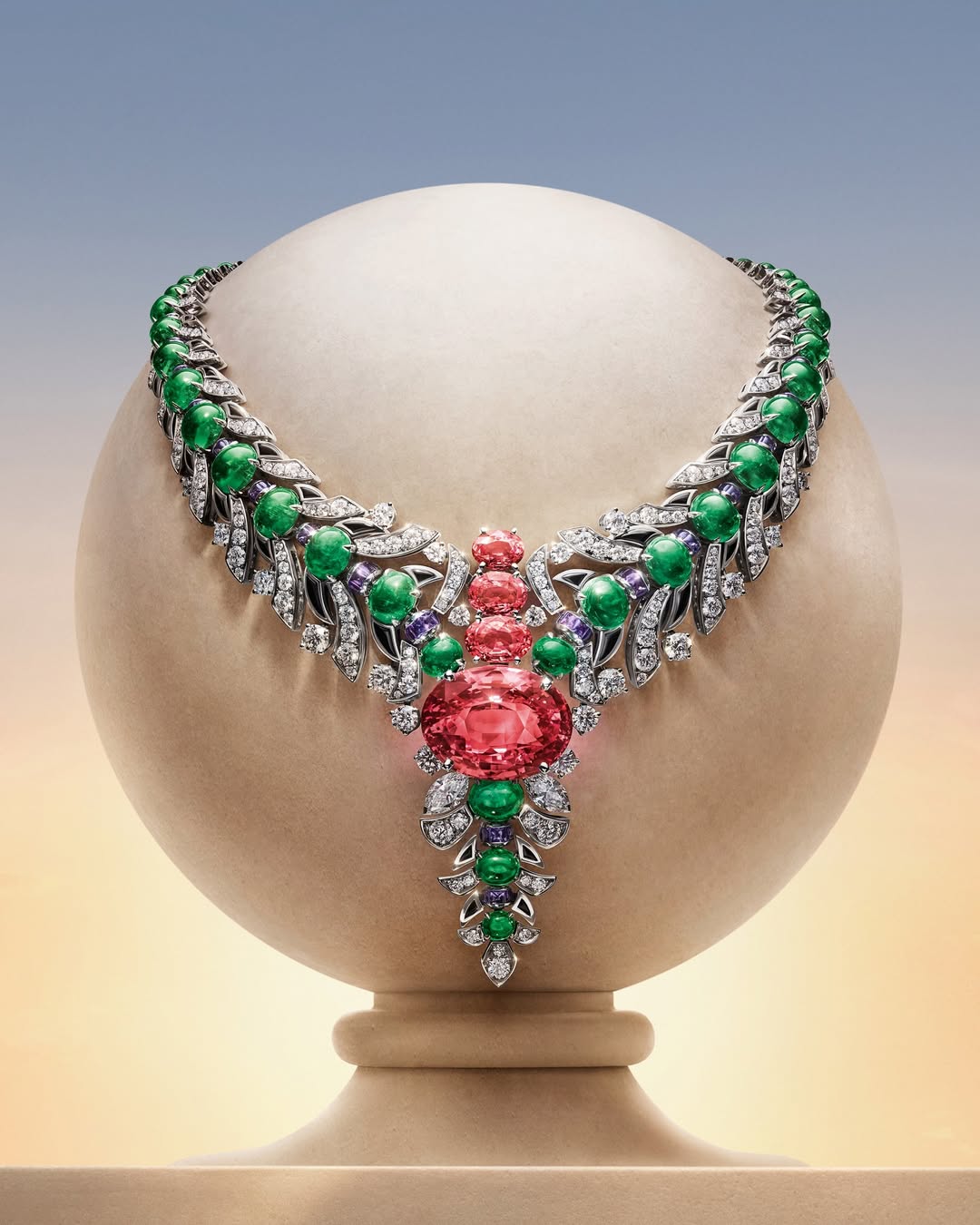
The Secret Garden necklace is a painterly masterclass in gemstone composition, built to evoke the dappled, golden light of Rome’s hidden courtyards at sunset. Rather than relying on standard, rigid structures, Jewelry Creative Director Lucia Silvestri orchestrated the piece to mirror the fluid, natural geometry of climbing plants.

The design language mimics the sprawling, organic growth of Mediterranean flora. Leaf-like clusters of pavé diamonds flow seamlessly into rich, green cabochon emeralds, creating a texture that feels remarkably alive. Nestled within this rhythmic layout are deep purple sapphires and sharp onyx inlays that anchor the vibrant green tones, offering a stark, structural contrast that feels distinctly Roman.
At the absolute heart of this organic network sits the crown jewel: an exceptionally rare 26.65-carat pink-orange Padparadscha sapphire from Sri Lanka. The stone glows with a warm, fiery interior radiance. When caught in the natural light, its peachy-pink hue acts as a visual sunset, warming the cool diamond and emerald leaves surrounding it.
From Cultivation to Couture: The Olive Branch Lens
By shifting the perspective away from standard floral motifs, the Secret Garden transforms into an architectural study of the olive grove. The intentional choice of smooth, domed cabochon emeralds mirrors the plump, oil-rich fruit of the harvest, while the interlocking white gold elements drape across the collarbone with the effortless slack of a natural branch.
This isn’t luxury that demands you bow down to an unattainable fantasy. This is unpretentious modern luxury taking a plant that grows wildly along dust-choked Italian roadsides, the source of the oil that feeds families and conditions skin, and translating its DNA into a three-million-dollar work of art.
Bulgari’s artisans spent over 1,200 hours hand-assembling the necklace’s 235 individual elements, ensuring that despite the staggering carat weight, the piece retains a soft, lightweight drape that moves in tandem with the human body. It is engineering that mimics motion, prioritizing curves and clean fluidity over static, bulky ostentation.
Ultimately, the Secret Garden proves that the most powerful design narratives don’t need to invent new worlds. They simply need to look at the existing one at the simple, ubiquitous olive branch that has defined a region’s survival and comfort for centuries and render it in diamonds. It’s a testament to the fact that true sophistication will always find its roots in the earth.
For a deeper dive into how these complex, organic forms are brought to life in the Roman ateliers, you can watch Lucia Silvestri’s Deep Dive on the Secret Garden Necklace. This footage offers an intimate look at the meticulous gemstone selection and 1,200-hour assembly process behind the masterpiece.